


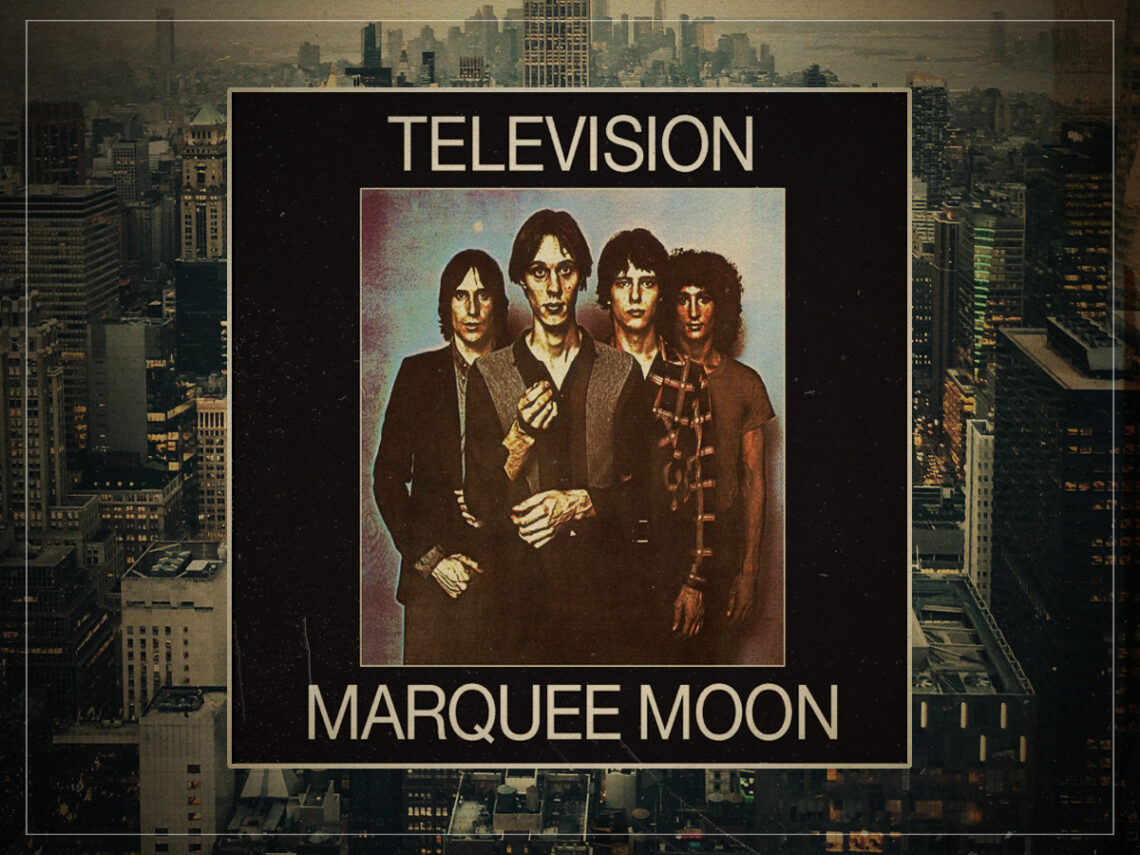
Breaking down the New York references in Television’s masterpiece ‘Marquee Moon’

When Tom Verlaine passed away at the age of 73 in late January 2023, a piece of New York City left with him.
As the frontman and consciousness behind Television, Verlaine wrote with an intensity that was unmatched in a sea of nascent punk writers. Often performing with a reserved demeanour, he let his words weigh in the balance. As his close friend Patti Smith memorialised him in a beautiful tribute in The New Yorker: ”As I watched Tom play, I thought, ‘Had I been a boy, I would’ve been him’,” adding, “There was no one like Tom. He possessed the child’s gift of transforming a drop of water into a poem that somehow begat music.”
Verlaine and fellow wayward poet Richard Hell met in Delaware before their paths crossed again in New York City, where they moved. They formed a band, the name Television devised by Hell, a play on the phrase ‘tell a vision’ and a reference to mass media. Recruiting second guitarist Richard Lloyd and drummer Billy Ficca, Television became the unofficial ‘resident band’ at CBGB, the infamous bar-turned-rock club on Manhattan’s Bowery district, in 1974. Buzz about the relatively new band rippled across the island, spurring strangers (like Smith) to wander through the club’s doors and catch a glimpse.
In a mutual struggle, where Hell was a brilliant songwriter, though purposefully unrefined as a musician, and Verlaine frowned upon any distractions from his songwriting, the former eventually left the band, taking his original songs with him. His absence left the latter to define the genesis of what would become Television’s debut, and so, despite rising to cult-like popularity as punk was beginning to take root in their downtown scene, Marquee Moon was intentionally subversive, playing with jazz and classic rock elements. As Verlaine had always intended, his lyrics would remain the primary subject, soundtracked by a refined rock sensibility.
The title track is a ten-minute opus centring Verlaine’s travels through fragmented pieces of New York’s image, carrying a loneliness evoked by the feeling of being engulfed by the city that seeps through the song, as he finds himself stuck between fantasy and reality. It immediately grips the listener with its two-chord riff, the jingle of the second guitar coming in with the quiet beat of cymbal-driven drums.
“I remember how the darkness doubled,” Verlaine sings in a drawn-out strain, “I recall, lightning struck itself”. Picturing 1970s New York, it is hard not to imagine it being dark and desolate, rain-soaked nights consuming his energy. As he was “listening, listening to the rain… hearing, hearing something else”, Verlaine attempts to reimagine the less favourable side of the city, as many of his peers who chose to move there did, believing that somewhere, hidden in New York’s grit and grime, there was hope.
In his vision, New York’s underground granted him a “life in the hive”, a second chance to reinvent himself. He grapples with the double-edged sword of the musician’s life, ”A kiss of death, the embrace of life” being a romanticised view, forming two sides of his fate’s coin. Being from the area, I can confirm that a true glimpse of the moon is rare; thus, Verlaine adopts for himself a “Marquee Moon”. Standing beneath its light, “waiting” and “hesitating”, he weighs a life of art and excess, his feet planted in opposite directions. In true New York fashion, he consults a stranger for advice on how not to go mad, and the man tells him to be neither happy nor sad, which implies that the only way to survive is to simply exist in a grey area.
This leads the musician to the entrance to a graveyard, where a Cadillac pulling out beckons him to get in, but after spinning around, it drives him back inside, leaving him stranded in the grey suspension between life and death. Here, alone and surrounded by decay, he considers whether or not to live, perhaps not literally, but rather, to live for his work and the air of possibility, emphasised by the tone of the song. While the lyrics are meditative, the instruments are rather upbeat and experimental, each musician spiralling into their own worlds. Over ‘Marquee Moon’s’ ten minutes, the guitars explore various realms, with Lloyd calling it “a mini-symphony”, explaining, “Towards the end of the song, Tom gets a long solo, and he would often meander through parts of it, but we had it structured”.
New York is possibly the most personified city in music history, but no one has quite defined it like Television. The musicianship in ‘Marquee Moon’ highlights the opportunity that lies in its cracked streets, and rather than overtly, Verlaine wrote of the city through an illusion, picturing it as it has grown to be intended: as a space for reinvention.
