


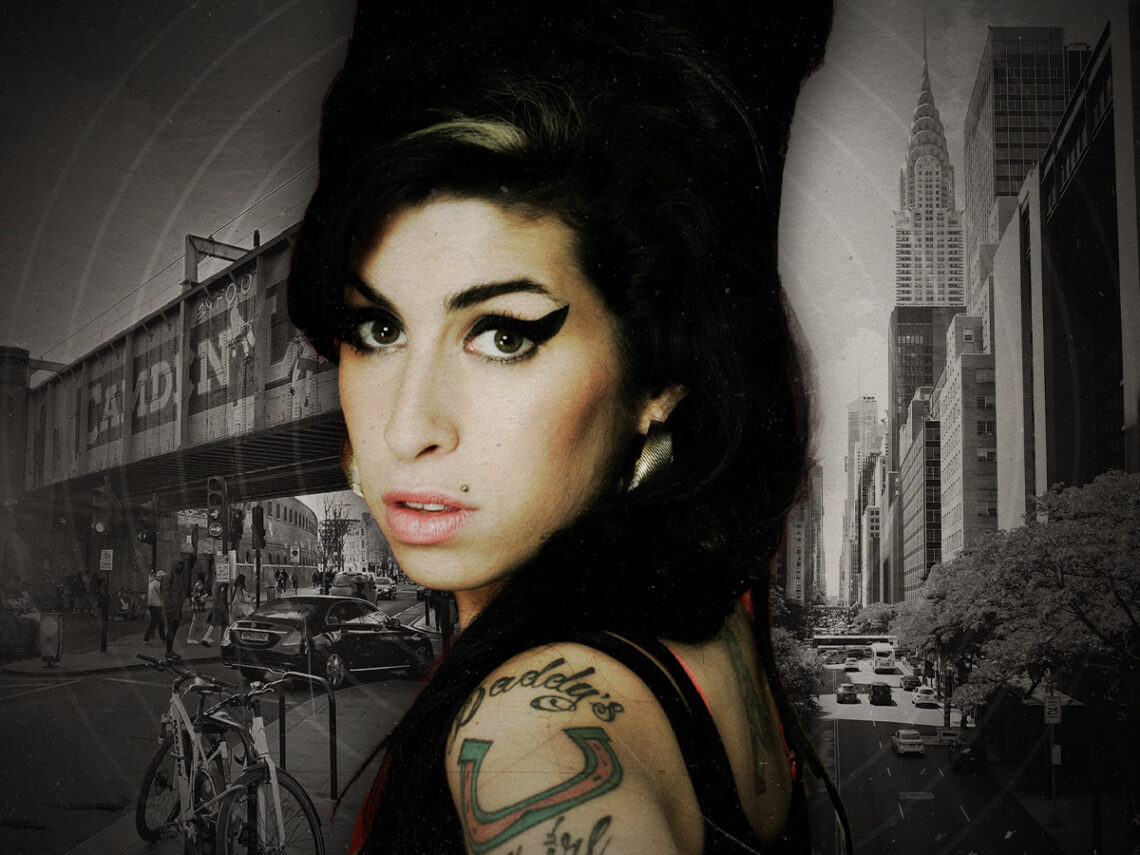
How New York birthed the song that defined Camden in one night

When Mark Ronson first met Amy Winehouse, he knew he had a star on his hands, and as he recalled at the recent Brit Awards, it was 20 years to the day that Winehouse first went to his studio in New York City, and it was a moment that changed his life forever.
As far as first meetings go, Ronson and Winehouse’s wasn’t just a clear match made in musical heaven – it was also an unexpected union that immediately told Ronson everything he needed to know. “She came up to the steps, and she said, ‘I’m here to meet Mark Ronson,’” the legendary producer recalled. “And I said, ‘That’s me’, and she goes, ‘I thought you were an old guy with a beard.’”
That night, the pair not only likely navigated several other amusingly awkward moments, as strangers often do, but they also captured lightning in a bottle, working their magic on what eventually became Winehouse’s career-defining hit, ‘Back To Black’.
“We talked for hours,” Ronson recalled. “That day changed my life forever.”
In one night, New York City effectively witnessed the making of Winehouse’s future legacy, with a song that captured the spirit not only of her unique artistry and image but also of another facet that became inextricably linked to her legacy: Camden. Anyone who has recently set foot in London’s edgiest hub will know just how much her associations endure, but this isn’t just the lingering impact of a lost hero; it’s also the perfect embodiment of the mythology surrounding that fateful night in Ronson’s studio – a room filled with that exciting feeling of witnessing the cusp of something great.
Anyone who has recently set foot in Camden Town – or ever – will also know just how much that energy persists, in everything from the hustle and bustle of catching it on one of its busiest days to the satisfaction of those first few sips of a cold, icy beverage in the evening at one of its lively bars. There’s a constant atmosphere of chasing that same excitement that comes with feeling like you’re a part of something bigger. Or perhaps that’s just the effect that comes with the buzz of nightlife in a place still irrevocably linked to one of the greatest partygoers the world has ever known.
Either way, that was the little slice of energy that Winehouse and Ronson sought to recreate during their partnership. Within their first meeting, Ronson urged the singer to open up about her hobbies and musical tastes, and her answers captured precisely the type of outgoing feel you’d expect of someone who wasn’t sure what musical direction she’d go in, but knew exactly how she wanted it to make people feel.
“I just thought, let’s talk about music, see what she likes,” Ronson recalled to Mojo. “She said she liked to go out to bars and clubs and play snooker with her boyfriend and listen to the Shangri-Las. So she played me some of those records, which turned into a crash course in girl group productions.”
The following day, they listened to a riff Ronson worked on overnight, which formed the basis of the iconic ‘Back To Black’ verse progression that immediately established that familiar Winehouse groove. He then added a kick drum, a tambourine, and “tons of reverb”, effectively transforming Winehouse into a singer with lots of potential to an iconic musician poised for changing the pop scene forever.
If you venture to Camden today, the words “Back To Black” are written in various places around the town. Although it was rightfully reclaimed, it also proves just how much Winehouse’s magic wasn’t actually tied to a specific location. Or rather, not in the physical sense, but a place that the pair managed to capture through sound alone, isolated from any community surrounding them. Perhaps this was its true magic, as Winehouse pinpoints in the song: being “so far removed from all that we went through”.
