


Where It All Began: the new co-operative hoping to reinvigorate the UK independent festival circuit

The grassroots festival circuit has faced many existential threats in recent years. First, it was the Covid-19 pandemic, with 192 events having disappeared in the UK since 2019. Then it was huge corporations taking over, such as Superstruct Entertainment and Live Nation.
Now, it appears to be dissipating before our very eyes. Thankfully, a new co-operative organisation is hoping to change that and put independent festivals back on the map.
Chai Wallahs is a staple of the grassroots movement on the existing live festival circuit, but now they are set to take that mission one step further by spearheading their own live event. It is backed by other small venues and industry heavyweights, including the Music Venue Trust. Their brainchild, Where It All Began, is scheduled to take place in spring 2026.
In order to pull off such a massive feat of live music, Chai Wallahs’ founder Si Chai has a crack team behind him, including Luke Potter – better known simply by the mononym Potter – who shares the co-operative’s singular vision. The premise is easy to understand, he explains to Far Out. “If there’s a festival or event that’s been happening, but is either struggling, taking a fallow year, or gone bust completely, what if we could help them? We’ll bring them into a co-operative to keep their audiences warm, give them something to market to their audiences, but share all the infrastructure costs to a point where their audience can come and experience the entire thing.”
The membership in the co-operative isn’t designed to be permanent, either. Potter adds: “Maybe in a year’s time, that festival thinks, ‘Right, we’re OK, we’ve recovered, we’ve survived, we can get back out again now and do it on our own’, but then maybe another person’s struggling and they can come into it.”
Within this, the team at Chai Wallahs isn’t blind to the plights of grassroots venues. More than anyone, Potter knows they have to rely on all the levers and skillsets that these institutions have in order to pull off an event of this scale. With the help of the Music Venue Trust, “nine independent venues from around the country [are] coming in as well, doing stage takeovers, marketing to their audiences.”
As such, with the backing of independent venues ranging across Manchester to Leeds, Cardiff to Bristol, and Birmingham to London, Where It All Began certainly seems to have a strong wind in its sails. But what exactly is in it for the audience? They have a different way of thinking when it comes to that, too.
Potter explains, “We also want to operate on a crowdfunder model, which means there’s no VAT, so there’s no ticket sales. As such, you make a donation to the crowdfunder of £175 and you get invited to the event, and you can be there all weekend. Alongside that, we have a minimum offering. We think we need to hit 5000 people. If we can get 5000 people to donate to it, then the event can go ahead.”
It sounds simple in theory, but as he is extremely keen to point out, the possibilities within this model are endless. It’s all about “transparency”, Potter claims, noting that as the crowdfunding pot rises, they can offer more festival perks to the audience. “In fact, if we get to a certain amount of money,” he explains, “You can start choosing what content you want to see at the festival. We’ll give you the list. You can pick it. So there’s this interactive element to it as well, where the invitees get to be a part – a direct part – of creating this thing. I think that’s really exciting.”
According to the Music Venue Trust, grassroots venues are still closing at a post-pandemic rate of roughly two per week, and smaller festivals without the anchor weight of a major corporate sponsor are hardly far behind – last year alone, 72 UK festivals announced they were postponed, cancelled, or had to close, which was double the number that faced this in 2023. Yet there are also audience targets too, particularly within the 18 to 24 age bracket. A Festival Insights market report, published in 2022, suggested that this demographic only represents ten to 12 per cent of overall festival audiences. Potter is hellbent on getting them back into the live music space.
“I worry that it just kind of dies, because if you lose a generation of people, what do you do? Where does it all shift to? Does it all end up on your mobile phone? I find that terrifying,” he admits.
It also plays into some much bigger societal issues at large, which the reinvigoration of independent festivals could help to rally against. “There’s a lot about the identity of our country in the news, and there’s not a massive amount to be proud of at the moment as a citizen of the United Kingdom,” he ponders.
“One thing that we’ve always done really well is live music – I’ll hang my hat on that.”
Potter
“We’ve produced some of the world’s greatest songwriters, some of the world’s greatest festivals, and we continue to do it.”
Another worry, at least at this specific point in time, is that the live music industry is in the hands of a select few corporations. Potter cites statistics from the Association of Independent Festivals (AIF) from July this year, which states Live Nation now owns 66 per cent of all live music venues and 25 per cent of festivals in the UK.
“That’s illegal to start with, and they should be dismantled,” he says. But Chai Wallahs’ idea for the Where It All Began festival, in whatever form it may take, is rooted in their ambition of fighting for a bright new future.
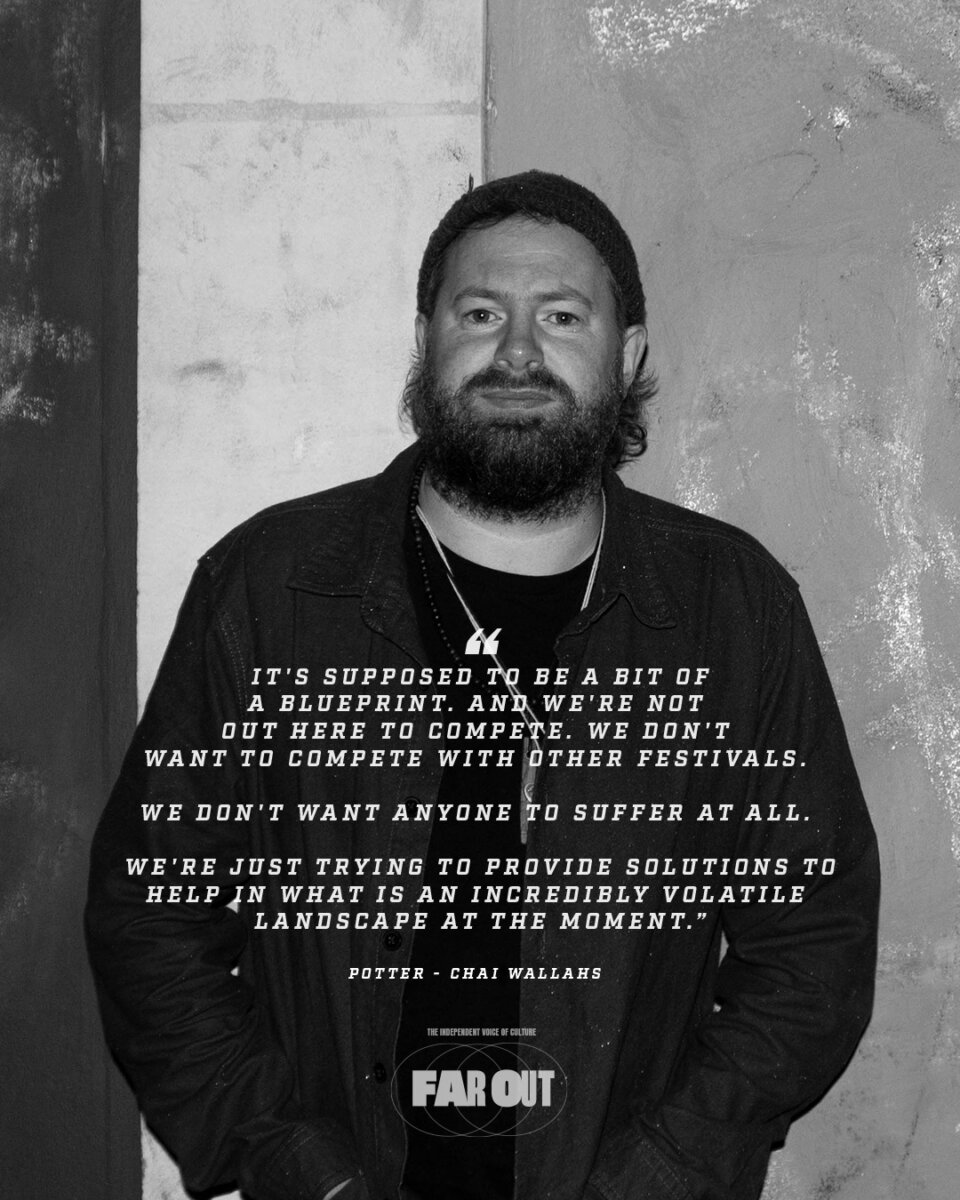
“It’s an incubator event,” Potter concedes, but with this is the hope that the collective will only continue to grow and grow further beyond its infancy. Their approach, however innovative, is not to be construed as combative. “It’s supposed to be a bit of a blueprint. And we’re not out here to compete. We don’t want to compete with other festivals. We don’t want anyone to suffer at all. We’re just trying to provide solutions to help in what is an incredibly volatile landscape at the moment.”
Next spring, when Where It All Began sets up camp for the first time, only then will they be able to tell if they can reap the rewards. Until that point, there’s a lot of work that has to be done first.

Never Miss A Beat
The Far Out Music Newsletter
All the latest music news from the independent voice of culture.
Straight to your inbox.