


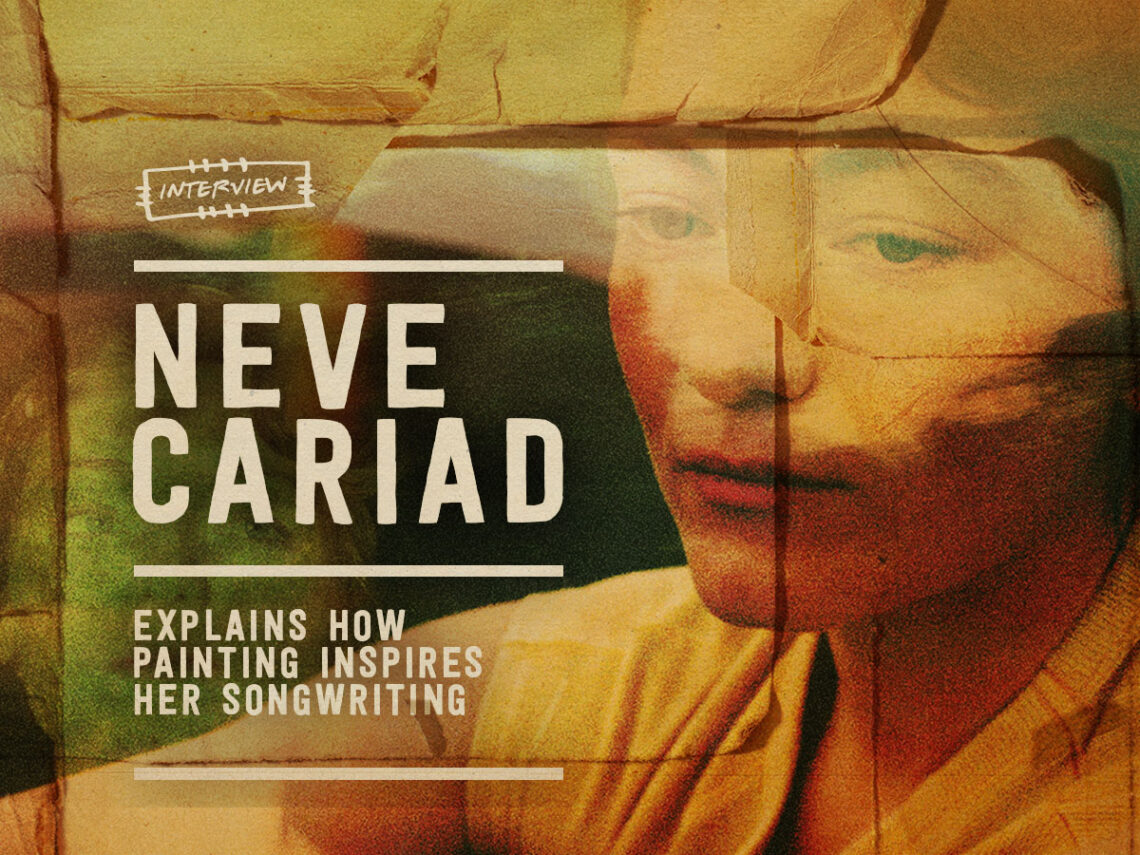
Artistic interference: Neve Cariad explains how painting inspires her songwriting

I’ve attended more gigs in Leeds than I can possibly remember. I’ve seen countless post-punk bands, softer indie outfits, pop acts, and everything in between. But I’ve never seen anyone quite like Neve Cariad. Wielding an acoustic guitar and a pen that seems to be filled with poetic prowess rather than ink, the Welsh-born, Leeds-based songwriter and visual artist draws from old-school Americana and 1960s folk to weave densely emotional sonic tapestries, leaving audiences in awe each and every time she takes to the stage.
When I meet Neve under the fairy lights and glitter balls that adorn Leeds’ newest venue, The Attic, she isn’t preparing to stand behind the microphone. Rather, she’s there for an exhibition held by fellow Leeds band and close friends Prima Star Power, and she’s displaying a couple of the fruits of her other artistic love, painting. “I’m exhibiting two really small oil paintings on this really rough wood,” she tells me, “I did them very last minute, so I don’t feel like they’re finished, but I thought it was a good opportunity to show work that I’m not 100% sure of.”
One of the tiny wooden slabs displays a youthful face in a bluish-grey colour, the other pairing yellows, blues and greens in a sort of landscape. They’re suspended directly above the stage, forcing attendees to tiptoe around Prima Star Power’s miscellaneous instruments if they want to take a closer look. Neve has been penning poems and songs since she was around five years old and performing them since she was a teen, but it wasn’t until she started studying art that she noticed the connection between her visual artwork and her songwriting.
“I think when I was a teenager, I got quite creatively stuck,” she remembers, “Then, finding a visual language through the fine art course helped me find the words again. The visual language helped me access the words to use through images first.” The connection between the two isn’t always necessarily obvious at first, but Neve has noticed how her visual art and music intertwine retroactively, bringing unconscious symbols and images to the surface and creating parallels she finds “satisfying and affirming.”
“They’re not often directly linked,” she explains, “It’s not like I’ll make a painting, and then I’ll write about what’s happening in the painting. But it just allows certain things to come to the surface a bit more, for me to make certain connections that I wouldn’t have been able to do through writing. I’m not always that aware of it happening. But then, when I look back at the songs, I’m like, ‘Oh, that period of painting definitely helped me to be able to find the ways of expressing that song.’ Unlocked it in a way.”

However, the connection between Neve’s love for painting and songwriting has manifested in more obvious ways, such as in her album artwork. The cover for her most recent EP, 2023’s Neve, features a painting made up of oil, acrylic, sticks, stones, bottle tops, netting and other miscellaneous materials. The background is filled with muddied colours and shapes, green ovals and brown triangles with branches curling around them, while a pink outline of a butterfly sits just atop.
It’s the perfect visual accompaniment for Neve, but the songwriter never really intended for the artwork to accompany the collection of tracks. “I didn’t set out to use my artwork, necessarily,” she acknowledges, “But I didn’t really want to have my face as the album cover. And then I was doing my art course at the same time, and this image of the butterfly just seemed to work with the EP.”
Now, the EP seems to have set a precedent for the rest of her catalogue, and she plans to carry on creating her own artwork for future releases. “I don’t actually know what’s going to be the cover of the new album yet,” she admits, “But I know what the themes are and certain images and symbolism. So I’m planning to paint something for it, but I probably won’t have it in mind that I’m painting it for the album cover because I feel like it won’t happen as organically.”
“I’m just trying to paint more in general at the moment,” she continues, “And hopefully something will slot into the theme of the songs.” It’s taken some time for Neve to get comfortable with pairing her songwriting up with her artwork, all due to an article she once read about one of her earliest influences, fellow folk songwriter, poet and painter Joni Mitchell.
Like Neve, Mitchell often painted her own album artwork, though she was less averse to featuring her own likeness on the cover. She created the jubilant cover for Song to a Seagull, the gorgeous self-portrait that accompanied Clouds, and the Van Gogh-indebted artwork for Turbulent Indigo. “It was an idea I had when I was younger,” Neve explains of her own decision to paint album covers, “And I didn’t really click that Joni Mitchell had done the same.”
When it did click, Neve stumbled across an article about Mitchell that almost changed her mind. “It was this man saying that he thought that she was really self-indulgent for using her artwork as album covers and releasing this music,” Neve remembers, acknowledging that she absorbed this opinion and decided it would be self-indulgent for her to take the same route. Fortunately, her mother soon shook some sense into her.
“I told my mum about it,” she remembers, “And she was just like, ‘That’s complete bullshit.’ And now I don’t think that at all. I’d quite like to direct some music videos for myself as well. That feels like quite an exciting prospect now, instead of one that has shame around it.” Visual art isn’t the only influence that has found its way into Neve’s songwriting process; she also acknowledges books, films, and other artists as muses.
Growing up, Neve listened to Mitchell, Van Morrison and David Grey courtesy of her mum, through whom she discovered her interest in poetic, transcendental music. Her dad was a fan of the twee pop outfit Camera Obscura, and Rufus and Martha Wainwright also had an influence on Neve’s sound. “I find the Wainwrights have a real strength to their songs,” she comments. “And Camera Obscura have quite a fun sound, but there’s also such a melancholy to their songs, but also quite sweet sounding.”
“I think I’m inspired by most things that I come into contact with,” she acknowledges, “All types of media. Even social media. I soak things in quite easily, which can make my creative process feel a little bit chaotic or overwhelming at times because there’s so much information all the time.” When she was younger, Neve found that she was particularly drawn to fictional characters, absorbing elements of characters in books or on television.
She’s shaken off that habit now, but she still finds that those mediums can influence her writing and even encourage her to explore other art forms. “I love films,” she specifies, “And I find that these days, my ideas manifest in the cinematic more than the painterly. I’d quite like to make films, and I’ve started writing one. I find that that’s where my ideas tend to go now, thinking about storylines and characters and dialogue, as opposed to a painting, which I still love doing, but it’s kind of the next step up from that. Fusing lots of different elements together.”

Given the informational overload of her influences, it makes sense that Neve’s songwriting process is never quite the same. Sometimes, she simply picks up a guitar and sings, hoping that she remembered to hit record. Other songs take a little more fine-tuning, with Neve consciously editing and perfecting her writing as she does it. “That results in something quite neat and chiselled,” she observes, “which I think is reflected in the writing.”
“I guess the process itself reflects the tone that I’m wanting to imbue,” she explains, “Whether that’s hesitant or rushed and messy or direct. Quite often, the process seems to help the tone of the writing itself.” ‘Balloon and Kite’, one of the songs Neve plans to include on her new album, serves as an example of that perfectionistic approach, an example of a song that she closely edited while writing it, and you can tell.
“The lyrics seem very tight, unique and direct rather than a stream of consciousness,” she notes, “And that definitely reflects the attitude that I wanted to have in the song. In contrast, there’s definitely other songs on the album which are more raw, and I probably wrote those in a few minutes and felt that they should be left like that because that’s what I wanted to express.”
There are other songs that Neve has worked out more closely in a band setting, including her current set closer, ‘Jigsaw’. A stirring track about a parental relationship, ‘Jigsaw’ builds to an emotional climax as Neve’s entire band play with urgency and intensity, before stripping right back to her acoustic guitar for the final moments. It’s the perfect end to her set, and it’s a song that they worked out together in the studio in just under an hour.
“I’d written that quite a while ago,” Neve elaborates, “We’d never played it together before, and we were in the recording studio trying to record some of the songs, and we needed to try and work out how we were going to do it as a band, and they’d never heard it before. I played it to them, and then we just started recording to see what would happen. And I think by the seventh or eighth take, that was what we were using on the album.”
“They all just seem to know what to do on the spot,” she continues, “And now I feel like that’s probably one of the strongest songs on the album. It just came together really naturally, and I think that uncertainty that we had while trying to record it was where that magic happened, and that’s why it worked so well. Everyone was acting on excitement and really feeling the song.”
The song is certainly one of the strongest in her set, a feat in and of itself, and an example of how Neve’s band have helped her grow as a musician. As a collective, their influences are all over the place, pulling from jazz backgrounds, 1960s rock, baroque, and more, while Neve has been delving more into 1990s art rock and art pop. “I feel like the new album is a really nice fusion of all of these unique, different backgrounds that we’ve got,” she adds.
While her songwriting process increasingly pulls from different sonic influences, Neve’s approach to painting follows a similar pattern, often depending on visual prompts. She tends to collect images that she’s particularly drawn to, often based around childhood nostalgia, printing them out and making physical mood boards. “I’ve made a little studio in my basement,” she shares.
“I’ll just put the pictures up on the walls and try to paint something, just whatever image I’m most drawn to,” she explains, “Or sometimes I’ll group them in a mood board together and make a connection between images for some reason. I won’t necessarily know why, but I’ll put them into categories, and maybe the painting will be two or three images.”
In the same way that she sometimes has to sit with songs, Neve sometimes finds herself returning to visual pieces, too. “Sometimes, I’ll leave a painting and not really like it,” she shares, “and then I’ll come back to it and paint over it, but the initial image will somehow interfere with the second image, and I find that interesting as well.”
As Neve’s painting continues to intertwine with her songwriting and vice versa, it’s easy to imagine her capturing hearts far beyond the boundaries of West Yorkshire. The county’s answer to Julia Jacklin or Karen Carpenter, her lyrics are just as visual as her work on canvas, and her live presence is just as stunning.
