


The Cover Uncovered: Neutral Milk Hotel’s missing face ‘In the Aeroplane over the Sea’

Alternative rock group Neutral Milk Hotel seem destined to be remembered for their one defining album – 1998’s In the Aeroplane over the Sea. The band, effectively the brainchild of vocalist and multi-instrumentalist Jeff Mangum, has barely been active since its release. And it’s still their most recent record.
It’s an absolute triumph, though. A musical collage accompanied by lyrics that are at once dark and innocent, much like the book which apparently inspired them, The Diary of Anne Frank. In part thanks to the band’s chaotic kaleidoscope of sound, which draws on Eastern Europe folk music, Mangum somehow imbues his often disturbing imagery with a sense of childlike wonder.
With so much happening sonically, it’s easy for the casual listener to gloss over obscurities within the lyrics. You can simply enjoy Aeroplane‘s songs at face value, losing yourself in their bittersweet juxtaposition of joyful abandon and nostalgic melancholy while occasionally accepting bizarre and opaque wordplay as just that.
But it’s not only the meaning behind many of the album’s lyrics over which question marks remain. There is another aspect of the record which seems particularly peculiar.
A penny for Mangum’s thoughts?
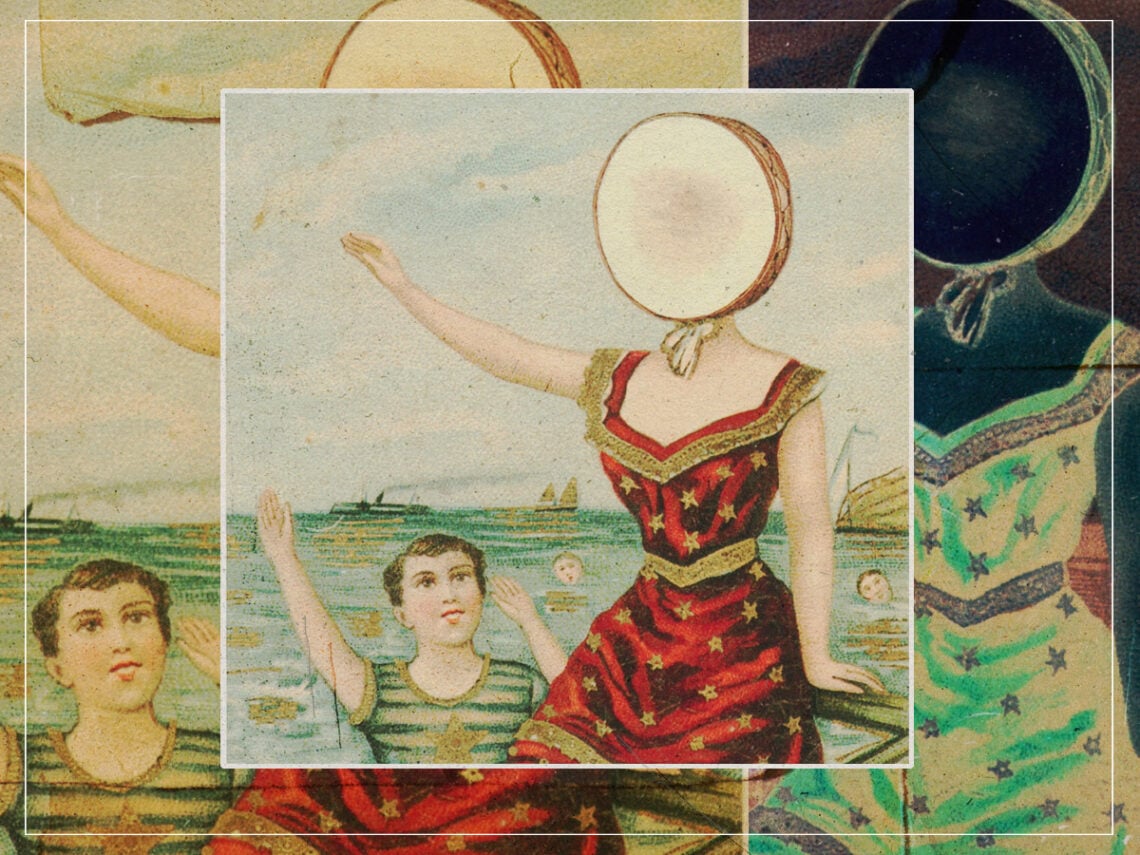
The album’s front cover features an image from a vintage postcard edited by former R.E.M. artwork designer Chris Bilheimer. Mangum chose the image from among the postcards he collected from thrift shops, reflecting the aesthetic of seaside penny arcades from the early 20th century—coincidentally, around the time Anne Frank was alive.
Bilheimer cropped and edited the image, most notably replacing the face of the woman at the centre with what appears to be a drum skin. Both the woman and the boy by her side have their right arms raised against a backdrop of sea. In the background, two more children appear to be swimming. Boats pass by behind them.
Like so much about Mangum’s art, it’s very difficult to discern precisely what’s going on here and what his intentions are. Are the woman and the boy waving or pointing? Either way, what are they waving or pointing at? They are facing away from the other children and the boats. And why has Bilheim superimposed the drum skin in place of the face?

Well, Anne Frank could certainly give us a clue or two. Although it wouldn’t have been the intention of the original postcard designer, it appears that, rather than pointing or waving, the woman and the boy are performing a Nazi salute. That certainly seems to be what Mangum saw in the picture, given what we know about the context of the album.
He once explained in an interview that he “completely flipped out” upon reading The Diary of Anne Frank and then “spent about three days crying.”
“It stuck with me for a long, long time,” he admitted. Magnum seems to have projected that preoccupation with Anne Frank onto the image used for this album cover and its content.
Is there another way to interpret the cover?
If we ignore the smile on the boy’s face in the foreground, we suddenly get a different perspective on the children in the water behind him, too. Neither of them is smiling, and they both seem to be struggling to keep their heads above water. Are they drowning? Does Mangum see in their predicament the same premature fate that met Anne Frank?
Still, we don’t have a hypothesis for the most confusing part of all: the drumhead. It’s worth remembering that this was the cover designer Bilheimer’s work, and not necessarily suggested by Mangum himself.
For this conundrum, it’s time to turn to the lyrics of one of the album’s best-known songs, ‘Holland 1945’. While referencing the story of Anne Frank extensively, this track also contains several references that could direct us towards the meaning of the missing face.
There are multiple references to “white” covering a face or eyes, whether it’s “white roses” or being “wrapped in white”. We also hear mention of a “circus wheel” (the circular shape of the drumhead?), and the suggestion that the others would rather see those in the song have “their faces filled with flies”.
And so, the song gives us a sense of facelessness, variously representing death, blindness and hiding away from the world. It reflects the death of Holocaust victims, on the one hand, and those turning away from those victims or refusing to see them, on the other. At one point ‘Holland 1945’ directly calls out those passively complicit in the Holocaust: “It’s so sad to see the world agree.”
The missing face, then, appears to symbolise the two opposite sides of Anne Frank’s tragedy at the same time. Both the horrific tragedy of what happened to her and the wilful ignorance of others to it.
