


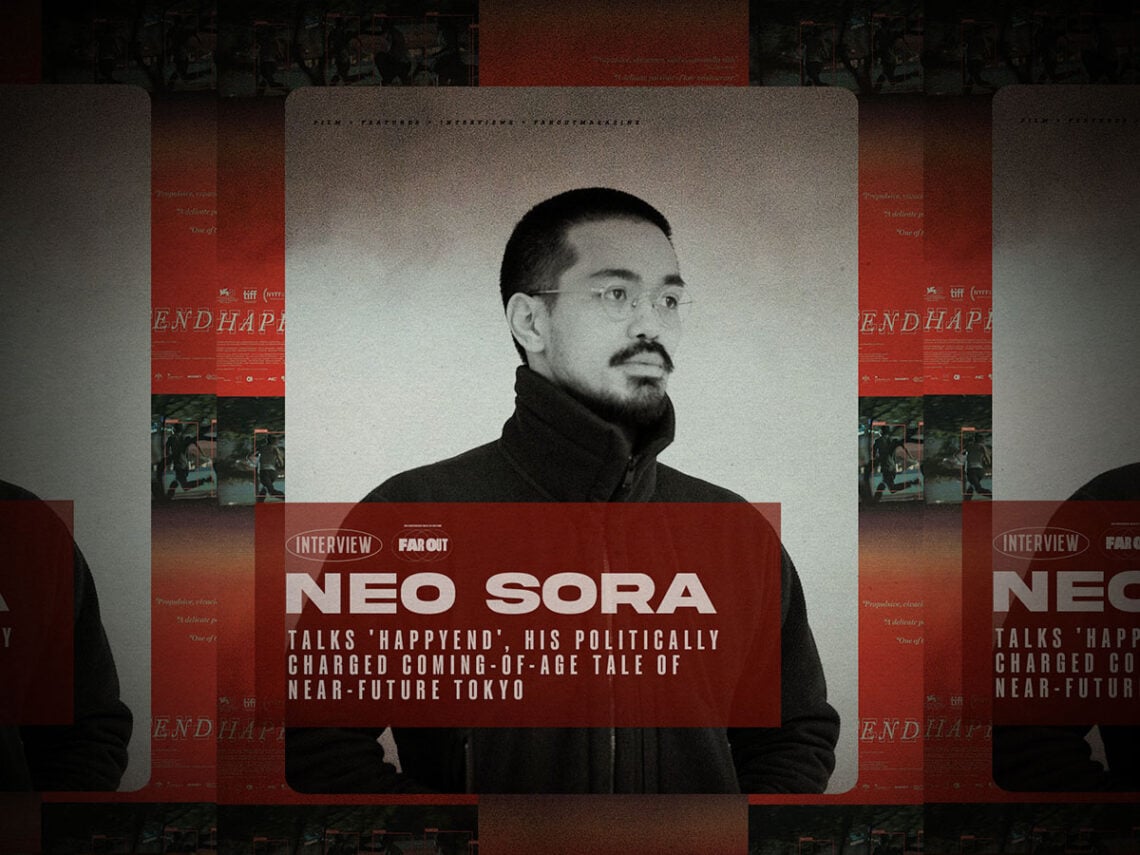
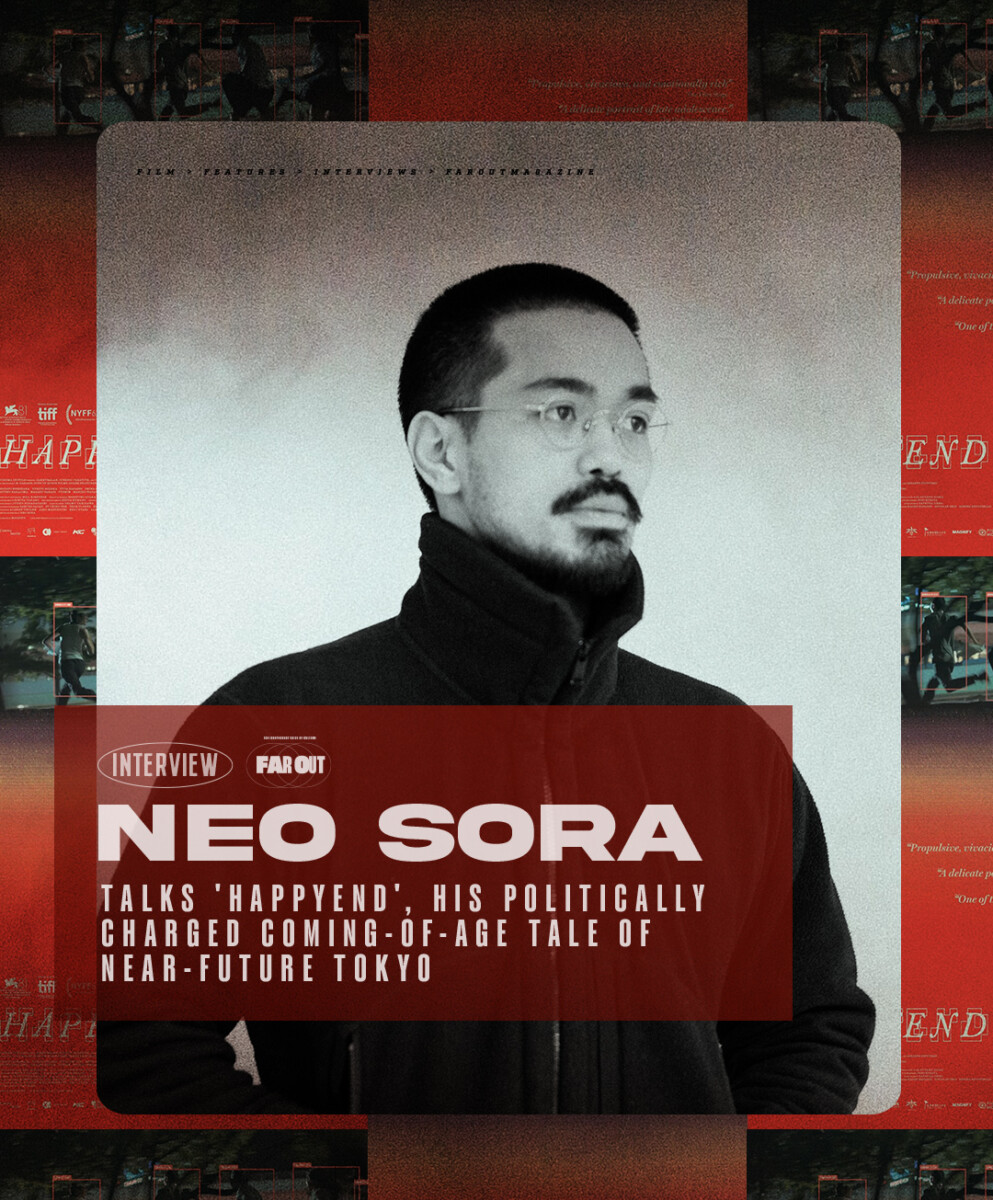
Neo Sora talks ‘Happyend’, his politically charged coming-of-age tale of near-future Tokyo

It’s tempting to try to list the various themes underpinning the narrative of Neo Sora’s Happyend, the feature film debut from a writer/director with a hell of a lot to say about our world.
The film tackles the thorny topics of AI technology, privacy and our modern surveillance society, all while also engaging with Japanese identity, xenophobia, and the disillusionment of modern youth, making for a heady brew, and one which will leave viewers with much to ponder.
Interestingly, though, if you ask Sora himself about the many themes in his movie, he’ll tell you that they’re actually all part of one big umbrella. “These aren’t really separate issues necessarily,” Sora, an intense, thoughtful, and hugely likeable personality, told Far Out amid a wide-ranging conversation about his work, “In my mind, it’s quite the same issue, I would say, of Japanese colonialism”.
Before Sora’s peeling back of the curtain on Japan’s colonial past via a story he began writing in 2014, it’s worth providing some context to what we are discussing here. On its surface, Happyend is no cold, academic polemic; instead, it’s a funny, highly watchable, and ultimately heartbreaking coming-of-age tale of two friends who react in opposing ways to a political awakening, typical of teenagers all over the world.
If you simply become invested in Hayato Kurihara’s Yuta and Yukito Hidaka’s Kou’s disintegrating friendship, set against the backdrop of a high school cracking down on its students as a surveillance machinary, you’ll not be watching the movie incorrectly. After all, thinking about the nature of friendship, in all its strange, wonderful glory, was what first prompted Sora to begin writing.
“The biggest motivator was the thoughts and feelings I was having towards the very specific relationship that a friendship is,” Sora explained, “Friendship, as a form of a relationship, is quite ambiguous. It’s different from romances, marriages, or family in that there’s no prescribed form of what that relationship should look like. There’s no paperwork that goes into forming a friendship.”
Thinking about how people approach friendships in wildly different ways began to consume Sora. Some friendships are as simple and low-maintenance as seeing someone every month at the pub or a club, sharing the same space, but not talking about anything particularly deep or meaningful. Other friendships, though, could have a deeper emotional resonance than with actual family members or with a romantic partner. “In a place like America, for example,” Sora noted, “the divorce rate is extremely high, whereas I feel like if you have a best friend from childhood, you never divorce them.”
For him, friendship has tended to fall into the ‘for life’ bracket: “I had a group of friends from elementary school all the way through high school, and today, I still hang out with them all the time, so that’s the kind of value system that I would put into my friendships.” When he attended Wesleyan University in Connecticut, he made “other friends of the same depth and calibre” and these were the ones who “politically inspired” him to “see the world more critically”. Political movements in the US and Japan such as the anti-nuclear campaigns of 2011, Occupy Wall Street, and later Black Lives Matter, formed the basis of Sora’s “political consciousness”, and led to countless impassioned conversations with his pals about the rights and wrongs of the world.
In this respect, Happyend began as Sora’s “ode to those feelings and memories”. He began writing about a pair of school friends in Japan, almost joined at the hip since they were children, whose friendship becomes rocky when one is politically awakened to the wrongs of a system that vilifies foreigners and invades its own citizens’ privacy, while the other wants to keep things fun and light, the way they’d always been, turning a blind eye.
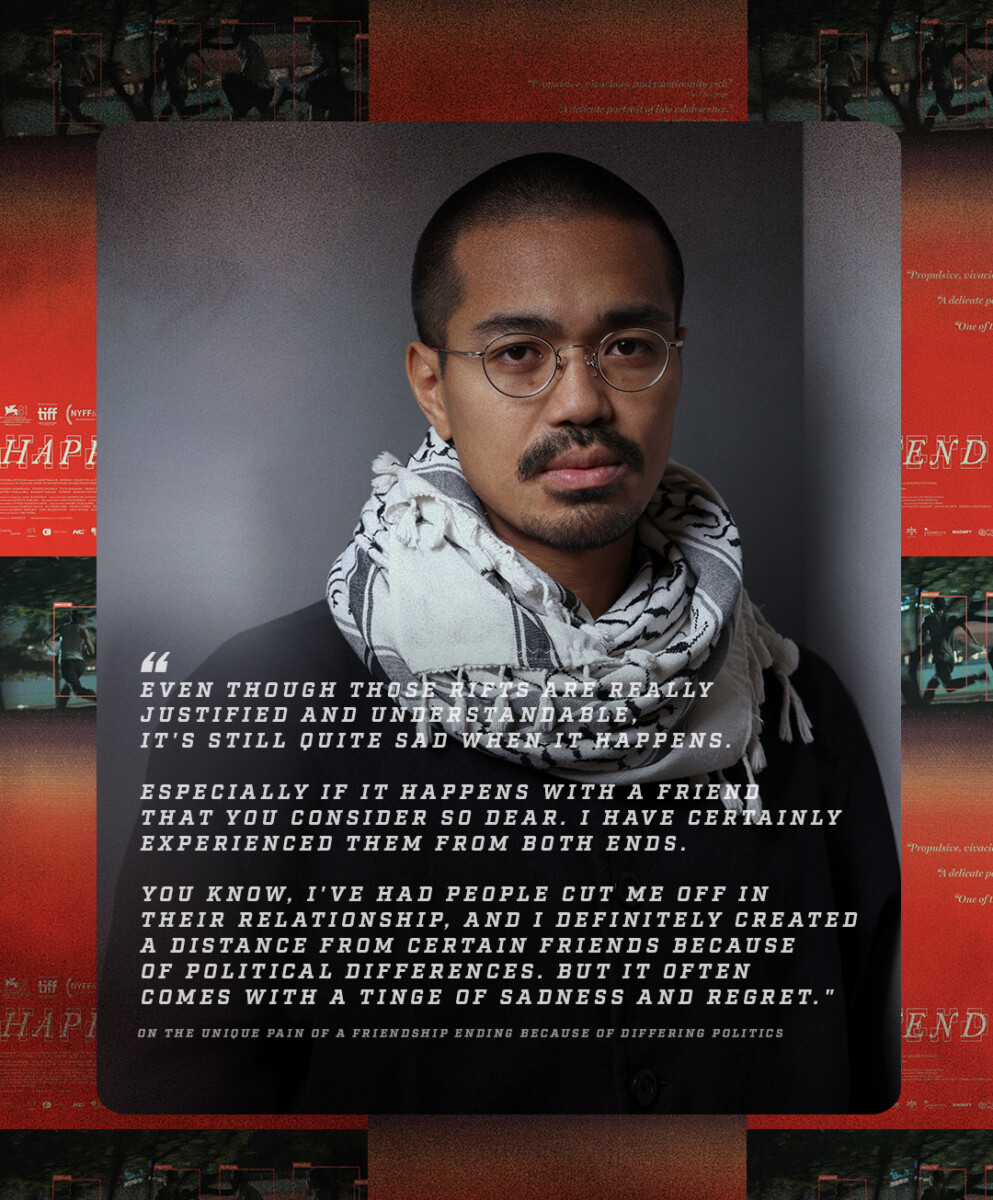
“Even though those rifts are really justified and understandable, it’s still quite sad when it happens,” Sora explained with a resigned nod, “Especially if it happens with a friend that you consider so dear. I have certainly experienced them from both ends. You know, I’ve had people cut me off in their relationship, and I definitely created a distance from certain friends because of political differences. But it often comes with a tinge of sadness and regret.”
For teenagers, whose minds and bodies are already changing and evolving so much as they grow up, a falling out can literally seem like the end of the world, and Sora wanted to capture this sense of magnitude in Happyend, which has the threat of an earthquake looming over Tokyo for its entire runtime. In a way, it works as a metaphor, showing that, when Yuta and Kou’s friendship “fractures and cracks”, it feels “as consequential as the ground collapsing underneath your feet”.
When it came time to cast the film, the maker knew he needed a group of teens who already felt like the characters he had written and exhibited some of their characteristics. Miraculously, he found five kids who fit that bill perfectly, with Yuta Hayashi, Shina Peng, and Arazi rounding out the core group. Despite only Hayashi having any prior acting experience, the group had incredible chemistry on-screen, no doubt helped by the fact that life imitated art. They all became close behind the scenes and, to Sora’s delight, Kurihara and Hidaka emulated Yuta and Kou by becoming best friends. Hell, they even wound up living together as roommates after the film.
To foster the extremely naturalistic, fun energy of a group of teenage friends, Sora held extensive rehearsals and workshops for his cast. He knew the movie “hinged on you feeling the palpable love and camaraderie that they had in the beginning, and how tragic it is that it ends”. This fondness between the stars helped a playful vein of humour develop throughout shooting, which hugely gratified the director. He didn’t want the movie to be po-faced, despite its high aspirations, and felt humour was vital to striking the correct tone.
For Sora, another vital element of Happyend is its depiction of the nightlife of a near-future Tokyo, all pulsing techno music played in cavernous warehouses, and schoolkids skating around the nearly-deserted streets at twilight. In an early scene, the main characters attend one of these raves, and the DJ playing in the abandoned building is Yousuke Yukimatsu, one of Sora’s favourite real-life DJs. “It’s the experience of being in the club and just feeling the rhythm and the bass and the low frequencies in those spaces,” he gushed, “I really love that feeling. I wanted to bring a little bit of that into the film.” Indeed, music has always been an important part of Sora’s life, not least because he grew up the son of famed composer Ryuichi Sakamoto, who scored The Revenant, and was the subject of his 2023 concert documentary, Opus.
To return to that overarching theme of Japanese colonialism mentioned at the beginning of the article, though, Sora believes Happyend can foster discussion and illuminate some uncomfortable truths, should an audience member want to inspect them. For example, even though it’s not specifically mentioned in the film, the Great Kantō Earthquake of 1923, which killed between 105,000 and 142,000 people and left 2.5million homeless, is key to understanding his vision, as it had reverberations throughout history that are still being felt in modern-day Japan.
“Something that is often neglected is the massacre that the earthquake triggered,” Sora noted, adding introspectively, “A lot of Japanese people at the time harboured imperial resentment toward Korean people, their colonial subjects, and feared this rising sense of Koreans wanting to become independent from Japan. So, after this earthquake, due to lies and conspiracies spread through word-of-mouth, newspapers, and the police that foreigners and Koreans were poisoning the wells, there was a huge massacre of Koreans. Bands of Japanese vigilantes slaughtered 6,000 or more Korean people, and they’re still trying to find bones to this day.”
To his dismay, in 2014, nearly 90 years after the devastating earthquake and its horrifying aftermath, he started to see history repeating itself. “There was a wave of anti-Korean and xenophobic protests happening within Japan,” he explained grimly, “These hate speech marches were quite shocking to me as a young Japanese person.” Even more shocking, though, was the push for “historical revisionism” to deny or hide that the Korean massacre ever occurred, which Sora believes has snowballed into a drive to “rewrite Japanese colonialism”.
Still, you may ask how this history relates to a story of a near-future teenager being politically activated for the first time. Well, Kou has no right to vote in Japanese elections, because he is a ‘Zainichi Korean’ (an ethnically Korean person who has permanent residence in Japan), and this injustice radicalises him when he sees how his school is invading its students’ privacy, but he can seemingly do little about it.
“In 1945, the final law that the Japanese Emperor put in place was called the Foreigner Registration Act, which stipulated that every former colonial subject of Japan had to register as a foreigner,” Sora explained. A governmental body was subsequently put in place to surveil and deport these foreigners, which included Koreans (like Kou’s family), as well as Taiwanese, Manchurian, and Chinese residents.
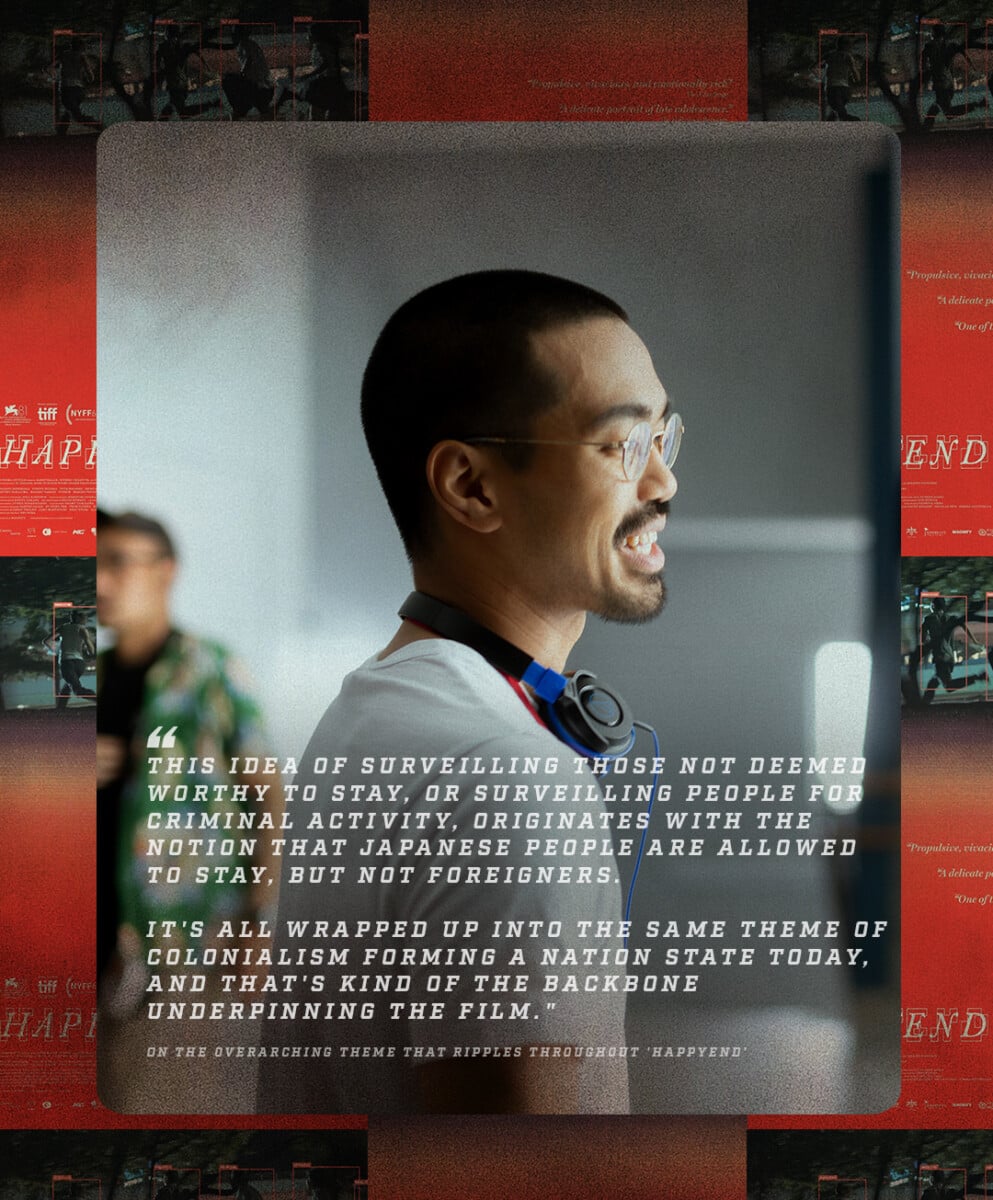
“That body is still the foundation of the immigration detention system today in Japan,” Sora added, bringing everything full circle, adding, “This idea of surveilling those not deemed worthy to stay, or surveilling people for criminal activity, originates with the notion that Japanese people are allowed to stay, but not foreigners. It’s all wrapped up into the same theme of colonialism forming a nation state today, and that’s kind of the backbone underpinning the film.”
