


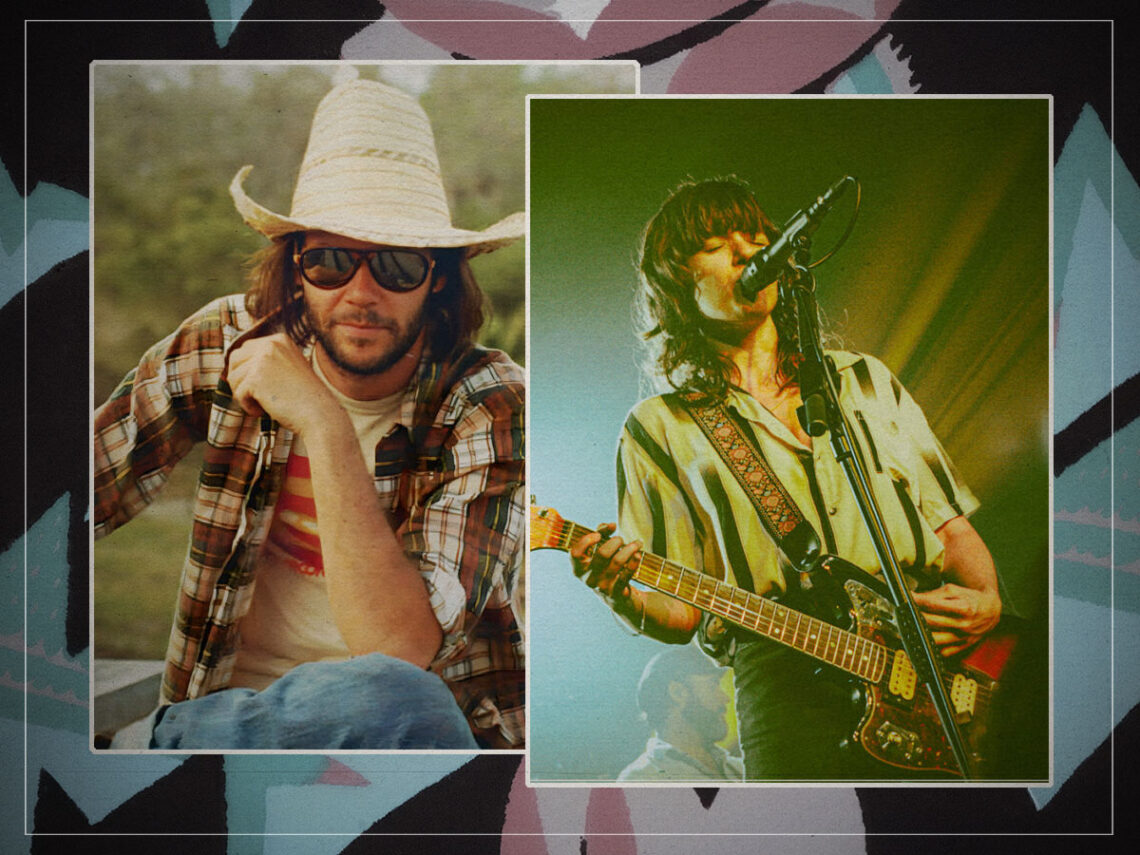
The Neil Young recording method Courtney Barnett used on her own album

During her quiet rise to becoming one of modern life’s most astute storytellers, Courtney Barnett proved that she has a knack for articulating the nuanced feelings that make up the human condition. Blending sincerity, wit, and rapturous humour, she has perfected the art of the socially aware slacker with her effortless style of alt-rock.
Compositionally, her music taps into something innately human; however, the star player has always been her lyricism. Whether it’s the first-person narrative of the experience of owning real estate as a millennial in ‘Depreston’ or tackling subjects with a wider scope, like climate change in ‘Kim’s Caravan’, she toes the fine line between scathing and empathetic with articulate ease.
So when director Danny Cohen asked her to compose a film score, the question of how empathetic her music could be without the power of words was posed. A daunting enough task quadrupled by the fact that the film in question would be a documentary of her own life. Anonymous Club chronicles the ups and downs of Barnett’s world tour for her album Tell Me How You Really Feel, providing an unfiltered view into her shy and relatively insecure disposition.
Being somewhat of an introvert, watching that documentary must have undoubtedly felt confrontational. However, soundtracking the feelings your own self is experiencing on screen is an entirely different matter.
Nevertheless, Barnett gave it a go, and it had a stunning effect. The score can be found on her album End of the Day, and it captures Barnett’s signature tenderness through sparse guitar melodies and airy synths to truly evoke the feeling of being lost in a world of self-exploration. Barnett pulled on influences from Brian Eno and Floating Points to Alice Coltrane to achieve this sound, but one long-time inspiration snuck into her rotation again when preparing for End of the Day.
Barnett has made no bones about her affinity for Neil Young, whose careful songwriting style can be traced in all her works. And despite his more conventional role as both a melodic and lyrical inspiration to her early work, she took solace in knowing that Young, too, wrote a soundtrack for Jim Jarmusch’s western-themed film Dead Man. So naturally, Barnett turned to the record when searching for methodology tips:
“I love how improvised this record sounds, but also how sure of itself it sounds at the same time,” she told Line Of Best Fit when discussing Young’s work. “There’s such a confident, open energy. The music feels so open to the world around it like it’s soaking everything in and turning that into sound.”
This feeling is the essence that underpins the work Barnett aimed to emulate, and ultimately, she did so by practising the same writing method Young had adopted for the 1995 film. Explaining, “I remember reading about the way he recorded it: he was in the cinema with the movie on and played along and recorded right there. And this is actually how we recorded our soundtrack.”
She concluded, “We played the film on the wall in the recording studio and responded in real-time to the images we were seeing. It just feels like it gives us extra depth, especially for something without lyrics. You can almost hear what’s being felt in the moment.” No wonder the final product sounds as evocative and soulful as it does.
