


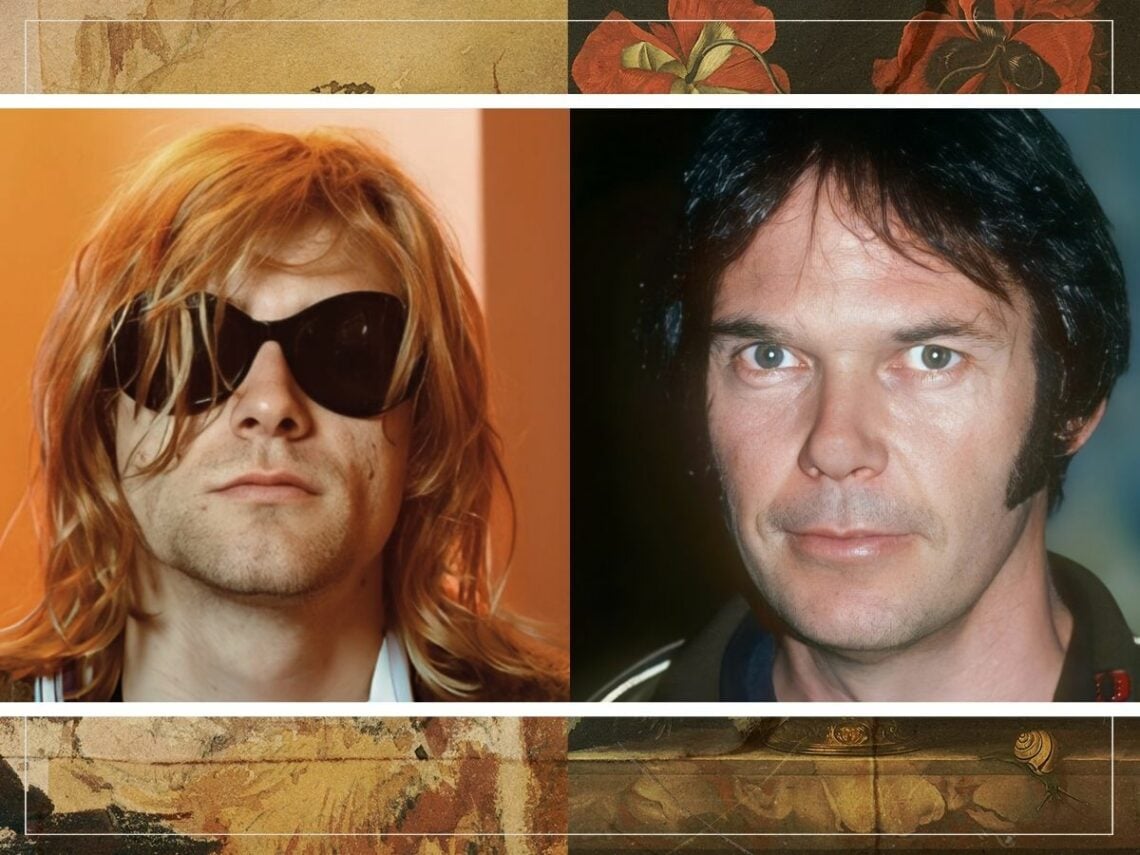
The album Neil Young wrote about Kurt Cobain’s suicide: “It fucked with me”

Neil Young is rightfully celebrated as the ‘Godfather of Grunge’ for his profound yet subconscious influence on the genre’s emergence. Both Kurt Cobain and Eddie Vedder idolised him, drawing inspiration from Young’s relentless spirit to infuse their own work with a similar intensity. After Cobain’s tragic death, Young was deeply anguished by the loss of his connection with the Nirvana frontman. This grief became a powerful force that he channelled into his next album.
Neil Young’s 1979 album Rust Never Sleeps is often seen as the record that unintentionally kicked off the grunge movement, thanks in large part to the heavy distortion of his guitar. He played a huge role in shaping the next generation of musicians, many of whom grew up listening to the former Buffalo Springfield star’s work.
From the opening track, ‘My My, Hey Hey (Out of the Blue)’, Young lays out a blueprint for an abrasive, raw form of rock that would become synonymous with the grunge movement. The song’s refrain, “It’s better to burn out than to fade away”, might as well be a mission statement for a generation of musicians disillusioned by the trappings of mainstream success—and infamously tied him closer to another grunge pioneer. This relentlessly quoted line has now transcended its origins, becoming an anthem for those who, like Young, preferred the brutal honesty of the punk ethos over the polished veneer of commercial rock.
The obvious tragic link, of course, comes after Cobain infamously quoted Young’s lyrics in his suicide note, a stark testament to the deep impact the artist had on him. In his memoirs, Young poignantly reflected on the profound effect this revelation had on him: “When he died and left that note, it struck a deep chord inside of me. It fucked with me,” he wrote. “I, coincidentally, had been trying to reach him. I wanted to talk to him, to tell him only to play when he felt like it.”
Following Cobain’s death, Neil Young channelled his grief into the song ‘Sleeps with Angels’, which became the title track of his 1994 album dedicated to the late Nirvana frontman. In the weeks leading up to the tragedy, Young had been striving to reach out to Cobain, hoping to offer him solace. ‘Sleeps with Angels’ epitomises the sombre themes that permeate the record, and Cobain’s death inadvertently guided Young into this reflective and melancholic artistic direction.

Young has previously skirted around the topic rather than offering a definitive answer, but there’s no doubt that Cobain played a role in the direction that the singer took with Sleeps With Angels. “Sleeps With Angels has a lot of overtones to it, from different situations that were described in it – a lot of sad scenes,” Young once said. “I’ve never really spoken about why I made that album. I don’t want to start now.”
Pressed further, he added: “I just don’t want to talk about that. That’s my decision. I’ve made a choice not to talk about it, and I’m sticking to it.”
Many publications falsely reported that Young had promised to stop performing ‘Hey Hey, My My (Into the Black)’ following its use in Cobain’s suicide note. Contrarily he lent into the renewed poignancy of the track and brought it back into his set for the first few shows after Cobain’s death. “It just made it a little more focused for a while,” Young told Uncut. “Now it’s just another face to think about while you’re singing it.”
While Sleeps with Angels isn’t solely about Kurt Cobain, the album’s exploration of mortality was profoundly influenced by the tragic loss of the Nirvana frontman. Cobain’s reference to Young’s work in his final moments brought the theme of death back into the forefront of Young’s mind. Had Cobain not died, Young might have pursued a different creative path, but as a true artist, his work reflects his life experiences. The death of the Nirvana leader compelled Young to confront thoughts of mortality that he might have otherwise left untouched.
The album was born out of an entrenched sadness, the death of Cobain “fucked with” Young, and when he’s faced with these difficult situations, he bleeds his emotions into his music. Heading into the studio is his go-to coping mechanism and precisely what he did with Sleeps With Angels. The majority of his work deals with serious and real topics rather than in an abstract sphere. The death of Cobain was the catalyst for the tenebrous road he heads down with the album in question.
