


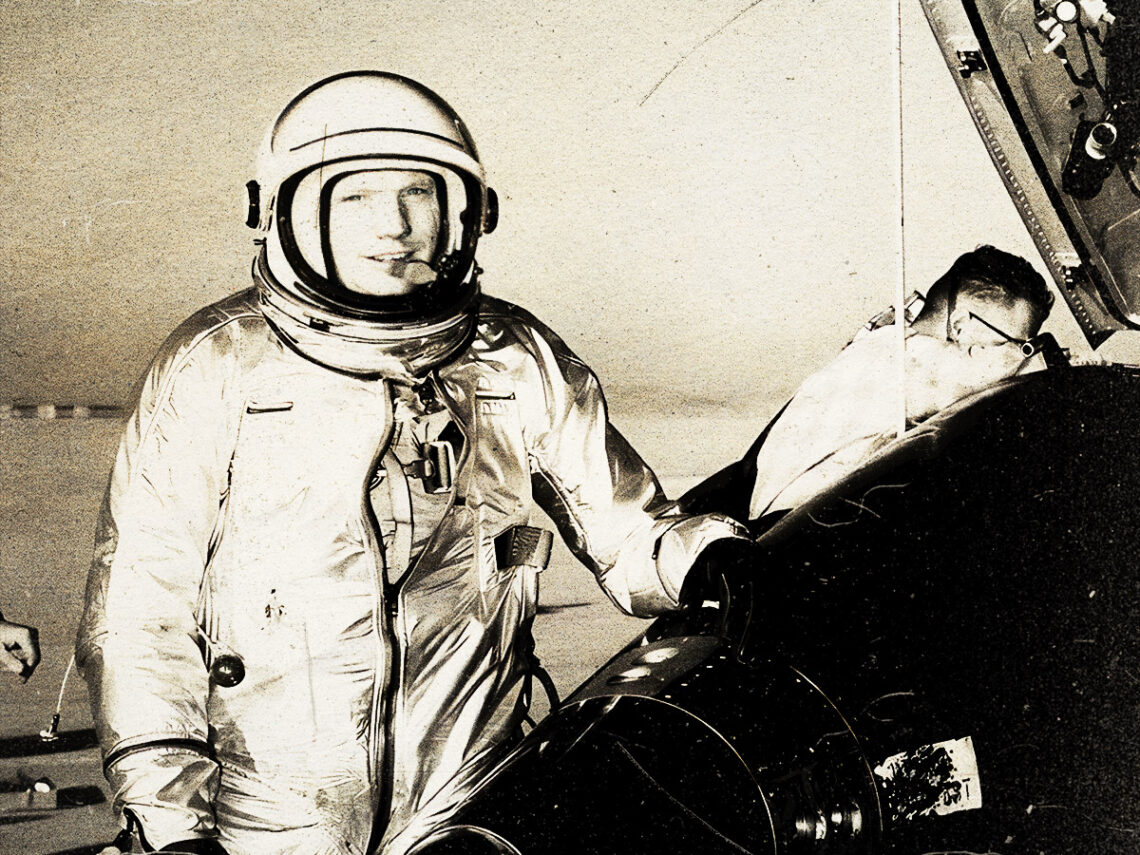
Neil Armstrong names his favourite space movie of all time

It’s difficult to make an accurate movie about the blank mystery of outer space, after all, only a handful of people in human history have had the fortune to visit the extraordinary plane. Still, this hasn’t stopped countless filmmakers from trying to scientifically replicate the conditions of outer space, with Alfonso Cuarón adding painstaking detail to 2013’s Gravity and Christopher Nolan bringing a black hole to life in 2014’s Interstellar.
But who is the greatest judge of the accuracy of these movies? Steven Spielberg, Ridley Scott, George Lucas, Damien Chazelle and other master filmmakers who have conquered fantastic space-themed films? Leading astrophysicists like Jocelyn Bell Burnell, Martin Rees and Neil deGrasse Tyson? In our humble opinion, it is the experience of astronauts themselves that we should listen to regarding the greatest space movies, and there’s no better soul to consider than the very first person in human history to step foot on the moon.
Taking “one small step for man, one giant leap for mankind” on July 21st 1969, Armstrong made human history when his Apollo 11 spacecraft landed on the moon, with the astronaut taking the first steps on the surface mere minutes before his partner Buzz Aldrin. Alongside pilot Michael Collins, the trio’s efforts have long gone down as the most iconic and influential space mission of all time, changing the shape of life on Earth forever.
Having seen the black emptiness of space and the glittery pattern of stars first-hand, Armstrong came with good authority when he spoke to American film critic Gene Siskel about his favourite space-related movies.
“It’s the single best vision of space ever to come out of the movies,” Siskel gleamed in his retrospective of Stanley Kubrick’s 2001: A Space Odyssey, a film released just one year before Apollo 11 achieved the successful moon-walk. A feat of incredible science fiction filmmaking, Kubrick’s classic movie had an impact across the globe, with Siskel recalling a particularly special conversation he had with Armstrong about the flick.
Continuing, Siskel adds: “Don’t just take my word for it, a couple of months ago, I happened to be flying to Cincinnati seated next to Neil Armstrong, the astronaut, the first man to walk on the moon. Armstrong told me that of all the space movies, he liked 2001 the best, that it did a remarkable job of communicating what living and travelling through outer space is actually like”.
In response, Siskel’s on-screen partner Roger Ebert, rightly noted: “That must be the best review that Stanley Kubrick ever got for 2001”.
Widely appreciated as Kubrick’s masterpiece, 2001: A Space Odyssey, follows the story of two astronauts and a supercomputer named H.A.L. 9000 who travel towards Jupiter to uncover the mysteries of human existence. An experimental, cinematically marvellous achievement, the film was based on the short story The Sentinel by Arthur C. Clarke, who also adapted his tale into the screenplay for the movie.
