


‘Neighbours’: Norman McLaren’s philosophical masterpiece

When we consider the dizzying developments of animation in the 20th century, the unforgettable films of Norman McLaren inevitably emerge as integral parts of the field’s rapid evolution. Ranging from abstract art to sound design, McLaren’s work proved to be a vital source of inspiration for many artists who have followed in his footsteps. While he was a prolific artist, very few of his outputs can compare to the pioneering achievements of his 1952 gem Neighbours.
Of course, McLaren produced several notable films throughout his illustrious career – especially essential works such as Dots. However, Neighbours transcended the realm of animation by managing to become a major part of the sociopolitical discourse. A relatively simple short, it revolves around two neighbours who get involved in a deadly conflict. Although Neighbours’ ideological messaging is universal, it was created within a specific political framework.
Described as a controversial work, Neighbours raised a lot of important questions. McLaren once said (via IndieWire): “I was inspired to make Neighbours by a stay of almost a year in the People’s Republic of China. Although I only saw the beginnings of Mao’s revolution, my faith in human nature was reinvigorated by it. Then I came back to Quebec, and the Korean War began… I decided to make a really strong film about anti-militarism and against war.”
In the film, the two neighbours are supposed to represent French Canada and English Canada, but the political context morphs with respect to the personal positions of the viewers. In fact, American audiences interpreted the film as a caustic commentary on the Vietnam War, and McLaren was actually asked to censor some of the more violent imagery in the film. It was the watered-down version of the short that eventually won an Oscar.
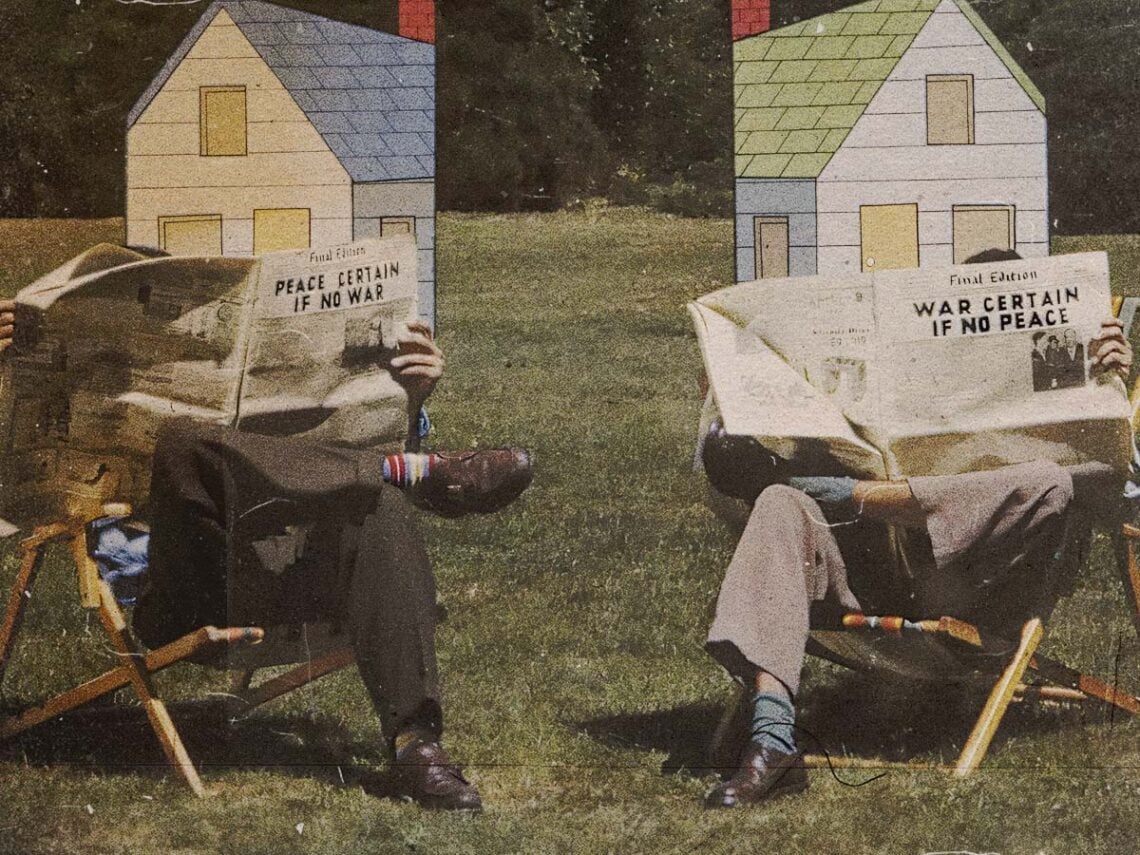
The conflict in Neighbours is generated by the appearance of a strange flower that is shown to have unique psychedelic effects. Prior to the flower’s existence, the two neighbours are shown to co-exist in an illusory harmony while consuming polarising information from pernicious media outlets. However, the two of them soon embark on a deadly quest to possess the flower – destroying everything that was beautiful in the process.
McLaren tears into the concept of private ownership, creating a timeless tale where two humans incorporate seemingly meaningless rationalisations like borders to create fabricated histories. This central idea would be further explored by Benedict Anderson in his seminal book Imagined Communities, which examines the mythology of nationhood and nationalism. Despite the fact that the subject requires serious academic engagement, McLaren ingeniously captures all of it in his 7-minute short through silly pixilation techniques.
Watch the film below.
