


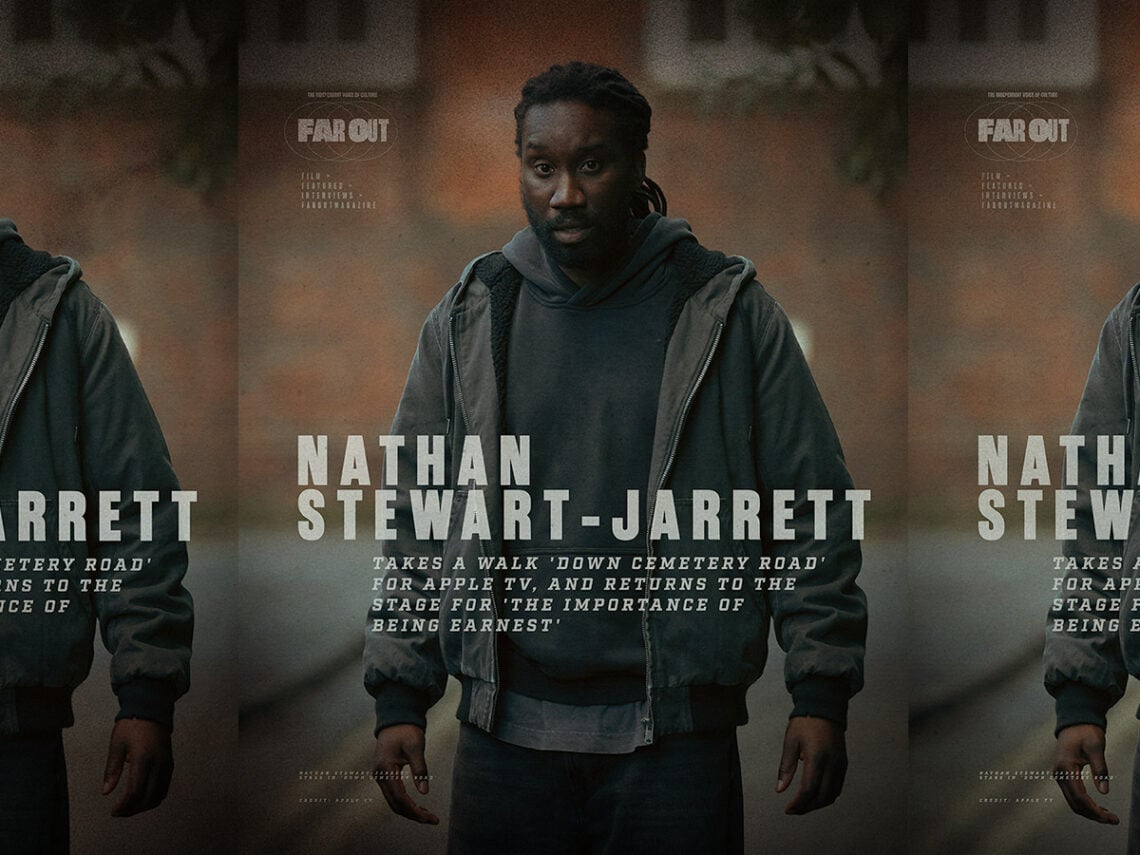
Nathan Stewart-Jarrett takes a walk ‘Down Cemetery Road’ for Apple TV, and returns to the stage for ‘The Importance of Being Earnest’

While shooting the first couple of episodes of Down Cemetery Road, Apple TV’s new thriller based on a novel by the brilliantly caustic mind behind Slow Horses, Nathan Stewart-Jarrett started to get a little paranoid.
Much like several of the characters in the show, which kicks off with an explosion and a child’s disappearance on the very same night in an unassumingly leafy English suburb, he began to obsess over what he didn’t know about his character, the mysterious Downey.
Amusingly enough, this obsession didn’t come from some burning need to crack the mystery of Downey’s motives, which remain properly under wraps in the early episodes. Instead, the ever-charismatic actor – best known for Misfits, Utopia, and Culprits – was simply trying to figure out how to play someone so deliberately unknowable at first.
For most of the opening two episodes, Downey just sort of lingers silently in the background of scenes with Ruth Wilson’s Sarah Tucker, until things finally kick off and get a bit clearer when he springs into action at the end of episode two. Even then, though, Stewart-Jarrett notes, “I wouldn’t assume anything” when it comes to Downey, and that inherent mystery proved tricky to pull off.
“In the first block of episodes, basically, I don’t say anything,” Stewart-Jarrett laughs, “So, I was like, ‘This is really, really hard. It’s a lot going on underneath'”. After a while, he found himself endlessly wondering, “Am I walking in the right way?” and agonising over whether he was bringing the correct motivation and backstory to Downey opening his car door. Then, like a bolt from the blue, he realised he was consuming himself with all the wrong things, and he needed to “just open the goddamn car door!”

After this seemingly humdrum revelation, Stewart-Jarrett began to understand that he’d been wildly overthinking everything. “I should have just relaxed and been like, ‘This is actually going to be the easiest part of this whole thing’,” he admitted, “You always want to turn up with your little flag for your character, and you want to plant it somewhere strong, but I was kind of running around just making holes everywhere! When I calmed down, it was much better.”
Indeed, calming down was the key to Stewart-Jarrett realising something very important: he had actually been given a great gift with Downey. “There is something about playing someone who doesn’t really reveal a lot, which is very, very exciting,” he told Far Out conspiratorially, adding, “It’s really, really hard to do. I feel like I’ve done it a couple of times now. Maybe they sense that it’s something that I’m able to do.”
Then, after a perfectly timed pause, he quipped, “Or maybe they just don’t want me to talk very much!”
Naturally, this couldn’t be further from the truth, and UK casting directors have loved landing the kind-faced, charismatic star in all kinds of roles for the past decade and a half. When he received the script for Down Cemetery Road, though, which was written by Slow Horses scribe Morwenna Banks, he was fresh off two recent series that dealt heavily in action and intrigue: Culprits and Black Doves.
Like the rest of the world, he was familiar with the TV adventures of the perpetually flatulent spy Jackson Lamb (“It’s kind of a huge sensation”) and was excited to wade into another world created by novelist Mick Herron. Down Cemetery Road was Herron’s first novel, published seven years before Slow Horses, meaning it’s taken Oxford’s private investigator Zoë Boehm a lot longer to make it to the screen, but in the spikey-haired form of Emma Thompson, she’s quickly set to make up for lost time.
“Emma Thompson is a legend,” Stewart-Jarrett gushed, “So, that’s incredible. I’ve been very lucky. She’s just very, very lovely and really caring about where you are, what you’re doing, how the whole thing is working.”
In the show, Stewart-Jarrett also shares many scenes with Wilson’s Sarah, an ordinary woman who hires Boehm to investigate the shady goings on in her village, and soon finds herself in way over her head. He quickly found out just how incredible Wilson is at her job, noting, “She’s just really, really smart. If there are things you haven’t thought about in a script, or in a situation, or a dynamic, Ruth has already thought about it.” One thing he perhaps didn’t expect from Wilson, though, was a steady stream of laughs.
“You’re bouncing off each other,” he smiled, recalling all the fun times on-set, “That bounce is amazing. She’s very funny”.

In truth, humour is a big part of Down Cemetery Road, just as it is in Slow Horses. To Stewart-Jarrett, it’s a typically British style of humour that sarcastically undercuts important moments, yet somehow doesn’t lessen the stakes or defuse the tension. In this sense, the shoot involved vacillating a lot between funny and traumatic, but instead of that being taxing, it actually made the job more rewarding.
“I had to ground myself in something very serious, emotional, and quite tragic,” he noted, hinting at some of the dark places Downey’s story goes to. “Some days were more fun than others within that, but the motivations were all there. There were moments where Ruth and I had a lot of fun in these ridiculous situations, and there were other moments where you have to dig deep or use a different part of your psyche.”
After he wrapped up with the show, Stewart-Jarrett threw himself into his next role, which involved returning to the stage for the first time since his 2018 turn as Belize in a Broadway production of Angels in America. He eagerly signed up to play Jack Worthing in Max Webster’s remixed West End production of The Importance of Being Earnest, having “said Oscar Wilde out loud” since drama school. To him, it was a golden opportunity to do “classical theatre”, which he’d never been a part of, and he wanted to challenge himself to see if he could excel in that arena. Finding himself acting opposite a legend like Stephen Fry was initially intimidating, but after scolding himself for being too deferential in rehearsals, he soon found his rhythm.
“A production like this, it’s kind of a no-brainer,” he smiled, “I’m really happy and joyful to be in something that’s not deconstructed, but definitely kind of a shaken-up version, for want of a better phrase. That’s really exciting.”
Overall, the actor couldn’t be happier with his career, whether he’s on television, film, or the stage. Each discipline is challenging and rewarding (although he admits theatre is the hardest technique to master because it takes “a lot more energy”), and he’s convinced that he’s actually loving acting more and more with each year that goes by.
“I really think that’s down to trying to challenge myself,” he concludes, “I’m just kind of like, ‘Oh, can I do it? I don’t think so. Then let’s try to do it’. That’s my new philosophy.”
