


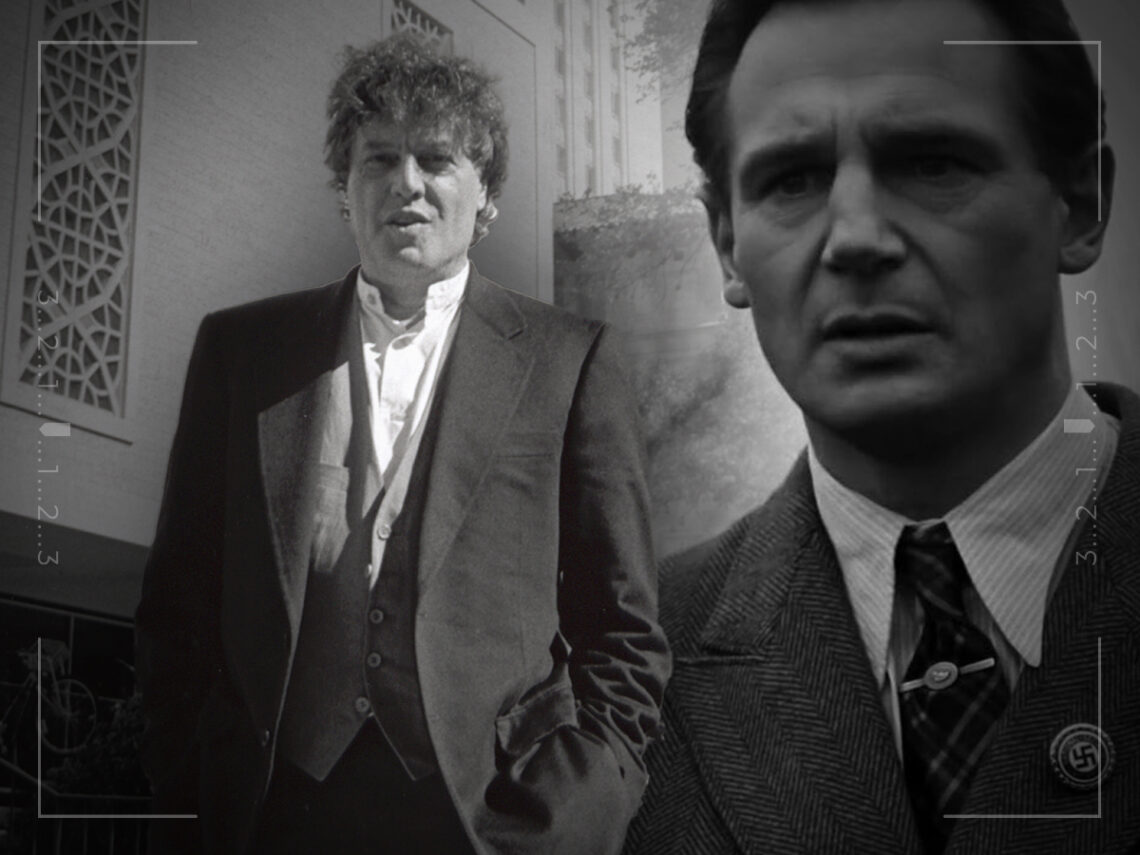
How a naked Tom Stoppard reshaped ‘Schindler’s List’: “I actually got quite angry”

They say one of the hardest things to do is fight naked, due to how vulnerable it makes you feel physically and emotionally, leaving you literally exposed to your opponent and putting you at an immediate disadvantage, so it probably speaks volumes about the late Tom Stoppard that he took on the world’s greatest living movie director without a stitch on.
Stoppard passed away this week and left a quite amazing body of work, within both the theatre and cinema worlds, and while he was best known as a playwright, he also penned a number of movies that have stood the test of time and that many people are unaware he was responsible for.
He initially gained fame in the late 1960s thanks to his play Rosencrantz and Guildenstern are Dead, the Shakespearean spin-off that he would eventually turn into a movie with Gary Oldman and Tim Roth, and over the next 15 years wrote several hit productions in the West End and on Broadway while also working on TV movies on both sides of the Atlantic. His first major movie was Brazil, the Terry Gilliam-directed surreal social commentary from 1985, which was a commercial disaster but has since gone on to be one of the more important films of the decade.
Stoppard was nominated for an Oscar for ‘Best Screenplay’ for the dystopian sci-fi, and although he lost out to Harrison Ford’s Witness, it was enough for him to immediately be hugely in demand in Hollywood, and he followed it up with his first work with Steven Spielberg, 1987’s Empire of the Sun, a war drama starring Christian Bale.
In the ‘90s, Stoppard wrote arguably his famous play, Arcadia, which has since gone down as one of the finest ever written, while he also continued producing screenplays for Hollywood, with the occasional rare miss like 1991’s gangster film Billy Bathgate starring Nicole Kidman and Dustin Hoffman. He more than made up for that with 1998’s Shakespeare in Love, however, for which he won an Oscar for ‘Best Screenplay’.
Thanks to his standing in the industry and authority as a writer, Stoppard would also work uncredited as a resource for directors to send scripts to in order to improve them, once telling The Guardian that: “The second reason for doing it is that you get to work with people you admire. The first reason, of course, is that it’s overpaid.”
One year, memorably, Stoppard was in the shower when a call came through from Spielberg, who was busy filming the Liam Neeson Nazi drama Schindler’s List, apparently agonising over a particular scene penned by the movie’s writer Steven Zaillian.
Stoppard recalled that he stood naked on the phone, suggested a tweak, and Spielberg used it in the final edit. He said, “I actually got quite angry with Spielberg, who was and is a good friend, and told him just to film Zaillian’s script. But Steven, like a lot of other people in movies, tends to think one more opinion can’t hurt.”
He wasn’t finished with historical films and over the next 20 years would go on to write screenplays, including the World War II code-cracking thriller Enigma starring Kate Winslet, and then 2012’s romantic drama Anna Karenina directed by Joe Wright. The screenplay earned Stoppard a Bafta nomination; he followed it with another two the next year for his writing on the period drama miniseries Parade’s End, starring Benedict Cumberbatch and Rebecca Hall.
