


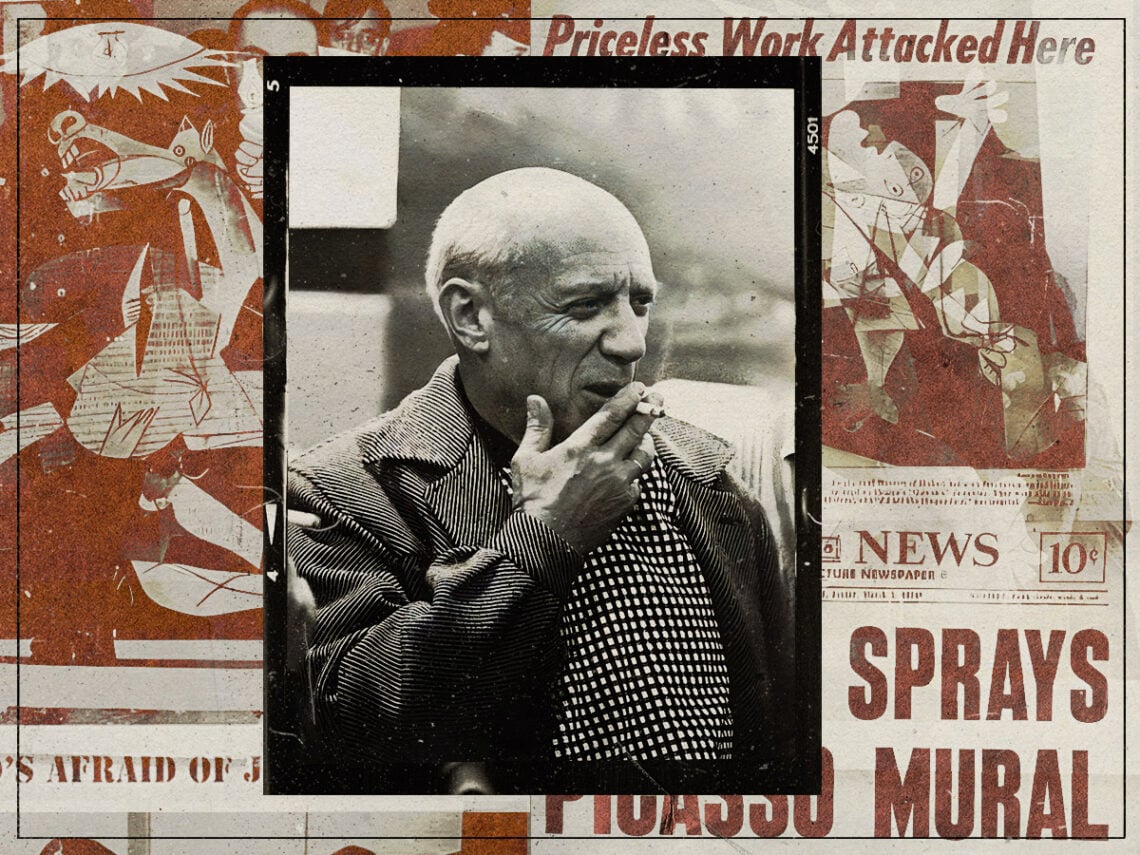
The mystery of the “Art Gangster” connected to the vandalisation of Pablo Picasso’s ‘Guernica’

In the modern day, the defacement of famous and priceless art has become common practice amongst various climate change protest groups, such as Extinction Rebellion and Just Stop Oil. The premise exercised here is that the shocking acts will receive global media coverage, thus spreading the cause far and wide. The effectiveness and morality of such acts of eco-vandalism are heavily debated, with some arguing the perpetrators could counterintuitively alienate the public against a worthy cause.
Enraged museum curators and art lovers around the world have been comforted by glass screens that protect valuable paintings from weathering. Although the pane fitted over Vincent Van Gogh’s ‘Sunflowers’ was designed with the insidious force of dust and mildew in mind, it had no problem shielding the masterpiece from half a gallon of tomato soup.
The defacement of notable artefacts for the express conveyance of political rhetoric appears to be a new and burgeoning practice. Still, isolated instances of art vandalism have occurred in one form or another for as long as museums have held valuable items.
Today, we return to the 1970s to remember a rather mysterious instance of art vandalism committed at New York’s Museum of Modern Art. On March 1st, 1974, The New York Times reported that an “enraged” visitor sprayed in large red lettering the phrase “Kill Lies All” on Pablo Picasso’s famous 1937 painting, ‘Guernica’.
The man responsible, later identified as Tony Shafrazi, brazenly declared himself an artist before being apprehended by museum security staff. This unprecedented incident unfolded amidst a crowd of stunned onlookers in the third-floor gallery, where the iconic antiwar painting was then displayed.
“We couldn’t move — we were all stunned,” commented Gregory Losapio, then 16 years old, who was in the museum with his Scarsdale High School class. “A man started to move toward the guy when he turned around, cursed and said, ‘I’m an artist’. Then everybody started yelling, and a guard came.”
The floor was immediately sealed off to the public, allowing a team of experts led by Jean Volkmer, the museum’s chief conservator, to carefully remove the fresh red spray paint using the organic solvent xylene. Within an hour of the incident, the lettering was removed without damage to the original work.
“There’s no damage at all,” said William Rubin, the museum’s director of painting and sculpture. Rubin explained that the 25‐by‐11‐foot painting was saved by a thick coat of varnish that “acted as an invisible shield”.
Meanwhile, Shafrazi, an aspiring New York-based artist, was whisked away to the local police station on West 54th Street, where he was asked why he sprayed paint on ‘Guernica’. “I’m an artist, and I wanted to tell the truth,” he reportedly replied.
Adding mystery to the story, the folks at Gallery 98 have been puzzled by a piece of mail art found in their inventory acquired many years ago from Artforum. The “artwork” consists of the front page of the Los Angeles Times, dated February 28th. On the front page is the bold headline, “Paint Sprayed on Masterpiece”, with the story of Shafrazi’s act of vandalism ensuing.
This particular page of the Los Angeles Times was mailed anonymously to Artforum shortly after the incident. It remains the subject of much conjecture because the anonymous sender rubber-stamped the phrase “Art Gangster” and handwritten the numbering “14/50” on the embedded image of ‘Guernica’.
The envelope used for the delivery held a postage stamp dated March 1st, which took Shafrazi out of the equation since he was still detained in New York at that point. At the time, a Los Angeles-based artist named David Hammons was known to have described himself as an “Art Gangster” on several occasions in interviews and hence became another suspect.
However, thanks to the ardent and meticulous research of curator Greg Ellis, the mystery “Art Gangster” has now been revealed as Jerry Dreva. The artist, who passed away in 1997, aged 52, was a known provocateur in mail art circles and used the “Art Gangster” handle for surreptitious graffiti works, which he stealthily promoted through his day job writing for the South Milwaukee Voice-Journal.
The below photographs of Dreva holding up the front page of the Los Angeles Times feature were deemed conclusive of Dreva’s hand in this mysterious mail artwork connected to the vandalisation of Picasso’s ‘Guernica’.
