


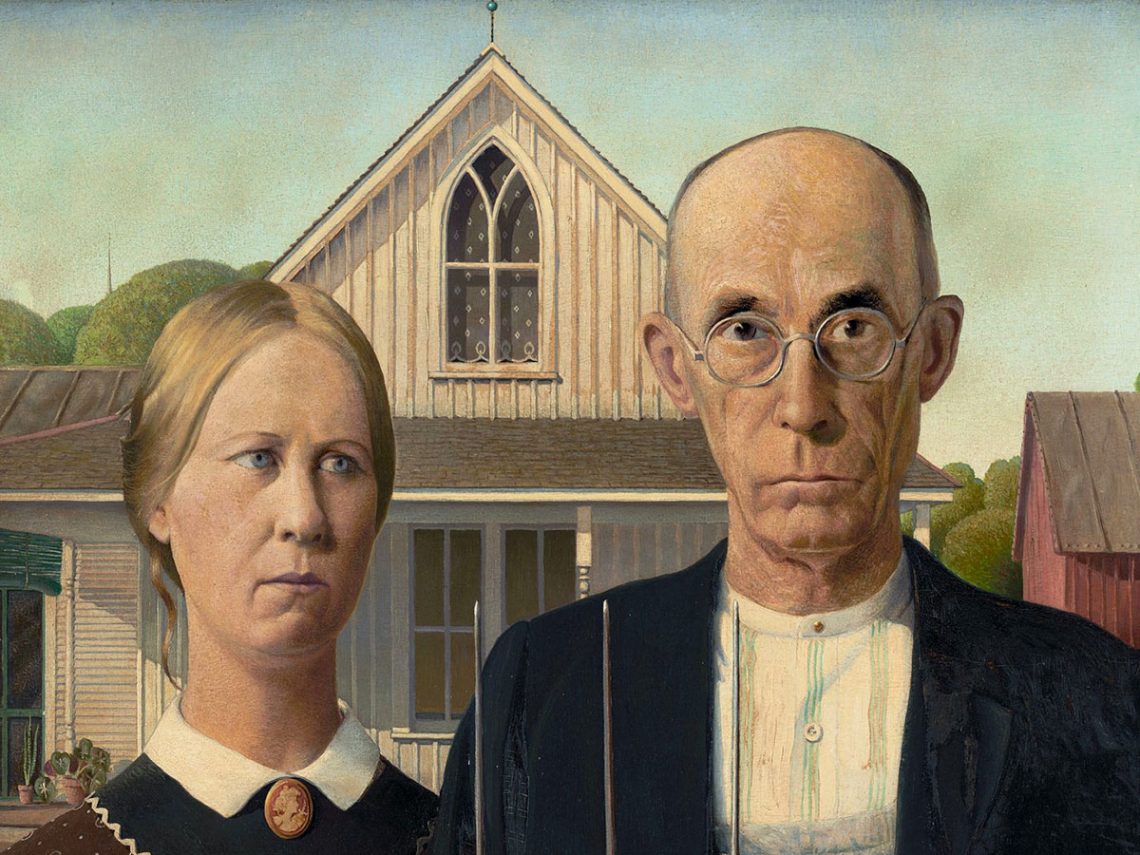
The mysterious meaning of Grant Wood’s ‘American Gothic’

Grant Wood’s 1930 painting American Gothic is one of the highlights of modern American art. This is ironic, as at the time it debuted, he was an unknown artist, struggling to make ends meet, hailing from a remote farm in Iowa. This was the 20th century, though, and the class system was to be challenged on all fronts.
He eventually won the Norman Wait Harris Bronze Medal and $300 in cash, which kickstarted his career and wrote his name in the history books. This work, and the others that followed, became symbols of the Great Depression. They conveyed the weariness of the age and other, more subtle nods to religion, sexual morals and the country’s recent political past.
While his other pieces, such as 1930’s Stone City, Iowa and 1932’s Daughters of Revolution, are significant, none are as impactful and mystifying as American Gothic. It was hailed as the first piece of the new American movement called ‘Regionalism’, kicking off a wave of realism in art fitting for America’s newfound place in the world and global economy.
With the painting, he presented an America that had never been represented in such an unapologetic style. This was the gritty, hard-working side that propped the famous faces of America – Hollywood and the politicians – up but took none of the plaudits. The pair in American Gothic were the real Americans, and thanks to the influence of the Great Depression, the way Wood depicted them was not a joyous one.
Notably, the painter was inspired by coming across a building in the small town of Eldon, Iowa: “I saw a trim white cottage, with a trim white porch — a cottage built on severe Gothic lines. This gave me an idea. That idea was to find two people who, by their severely strait-laced characters, would fit into such a home. I looked about among the folks I knew around my home town, Cedar Rapids, Iowa, but could find none among the farmers — for the cottage was to be a farmer’s home.”
Wood eventually turned closer to home to find a model, his sister Nan Wood Graham and, strangely, the local dentist, Dr. Byron McKeeby. He continued: “I finally induced my own maiden sister to pose and had her comb her hair straight down her ears, with a severely plain part in the middle. The next job was to find a man to represent the husband. My quest finally narrowed down to the local dentist, who reluctantly consented to pose. I sent to a Chicago mail-order house for the prim, colonial print apron my sister wears and for the trim, spotless overalls the dentist has on.”
Despite Wood suggesting it was his sister and dentist in American Gothic, with the pair even photographed in front of the painting, he went back on his story and claimed that those in the image were actually a husband and wife. This is rumoured to have been because his sister pressured him into it. It is said that she hated the idea of being married to a significantly older man.
Although Wood admitted that American Gothic featured Nan and McKeeby, his claim that it is a father and daughter is indicative of a broader point; it is tinged with mystery. Nobody has ever fully ascertained the meaning of it outside of the obvious, with theories ranging from the Roman gods, Pluto and Proserpina, to the spirit of the pioneers mentioned.
The question of what it is really about has kept American Gothic suspended in the collective consciousness, with the mystery passed on through many generations. Although numerous accounts exist, Christie’s auction house has offered some possible answers.
They note that because Wood was a keen admirer of the Northern Renaissance, both figures are imbued with symbolic attributes as painting in this style would be. The farmer’s pitchfork is both a weapon and an emblem of Christian militancy, but its strength is softened, as reflected by its faint presence in his top, which has faded with age. As was the case for most working Americans in 1930, the modern world had taken its toll, with the Great Depression the final kick in the teeth after a life of hardship, despite their religious devotion.
As for the wife or daughter, it appears as if the farmer is protecting or preserving her from the moral dangers of the modern world. The house may represent either the church or jail, two things that weren’t mutually exclusive to Wood, as it has long been rumoured that he was a closeted homosexual.
Elsewhere, the brooch’s presence could also indicate a mythological essence to the painting, as it contains the visage of Persephone – the Ancient Greek deity kidnapped by Hades and made the Queen of the underworld. Again, this might suggest that what Wood has depicted is nothing more than hell, which life was for Americans in 1930. Just ask John Steinbeck.
