


‘My First Film’: Zia Anger’s bold exploration of memory and filmmaking is too messy

Meta cinema can often be fun and inventive, as examples like the Scream franchise or Adaptation demonstrate. The idea of making the audience aware that they’re watching a film that has been constructed by a director, bringing attention to its innate artificiality, gives the filmmaker plenty of creative licence, something that Zia Anger takes into strange and often pretentious dimensions with My First Film.
The movie is Anger’s first feature film to be released following the disaster, which was her first attempt at filmmaking – Always All Ways, Anne Marie. The story of her failure to find any hint of success with her debut is documented in My First Film, which is a bold and uncompromising attempt to recall a memory, one that shaped the rest of Anger’s career. Unfortunately, Anger’s first official release is a mess of ideas that drags on far too long, forcing the audience into her self-aggrandising web of so-called artistry, one that it is hard to connect with.
Anger opens up the movie with a Word document, typing out an introduction for the audience that begins with the words, “This probably shouldn’t be a film.” Maybe Anger should have listened to that statement. We are shown vertical phone clips of Anger posing, bouncing the camera against her behind or wearing fake breasts – it’s obnoxious and, as Anger puts it, “ass-o-teric”. This is a film defined by the internet age, emphasised by Anger’s use of slang and spelling mistakes as she types out messages for us, including, “My videos are not the film lol”. This captures a moment in time, sure, but it’s gimmicky, and there is no doubt that these scenes will age poorly in just a few years.
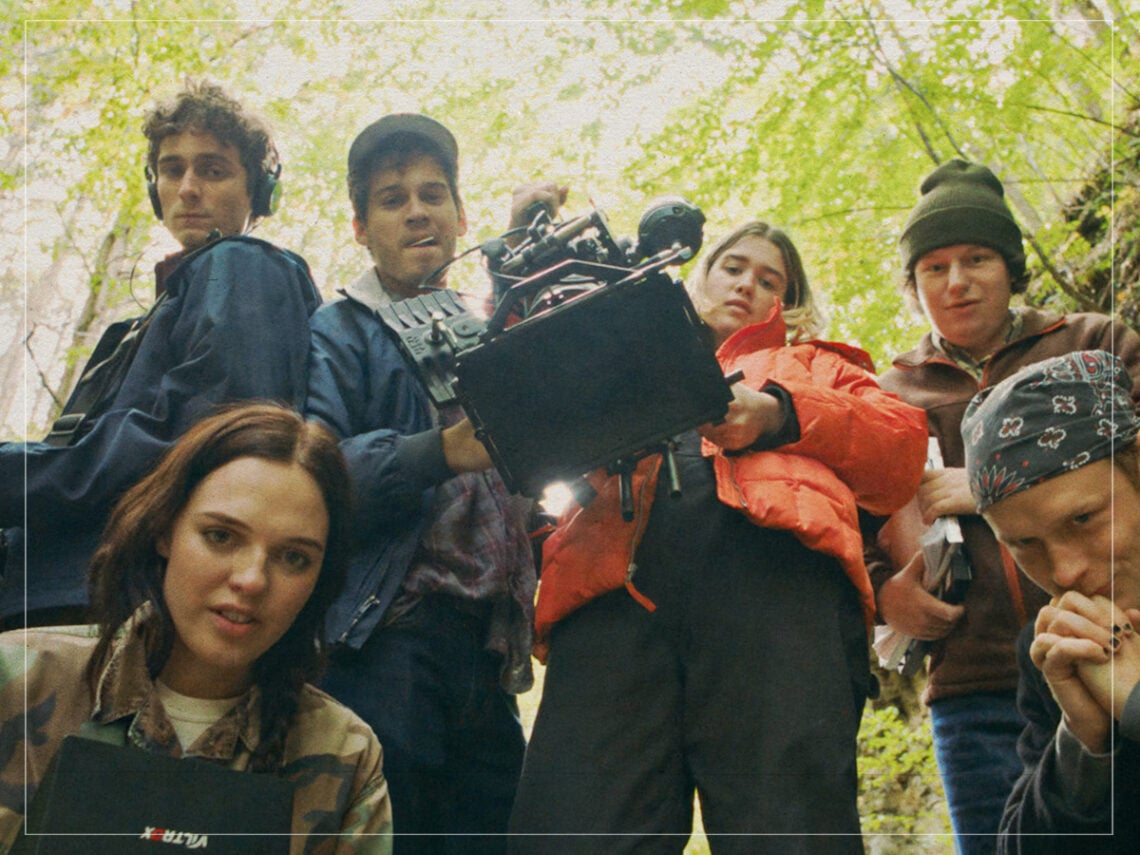
The film then takes us into the main narrative, which sees a semi-fictionalised version of Anger, named Vita, attempt to make her first film. With a small budget and an even smaller crew, it doesn’t look like the film could turn out well – we soon discover it did not at all. Not one festival accepted the finished result. Thus, what we see is a disaster unfolding in front of us, with Anger drawing a significant parallel between parenthood and filmmaking as she explores the two abortions she had during this period of her life.
The narrative is lucid and fluid. A voiceover recalls the events of the film shoot, with Odessa Young playing Vita and Devon Ross playing her muse, Dina. We see emails, IMDb pages, and texts laid out across the screen between clips of the troubled shoot and clips of pre-existing films, like a Maya Deren short. While this might seem like an experimental use of form, we’re simply overloaded with images—some of which only seem to truly matter to Anger.
There are scenes where the real crew are revealed to us, and the real Anger hugs her fictionalised self, but these moments carry a pretentious air of self-importance to them, as though we’re meant to feel emotional because Anger has finally made a ‘good’ film that’ll be screened at film festivals. However, with no likeable characters apart from the father, it’s hard to feel much more than annoyance.
My First Film does have its interesting moments, such as comedic sequences that accurately capture the stress of managing a film set, for example, when Dina repeatedly fails to give a convincing scream. There are also a few poignant lines sprinkled in, such as the recurring words (in reference to both abortions and a failed film production), “It happens to a lot of people, it’s just that nobody talks about,” and “All you need is a body to create, but what you create? That is up to you.”
Still, Anger seems to be making statements about filmmaking that she doesn’t appear to be qualified to make. My First Film is an attempt to self-mythologise, but it gets exhausting fast. There is a lot of potential here, but it is simply wasted on pretension.
