


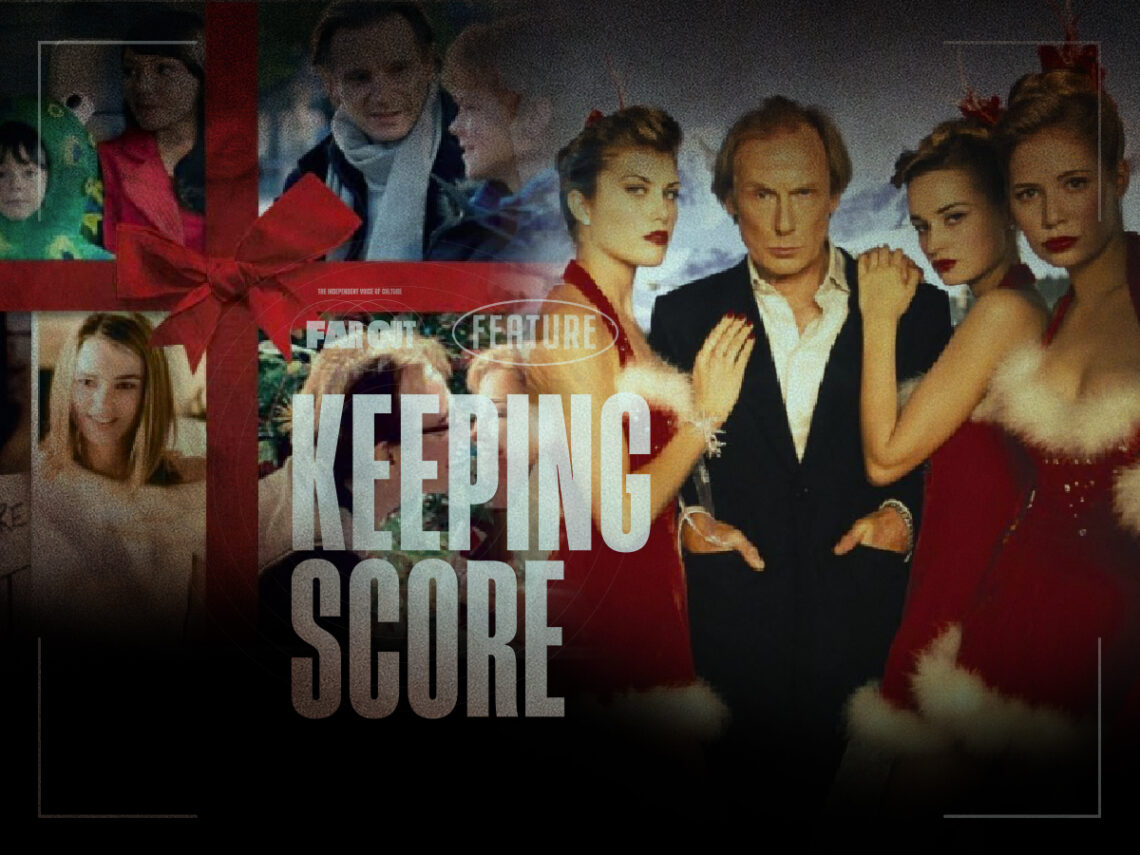
Keeping Score: Understanding the music that redeems ‘Love Actually’

Love Actually is a terrible movie full of cheesy dialogue, unrealistic portrayals of romance, and some storylines that are downright offensive and creepy.
It makes no sense how Colin Firth perving over his housekeeper (who doesn’t speak a word of English) became a symbol of holiday joy, and as loathed as I am to praise this diabolical affair, even I, the staunchest of Richard Curtis critics, have to admit that the music is pretty good.
From Bill Nighy’s quest to reach the top of the charts to Thomas Brodie Sangster’s efforts to learn the drums to Emma Thompson’s life falling apart to the sound of Joni Mitchell, music plays a big part in the story. The soundtrack is jam-packed with bangers too, including tunes from the Bay City Rollers, Girls Aloud, and Norah Jones, but for the real-world score innovation, we have to thank a man by the name of Craig Armstrong.
Starting out as a touring musician for Ultravox and Massive Attack, Armstrong was lured into the glamorous world of film by Baz Luhrmann, for whom he crafted the score for the Australian Romeo + Juliet. They went on to work together a total of four times, and once everyone realised how good the Scotsman was, the offers came flooding in. Love Actually contains two of his best pieces in the forms of ‘PM’s Love Theme’, a triumphant orchestral piece that is far more uplifting than the rotten storyline it’s attached to, and the focus of this write-up, ‘Glasgow Love Theme’.
This simple piano melody soundtracks the scene in which Keira Knightley’s Juliet realises that her new husband’s best friend Mark, played by Andrew Lincoln, has always been in love with her from afar, which is, once again, super weird to the point that even Knightley herself has called the storyline “slightly stalkerish”. However, that doesn’t stop Armstrong from knocking it out of the park with his melancholy accompaniment, which was written without the restraints of genre clouding judgment.
“When you write music for a romantic comedy, I find it’s best not to go with the humour and instead go with the emotion of the scene,” the composer described to Dazed, adding, “The ‘Glasgow Love Theme’ was one of several themes that I wrote for the film which had a romantic loneliness about it which seemed to reflect the unrequited love throughout the film.”
Given that the anthology is set in London, Portugal, and America, it’s a little odd that a city in Scotland gets a shoutout in one of its most prominent pieces of music, but the conundrum behind the name has a simple answer: it’s where Armstrong is from.
“Glasgow has always been my home, although I love to travel and be in new places,” he told Scottish Field.
Similar to how Mark finds himself unable to be with Juliet, Armstrong is constantly torn away from the place he loves the most, and this relationship between a man and his home city is beautifully mirrored in the music, and is a damn-sight more romantic a storyline than a bloke secretly filming his best friend’s wife.
As I am forced to be reminded of Love Actually’s regrettable existence each and every Christmas, at least I can take some comfort knowing that Armstrong was rewarded for his fine work with a movie that has become a firm seasonal favourite. The fact that I love his music and would rather stick my head in a bucket of piranhas than watch the film again is testament to his ability to elevate even the worst things to deeply affecting.
