


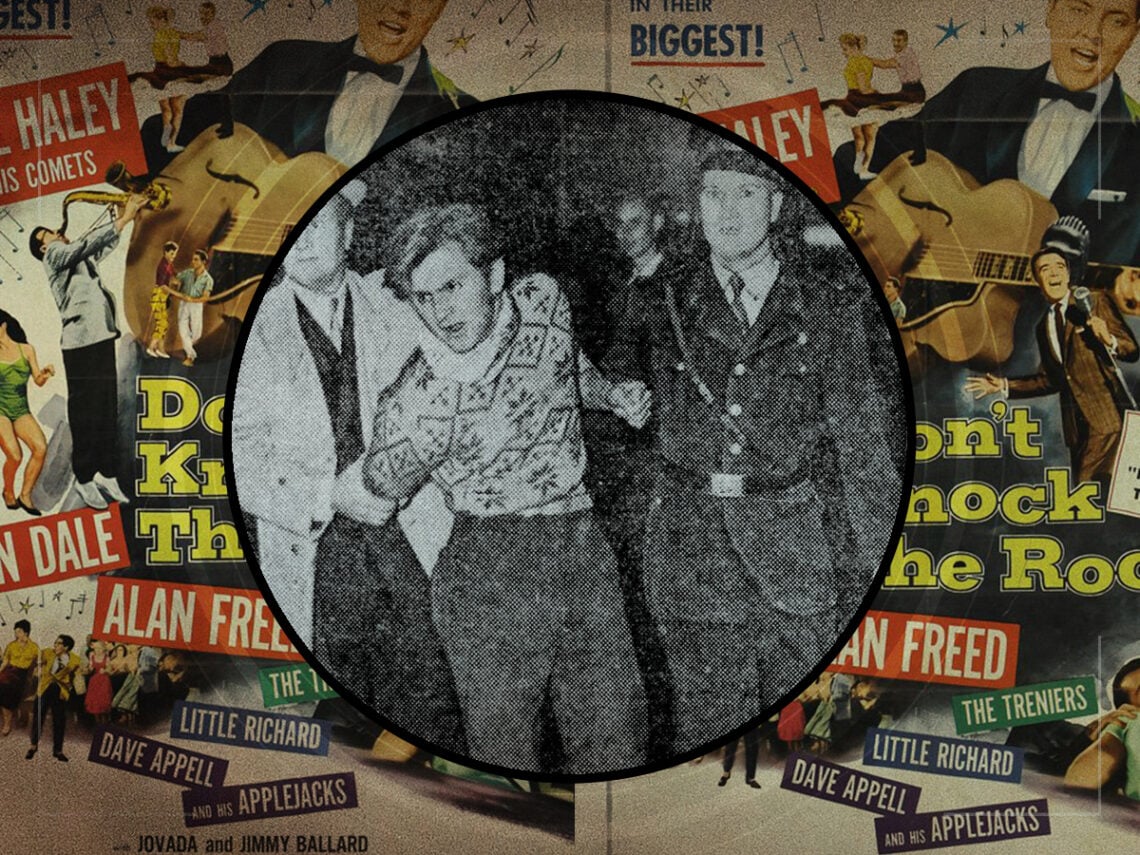
“It inspired waves of terrorism”: the 1956 movie that sparked riots on the streets of Ireland

While movies can still be occasionally picketed and protested, riots are largely a thing of the past. In the 1950s, though, the release of one motion picture caused widespread disorder in Ireland, although it was far from an isolated incident.
The way society and culture have evolved, it’s hard to imagine a film arriving in cinemas in the United States, the United Kingdom, Ireland, or mainland Europe that will cause multiplexes to start overflowing with violence, leading to a heavy police presence and brawls that spill out onto the streets.
Watch it through a modern lens, and 1956’s Rock Around the Clock, starring Bill Haley and His Comets, is about as inoffensive as it gets. At the time, though, it set off a powder keg, with the musical’s anti-establishment undertones leading teenagers to clash with law enforcement in Germany, Austria, and Denmark, among other nations.
In Ireland, most of the blame was laid at the door of the Teddy Boys, a rising working-class subculture that had emerged in the early ’50s, where youngsters adopted Edwardian-inspired attire and rock and roll music as their identities. From their perspective, Rock Around the Clock was speaking directly to them, even if the reaction to the song-and-dance flick was hardly proportional.
During screenings, the Teddy Boys would throw projectiles, rip up seats with pocket knives, and occasionally start fights with other patrons. In an attempt to quell any potential uprisings among the younger generation, the movie was banned by several UK councils, and in Belfast. When it played in Dublin, a scathing newspaper report relayed the extent of the problems it caused.
“When the show first hit Dublin, it inspired waves of Teddy Boy terrorism,” it was reported. “Usually, it erupted in the cinemas and flowed out into the streets. In an attempt to quell the riots, police brass looked for their toughest men. And with bottles, stones, and chains flying, they had to be really tough.”
Of course, Ireland was far from the only place where Rock Around the Clock had inadvertently lit the touchpaper on running battles between disaffected, disenchanted youths who’d finally found a piece of modern-day media they readily identified with, but the Teddy Boys only exacerbated the situation.


According to The People, James ‘Lugs’ Branigan, a member of the Garda and a boxer, had emerged as the most important line of defence against the riots caused by the picture. “If Bill Haley comes back to Dublin again with his Comets, Jim Branigan is one cat who won’t rip it up, even for free,” it was intoned. “But I dare say he’ll rip up any scraps who start.”
Haley must have remained oblivious, since he and the Comets played in Dublin in 1957, the year after Rock Around the Clock had debuted in cinemas, with thousands of youths packing the streets to get a glimpse of their idol ahead of a gig at the Theatre Royal, and he didn’t end up scrapping with Branigan.
