


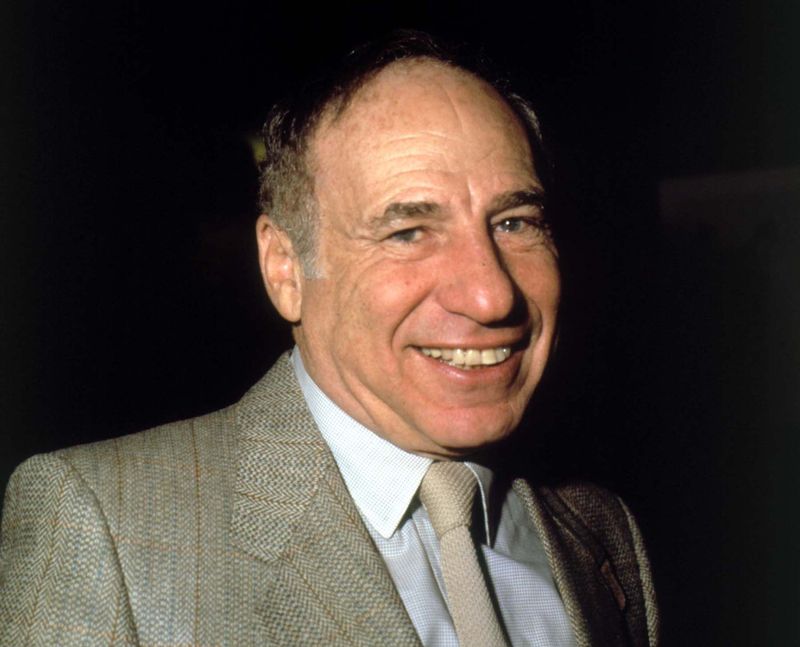
The movie Mel Brooks risked his entire career on: “I knew I was on thin ice”

The word ‘legend’ gets thrown around a lot when talking about people in the entertainment business, but few people are as deserving of that title as the titanic Mel Brooks. Beginning his career as a sketch writer alongside Carl Reiner, Brooks later transitioned into movies, writing and directing some of the funniest films of all time. Blazing Saddles, Spaceballs, Young Frankenstein, and more have all come from the pen of this great man and, at time of writing, he is still going strong at the ripe old age of 98.
As well as generating some of the biggest laughs in the history of the silver screen, Brooks has also courted his fair share of controversy. Blazing Saddles was nearly buried by Warner Bros because they thought it was too inappropriate, but his most contentious movie is by far and away the 1967 black comedy, The Producers.
Starring Zero Mostel as Max Bialystock, a down-on-his-luck Broadway producer, and Gene Wilder as Leo Bloom, a meek account with dreams of stardom, The Producers kicks off when the two leads discover that, through a clever accounting trick, they can make more money with an unsuccessful play than a big hit. To try and get their show cancelled as quickly as possible, they stage Springtime for Hitler, a musical celebrating the life and times of Germany’s most notorious leader.
Considering it was released just over 20 years after the end of World War II, it’s not surprising that The Producers wasn’t everyone’s cup of tea. Even Brooks himself admits that he wasn’t always completely sure about it. “That was a fight within me, a big struggle,” he told The New Yorker. “Of course, I didn’t want to pay any homage in any way to the Third Reich. However, I was true to my story.” Brooks, who was born in 1926 to Jewish parents of German and Ukrainian descent, fought in the Second World War. He took part in the Battle of the Bulge, the final major German offensive of the campaign. If anyone had any right to be making fun of Hitler, it was him.
“I knew I was on thin ice,” he continued. “But I said, ‘This will surely send the Jews flying out of the theatre in a rage, and they’d have their flop.’ And that’s what this story was all about, a great big flop making them rich. In the end, it turns out that I really was more interested in their relationship than anything else: two strangers become very good friends. That’s the unconscious engine that drives the movie.”
It’s interesting that, despite Springtime for Hitler being the most memorable part of the film, Brooks considers it to be about Max and Leo’s relationship more than anything else. In a way, the fact that the Nazis feature in The Producers is fairly inconsequential. They just so happened to be what Brooks thought would cause the most offence at the time, so they were made the subject of the intentionally bad musical. In a different time period, perhaps the fictional play at the heart of the story would have been about something else entirely.
Brooks seems to have a good relationship with the movie now, even stating that it should be where everybody starts when reviewing his body of work. He stuck to his guns and made the film he wanted to make, and thank God for that.
