


Moog celebrate 70 years by picking the 42 ultimate Model-D anthems

Moog’s place in music seems to grow all the more seismic with each passing day. It started in 1964 when Robert Moog invented the first commercial synthesiser. In 1976, Brian Eno came running into the studio where David Bowie was either squirrelling away or sniffing coke, perhaps both, and proclaimed ‘I’ve heard the future of music’. As Bowie recalls: “He puts on ‘I Feel Love’ by Donna Summer. He said, ‘This is it, look no further. This single is going to change the sounds of club music for the next fifteen years’. Which was more or less right.”
Along with Pete Bellotte, Giorgio Moroder and Robby Wedel, Donna Summer broke new ground with Moog’s invention and spawned the next advent of music—new wave. With the track, they demonstrated how you could synchronise separate elements on the same synth for a complete sound. “[Wedel] said, ‘It’s something I’ve figured out that even Bob Moog didn’t know his machine was capable of, and now I’ve told him how it’s done.”
The track was a masterpiece. It was a postmodernist breakthrough that paired art and technology with one force informing the other to break new ground. This welcomed the instrument into a new era—an era that is all the more pertinent in the modern age. Not simply because of the success of the song and its presceint way of making sound more scientific, but because of the fallout that followed.
Enter the battle against the synths. Once again, bloody Barry Manilow finds himself as the antagonist in this cultural war. In 1982, he was about to head out on tour. In an efficiency bid, he binned off his orchestra and employed a selection of synth players instead. The Musicians Union hated this. So, on the birthday of that dastardly synth pioneer Robert Moog, they decided to push towards outlawing this new musical contraption.
Obviously, they failed in this motion, and the 1980s became the most synth-heavy decade in history. While synth players were banned from the Union until 1997, this did little to curtail the rise. In fact, in a sort of anti-Luddite storm, the facsimile of synthesised sounds became an artistic tenet of the era—musicians used the technology not to mimic a handful of violins with just a few keys, but rather to enact some ‘Computer Love’, so to speak. As AI rises up around us, this is an important point to muse upon.
Synths, by most people’s definitions, have brought a new development to music that ought to be credited. Vitally as Prince proclaimed: “Technology is cool, but you’ve got to use it as opposed to letting it use you.” So, to celebrate the 70th anniversary of Moog, the legendary music company has created a jukebox of the tracks that use the classic Model-D the best.
As Moog told us: “Moog chose these songs because we felt it was a good representation of genres and usage of the Model D that have impacted popular music and culture across generations. This is by NO means an exhaustive list and we unfortunately couldn’t include many amazing songs due to licensing/clearance issues. We would have loved to include Dr. Dre, ELP, Goblin, Rush, and many more but could not get clearance. Also, we will continue to add to this playlist, so the jukebox continues to grow!”
For now, it stands at 42 epic tracks. Along the way, you can hear the evolution of the instrument itself. Its early days were joyously unrefined, typified by the primitive ways of John Bundrick who had never even encountered a Moog before he started working on Catch A Fire with Bob Marley. As he recalls: “I didn’t really know how to work the Moog, but as my intuition grabbed hold of me and I just started moving all the controls and accidentally brought up this wonderful sound, everybody in the studio yelled out, ‘That’s it! You nailed it Rab!'”
This ‘nailed it’ moment would befall a thousand over players as the instrument developed before us in real time. This resulted in the likes of Air mimicking moonscapes and 808 State flipping octaves and oscillators to create the weird futuristic epic ‘San Francisco’ as the possibilities of the Model-D were pushed to lofty heights.
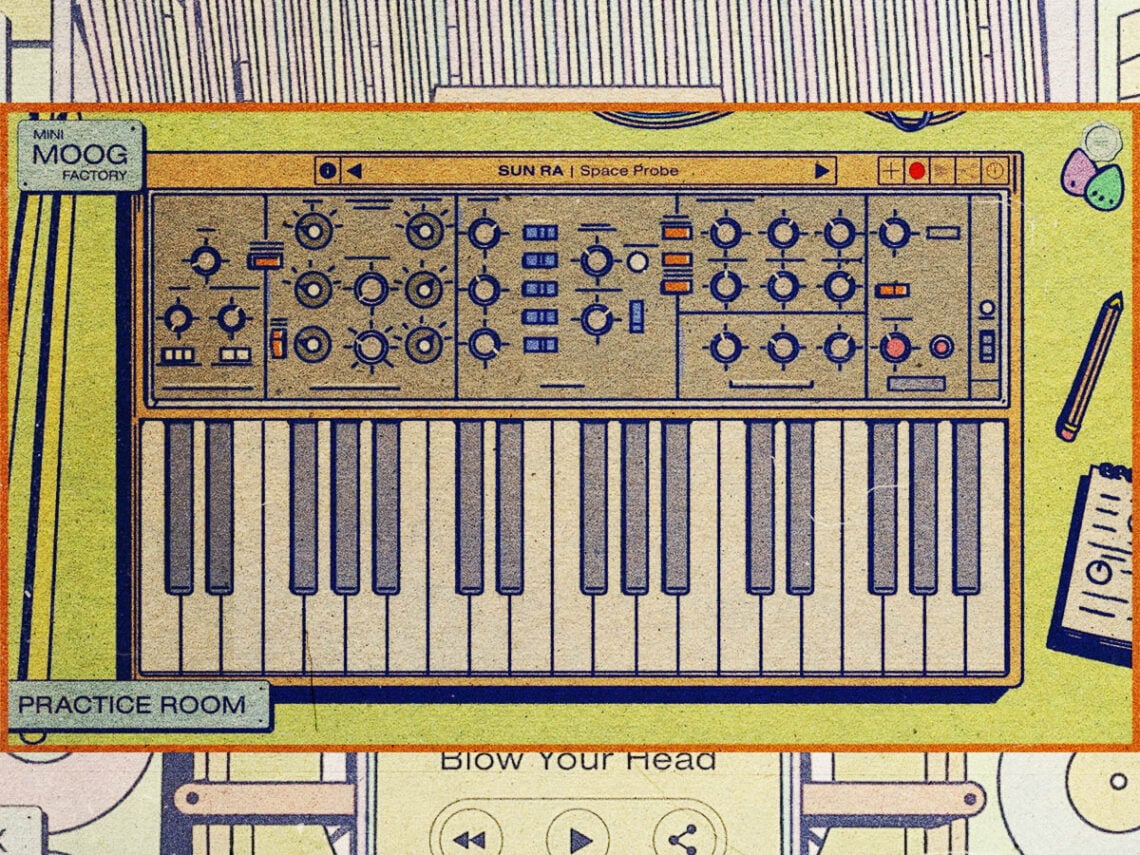
That development continues, and now to celebrate Moog’s continued contribution to music, they have created “a new web experience from Moog Music and Pentagram invites you to step inside the whimsical world of electronic sound with a virtual Minimoog Model D, online jukebox, and more fun for musicians and synth fans of all ages. Visit minimoogmodeld.com to tour the factory.”
Moog’s ultimate Model-D anthems:
- ‘Stir It Up’ – Bob Marley
- ‘Waka / Jawaka’ – Frank Zappa
- ‘And You And I’ – Yes
- ‘Jet’ – Wings
- ‘Daybreaker’ – Electric Light Orchestra
- ‘Space Probe’ – Sun Ra & His Arkestra
- ‘Beyond the Seventh Galaxy’ – Return to Forever
- ‘Autobahn’ – Kraftwerk
- ‘I’m Not In Love’ – 10CC
- ‘Dream Weaver’ – Gary Wright
- ‘Nights on Broadway’ – Bee Gees
- ‘Magic Man’ – Heart
- ‘Shine On You Crazy Diamond’ – Pink Floyd
- ‘Warszawa’ – David Bowie
- ‘Flash Light’ – Parliament
- ‘Roller Skating Child’ – The Beach Boys
- ‘Dukey Stick’ – George Duke
- ‘Chase’ – Giorgio Moroder
- ‘Are Friends Electric?’ – Gary Numan
- ‘Boogie Wonderland’ – Earth, Wind & Fire
- ‘Video Killed the Radio Star’ – The Buggles
- ‘While You See a Chance’ – Steve Winwood
- ‘Vienna’ – Ultravox
- ‘Whip It’ – Devo
- ‘Egypt’ – Kate Bush
- ‘Mr. Crowley’ – Ozzy Osbourne
- ‘Walking In the Rain’ – Grace Jones
- ‘Europa and the Pirate Twins’ – Tomas Dolby
- ‘Wanna Be Startin’ Something’ – Michael Jackson
- ‘Rockit’ – Herbie Hancock
- ‘People Are People’ – Depeche Mode
- ‘I Feel For You’ – Chaka Kahn
- ‘Sussudio’ – Phil Collins
- ‘Shake Your Rump’ – Beastie Boys
- ‘Head Like a Hole’ – Nine Inch Nails
- ‘San Francisco’ – 808 State
- ‘Sexy Boy’ – Air
- ‘South Side’ – Moby
- ‘Lovely Head’ – Goldfrapp
- ‘We Carry On’ – Portishead
- ‘Lotus Flower’ – Radiohead
- ‘Mysterium’ – Lisa Bella Donna
