


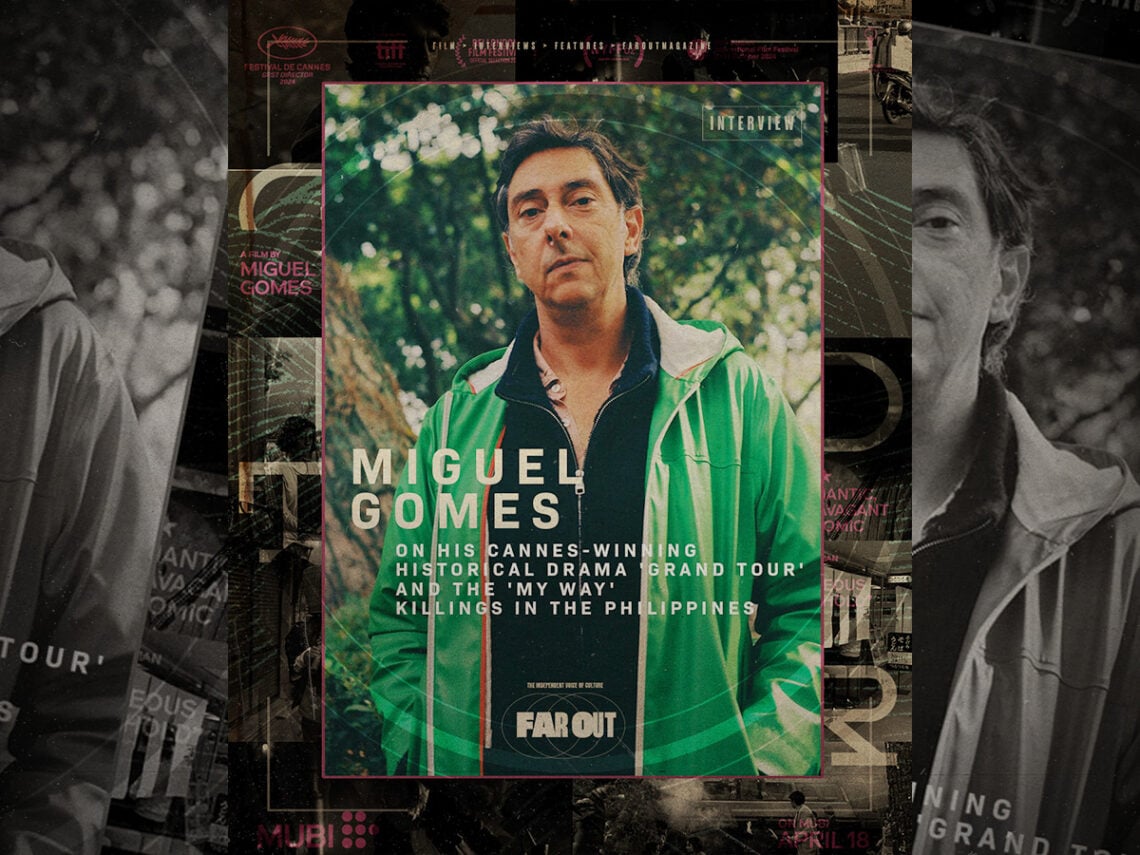
Miguel Gomes on his Cannes-winning historical drama ‘Grand Tour’ and the ‘My Way’ killings in the Philippines

“So, it’s a long story,” Miguel Gomes says, “I’ll try to make it short.” The Portuguese director is sitting in what appears to be his home office, sipping a glass of wine and puffing on a cigarette. We are discussing his film Grand Tour, for which he won the ‘Best Director’ award at Cannes last year and has just been released exclusively on MUBI in the UK and Ireland. What I want to talk about is a single scene in which a man at an empty bar in Manila belts out a Frank Sinatra song. It probably lasts less than a minute, but the fact that it takes so long for Gomes to explain how and why it came about is indicative of the immense work he’s put into the movie.
Grand Tour is partially set in 1918 and follows Edward (Gonçalo Waddington), a Colonial-era British civil servant in Burma who embarks on a continent-spanning journey to evade his fiancée, Molly (Crista Afaiate), who has just arrived from London to marry him. The first half of the film follows Edward’s ‘Grand Tour’ from Burma to Rangoon, Singapore, Bangkok, Saigon, Manila, and Osaka. The second half follows Molly’s journey as she attempts to trace his steps.
This black-and-white story is interspersed with modern-day documentary footage of the places where they land. Crowds ride ferriswheels, ride in jeepneys, and watch fireworks. It provides a glimpse into the post-colonial version of each location, the future that the characters in the fictional 1918 storyline will never see. To create these sequences, Gomes followed the ‘Grand Tour’ himself, filming what he saw along the way. From that footage, he created a travelogue before sitting down to write the script. As such, Edward and Molly’s stories are in conversation with the present-day visual journal, even if there is no explicit connection.
The documentary sequences may only take up a minute here and there, but they provide some of the most mesmerising and immersive moments in the film. Case in point, that scene in the empty Filipino bar in which a large man in an oversized t-shirt sits alone at one of the tables, picks up a microphone, and goes full Whitney Houston on a barnstorming rendition of Sinatra’s seminal classic, ‘My Way’. After completing that final, soaring note—vibrato included—he sits down again, wiping tears from his eyes. As an audience member, you might be moved to tears as well, even if you aren’t quite sure what you’re crying about.
So, what is the story behind that brief, showstopping scene? According to Gomes, it actually started years ago when his frequent director of photography, Rui Poças, told him what he thought was a lie. “Sometimes he tells strange stories,” the director says. “We are never sure if he’s inventing them.” This particular story involved a trip Poças took to the Philippines.

“He was in the bar,” Gomes says, “and there were these guys. They appeared to him with guns, and they pointed a gun to his head, and they asked him, ‘Sing ‘My Way’ in this machine, and if you get the highest score of 100, we’ll let you live. Or if you don’t do it well, we’ll kill you.'” Luckily, Poças passed with flying colours. Everyone was pleased, and no one got shot.
When he heard the story, Gomes didn’t think much of it, shrugging it off as his friend’s usual “bullshit.” Then, years later, he was reading the newspaper and saw a story that caught his attention. “So, apparently, there were these guys stealing [from] people, and they were obsessed with ‘My Way’, and so they robbed people in bars with karaoke machines,” he says, adding, “and, actually, they killed some people. They went to prison.” (All of this, by the way, is true. You can look it up).
So, when Gomes set his itinerary for his travels across Asia to make Grand Tour, he decided to kill two birds with one stone and settle his curiosity about that story once and for all. “I said, ‘Okay, let’s test ‘My Way’,” he says. “‘Let’s see what is happening here with this.'” He and his crew organised informal auditions with non-actors around Manila by putting them in jeepneys and having them sing whatever they wanted.
What he found was that even though the ‘My Way’ gang was behind bars (with 12 deaths attributed to them), the obsession with Sinatra’s songs was still going strong, as evidenced by the fact that the best singer chose that song for his audition. Gomes and his team arranged to meet him that night at a bar in the red-light district so that they could film him singing. “We got there, and he was already there drinking,” he remembered. “We put the camera, and he started to sing, and he started to cry.”
In the end, the director says, he didn’t actually get an answer to the mystery he’d set out to solve. He doesn’t know why that song has such a foothold in the country or why it’s the go-to karaoke song. “I cannot explain it,” he says, “But I’ve seen it, and it’s in the film.”
It’s easy to see how real-world experiences like this might lead to an inspired and unusual cinematic experience. Although the film’s central story about a man running from his fiancée through colonial Asia was derived from a few pages of a Somerset Maugham book, Gomes’s decision to incorporate the sounds and images of the present-day makes for a completely different type of historical drama.
Rather than drawing you out of the 1918 story, it adds wordless depth to the shadow of colonialism that hangs over the characters. It also contextualises a finite, melodramatic tale about unrequited love into the broader arc of the passage of time. Every vignette contains multitudes, but as a collective, they create that existential feeling of impermanence that can be both comforting and terrifying.
Grand Tour is now available to stream on MUBI.
