


‘Midwives’ Review: An eye-opening look at ethnic divisions in Myanmar by Snow Hnin Ei Hlaing

Midwives is the powerfully eye-opening debut feature documentary from Snow Hnin Ei Hlaing, shot over the course of five tempestuous years amidst the ethnic conflict taking place in the Rakhine State of Myanmar. As we follow the relationship between a Buddhist midwife, Hla, and her Muslim apprentice, Nyo Nyo, the film allows audiences to better understand the oppression facing Rohingya Muslims, who are denied basic rights and referred to as “terrorists” by the majority.
The film opens with beautiful aerial shots of fields and temples that are swiftly contrasted by images of a rough makeshift clinic, with young women laid on the floor, exposed to the elements, as they give birth with little pain relief. Here we are introduced to the outspoken yet determined Hla, whose clinic is the only place of care for outcasted Rohingya Muslims in the area. Throughout the documentary, Hla shows multiple sides of herself – sometimes laughing, caring, and making quippy statements; other times, she is genuinely mean, making racist comments towards her assistant Nyo Nyo. The documentary sheds light on the Rakhine State’s methods of indoctrination, showing images of anti-Muslim protests, and suggesting that even the most well-intentioned people like Hla can be swayed by their bigotry.
In an interview with Hlaing, she explained that it was Hla’s multi-faceted personality that drew her into the project. She said: “If she was just like Mother Teresa, I’d be so bored of the film after five minutes. But she lives with the contradiction. You can see racism creeping into the environment from the military propaganda, the media. And so people — including Hla and her husband — start to accept it.”
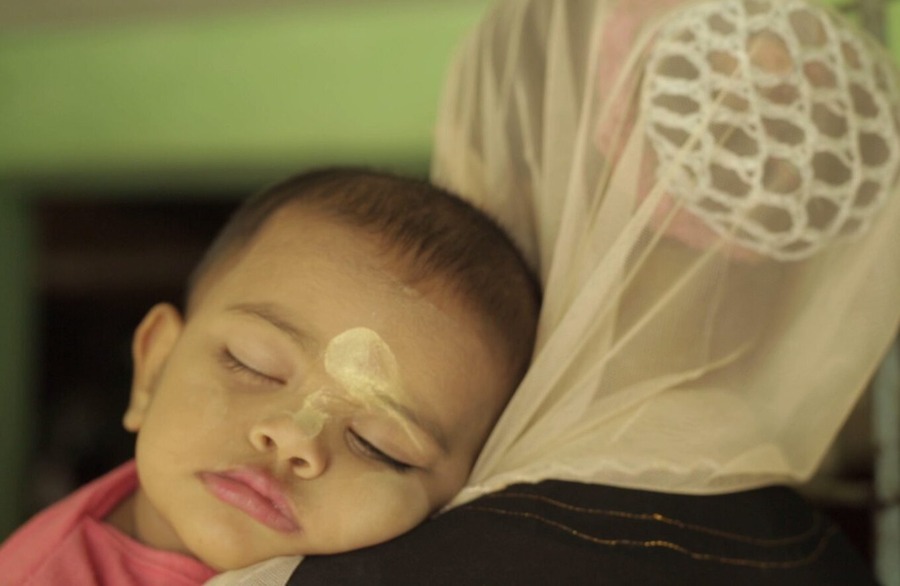
The camera casts a sensitive gaze toward the people of Myanmar, lingering on the documentary participants’ distraught, happy, or uncertain faces. Through the section of the film where Nyo Nyo seeks to open her own clinic with the help of savings and loans collective of other Muslim women, Hlaing offers a hopeful look towards the independence of Rohingya Muslims. However, of course, there is still a long way to go.
The film is often hard to watch. For example, Hla’s treatment of a woman who will die if she eats within the following three days is unnecessarily cold, yet Hlaing’s focus on the abuse received by Hla – just for treating Muslims – begins to explain the frustration that explodes under the roof of her clinic.
Hlaing allows her narrative to wander slightly. However, this almost always provides us with further insightful moments, such as an interview between the director and Hla’s ill mother, who stresses the importance of staying single. Furthermore, seemingly trivial scenes of the midwives shopping for clothes only aid our understanding of the complicated relationship between the two, who genuinely seem to care for each other.
The film seems to sag a little as Hlaing increasingly uses archive footage showing government officials and the military, which takes away from the strongest part of the film – the focus on emotions, desires, and oppression they face. With the momentum of earlier moments slightly fading, Hlaing’s film seems to get a little lost as it comes to an end.
Yet overall, Midwives stands as a relatively strong documentary that sheds a great deal of light on an issue that audiences probably know little about. At the film’s core is the hope for a sense of humanity to be recognised amongst people who really aren’t worlds apart, which is demonstrated by the relationship between Nyo Nyo and Hla, who, despite their ethnic differences, have a lot in common.
However, the film is most remarkable for its depiction of the crushing isolation experienced by marginalised people like Nyo Nyo, who can’t even access basic health care and give birth without facing oppression, suspicion and hatred.
