


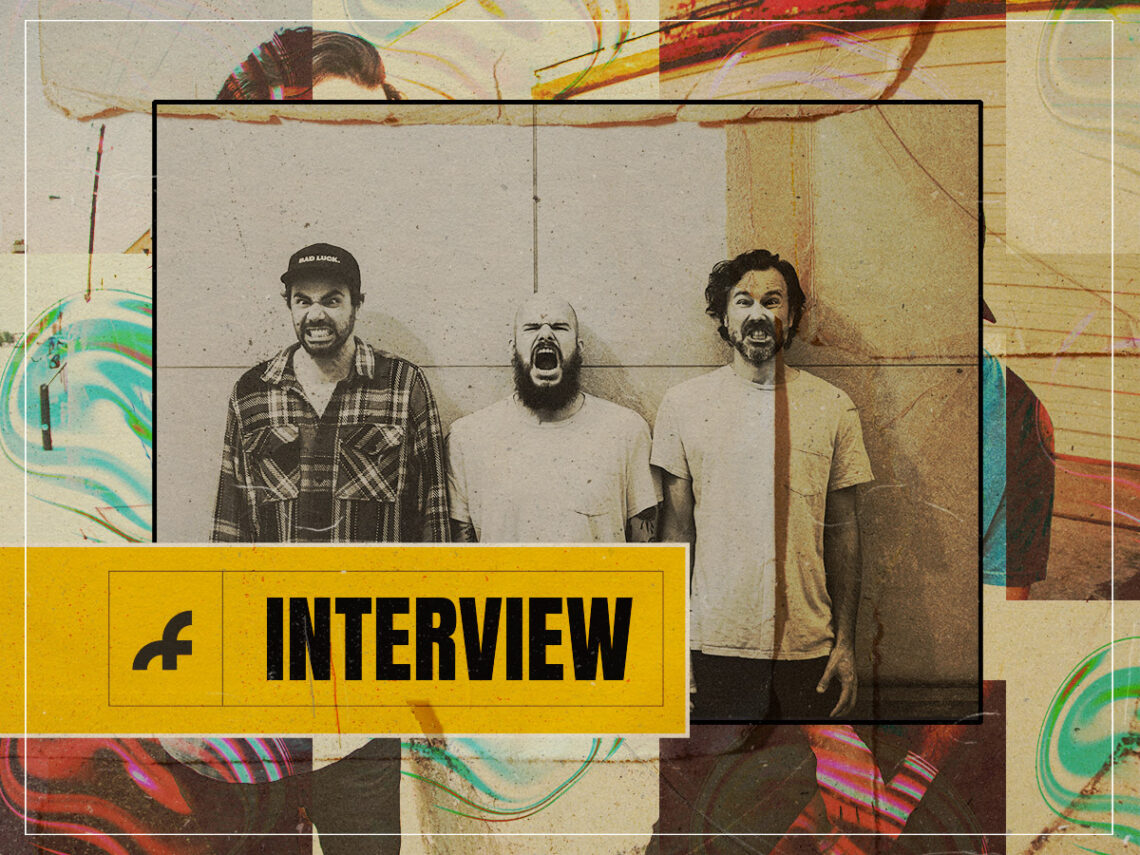
“Adopting this outlook will make the future much more tolerable”: Microwave on life and ‘Let’s Start Degeneracy’

After five years away, Atlanta trio Microwave return with their latest album, Let’s Start Degeneracy. Naturally, after such an extensive period of downtime, which has seen the pandemic and myriad other issues impress themselves upon life, the band we find on the new record differs from the one on 2019’s Death Is a Warm Blanket.
The trio’s sound has changed markedly, with them pushing into a new area that’s far more decompressed than the heavy post-hardcore twists that made them such fan favourites when they broke out. It draws on many diverse textures, such as ambient, psychedelia, trip-hop, and even Christian hymns, as the group seeks to break off from the past and write another compelling chapter. Given that such a change has been incorporated, the record Let’s Start Degeneracy will likely divide longtime fans, yet in the moments of sheer brilliance that the opus supplies, Microwave firmly assert just how masterful they are as songwriters, musicians and in the studio, with the production incredibly full-bodied for such a varied sonic composition. I get a sense that this is only really the beginning.
From Ayahuasca trips in Peru to a general commitment to championing happiness over self-doubt, in cutting a different image on the album, Microwave will likely appeal to a new breed of fans housed outside the emo-adjacent realm they inhabited for so long. Bold steps such as these often lead to a band’s longevity despite the requisite teething problems encountered at the outset of such a voyage. Furthermore, the authenticity and sentiment with which the trio have done it is undoubtedly a cause for celebration. It’s harder than ever to strike out on your own in contemporary times.
To mark their return, I sat down with frontman and guitarist Nathan Hardy to discuss Let’s Start Degeneracy more molecularly. Unsurprisingly, “it feels great” to be back, with Microwave ready to emerge from their “inactive rock cocoon” and “blossom into an active rock band once more”. Blossom is certainly an apt word in light of the new record’s highlights and the verdant South American vistas in which it was first conceived.
Given that their fourth offering marks the start of a new chapter, I wondered how it compares to its widely celebrated predecessor. Hardy was assertive in how they differ musically and philosophically: “It’s more chill and soundscapey. Death is a Warm Blanket was a more heavy punk, ’90s-influenced record. I’d say the new album is more modern R’n’B-influenced. We’ve still retained our rock roots and our love for big, loud rock sounds, though. The lyrics are more hopeful and positive than Death is a Warm Blanket was.”
Given the heady, electronic consistency that the new album establishes, it may come as little surprise to hear that the band were listening to a lot of Frank Ocean and his associates when making it, as well as the final two Mac Miller records, Swimming and Circles. Despite the heavily electronic-leaning flecks, guitar bands still took up some of Hardy’s listening time. He reveals that he loves the South London outfit Sorry and, perhaps more naturally, Big Thief, an influential group whose dulcet tones certainly can be heard at points in their latest sonic yield.

One of the record’s singles, ‘Bored of Being Sad’, explicitly distils this new concentration on letting go of the past and being happy, a process Hardy maintains is an ongoing “pursuit”. A wholly sincere number, for the frontman personally, wearing his heart on his sleeve so unashamedly also comes with its physical consequences outside of the pangs of the heart. “‘Bored of Being Sad’ was a cathartic one. The chorus is really high in my range, so I’m probably going to feel a little de-energised every night after we play it live,” he laughs.
I wondered if the liberation the group are striving for has opened them up to a future that appears different from the one they could have envisioned five years ago. In response, Hardy offered hope amid the bleak epoch the world is presently engulfed in. A smile on the face could be key to seeing the sunlight poke through the clouds, he suggests.
“I’ve always had a thread of hope that maybe I’m wrong about how hopeless everything seems to be. I’d say I’ve more been internalising that you can confront the challenges of your life, no matter how intense they are, with a smile on your face,” he states. “It’s all about developing habits that keep you smiling through the big, seemingly insurmountable life challenges, as well as through the day-to-day stressors. I think that adopting this outlook will make the future much more tolerable.”
For Hardy, the moments that stand out in the new effort are ‘Ferrari’, ‘Straw Hat’ and the glistening closer, ‘Huperzine Dreams’, with the lyrics and crisp production stoking a sense of artistic pride for the songwriter. He’s always wanted to delve into the world of hi-fi, modern R’n’B and put a unique twist on it, and has certainly done this with ‘Straw Hat’. It’s one of the finest numbers on Let’s Start Degeneracy, heightened by a spacey keyboard, an astute addition. He adds: “The lyrics on those songs really epitomise my current worldview, sort of like a manifesto.”
Offering another strand of hope for fans, Hardy concludes with a fitting piece of advice for budding artists: “It took me a long time to develop confidence and skills because I always felt the impending sense that the carpet was going to be ripped out from under me at any time and that pursuing my dreams wouldn’t ultimately be possible. I’ve wasted a lot of time in my life, pre-emptively feeling sorry for myself. I’d tell budding artists not to do that.”
