


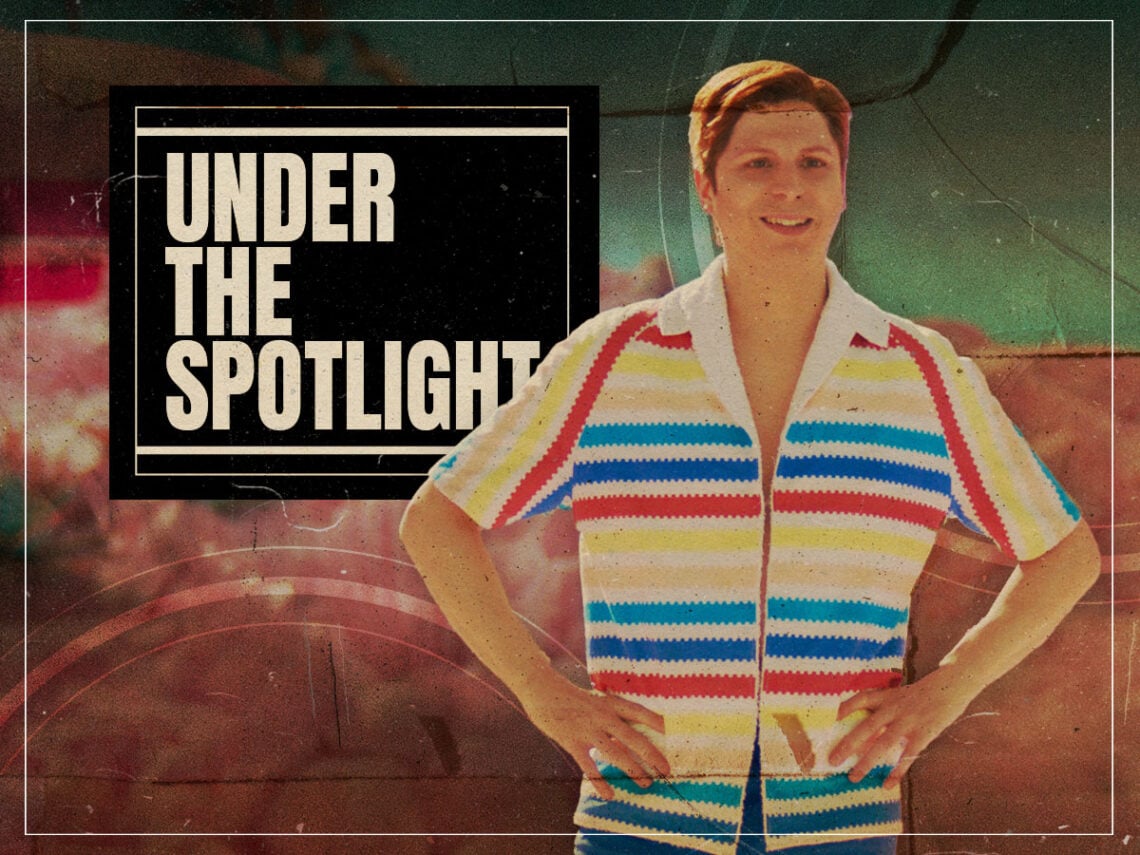
Under the Spotlight: Dissecting Michael Cera’s Allan in ‘Barbie’

One of the central conflicts of Greta Gerwig’s Barbie is the turf war between the Barbies and Kens, who battle for supremacy when Ryan Gosling’s plastic plaything returns from the real world and introduces his peers to the concept of the patriarchy, with poor Allan dragged into the war.
That creates a very clear societal divide that splits Barbieland straight down the middle, with the sole exception of Michael Cera’s Allan. He’s entirely in a class of his own, and while the part is tailor-made for the actor’s tried-and-trusted awkward schtick, the character exists for much more than comic relief.
It’s a very specific function that Cera performs within the context of Barbie, one that would never have been executed so well had original casting choice Jonathan Groff not turned down the role, never mind the eventual star revealing that he was supposed to be replaced by Ben Affleck during the climactic fight scene on the beach before scheduling conflicts arose.
Despite Ken transforming Barbieland into Kendom and attempting to subjugate half of its population, Allan sticks to his guns and keeps one foot firmly in either camp. He’s not quite a full-fledged Ken, as the name suggests, but he provides a sympathetic ear for the Barbies to establish him as a man without a country, torn between two factions he doesn’t really belong to either way.
As Helen Mirren’s narrator reminds the audience early on, there’s only one Allan, and he might well be the freest thinker Barbieland has to offer. After all, the Kens are all essentially extensions of the same core personality traits, something that also applies to the majority of the Barbies, but Allan is very much his own man, except he doesn’t really know what to do with occupying such rarefied air where similarity is what keeps the gears turning.
Allan is openly horrified by the encroaching threat of the patriarchy and stows away when Margot Robbie’s Stereotypical Barbie, America Ferrera’s Gloria, and Ariana Greenblatt’s Sasha try to flee. He’s been marketed as Ken’s best friend, and while that’s technically true, it’s only because he’s the only man in all of Barbieland who isn’t a Ken. The clothes fit, sure, but Allan isn’t too interested in trying them on for size.
It’s a simple message reflective of Barbie‘s overarching themes that applies to the real world just as much as it does the movie; not everybody is a Ken, nor do they have to be. There are other ways to survive and thrive in a macho society, with Allan becoming increasingly ruffled at the downfall of his idyllic home once the notion of a male-dominated ecosystem gets put into practice.
In the broadest sense, it’s Cera doing the things that Cera has been doing on-screen ever since he first shot to prominence with Superbad, but it works perfectly in relation to both the character, the overall film, and the message he’s being used to relate to the audience. Groff is perhaps too conventionally handsome and chiselled to have conveyed it anywhere near as effectively; one might even say outwardly Ken-ish.
In Cera’s hands, though, Barbie presents a viable and endlessly entertaining third option. In a world where everybody has been pre-ordained as either a Barbie or a Ken, why not try something different and be an Allan?
