


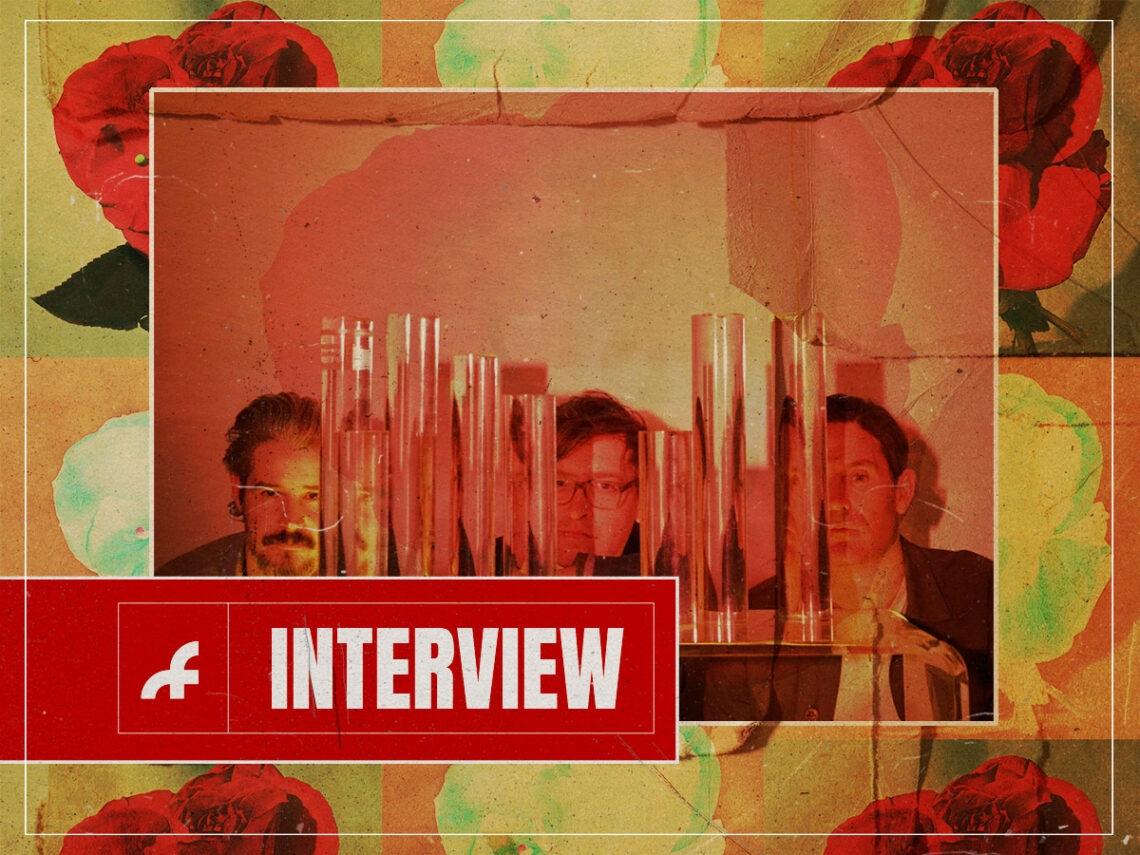
The metamorphosis of Metz: “It’s about pleasing us”

With their fifth album, Up on Gravity Hill, Metz move firmly into a new space and aren’t looking back. While a metamorphosis has been slowly bubbling away from the beginning, it was made readily apparent on 2020’s Atlas Vending that things were changing. Now, the sonic movement is undeniable, with them entirely breaking off from the past.
Whether it be frontman Alex Edkins’ constantly locomoting guitar work, his spirited delivery or the many compelling moments of symbiosis between bassist Chris Slorach and drummer Hayden Menzies, the artistic shift is a culmination of many musical variations. Engineer Seth Manchester returns from their last album, and helped the trio evolve once more. That growth affirms why there’s still a long and enjoyable road ahead.
As I settled down with Edkins over Zoom, ready to talk about the evolution toward the new effort, he seemed pleased with how the group have seamlessly taken the baton from Atlas Vending and used it to break the boundaries of their sound again. While all of their albums are exceptional, Up on Gravity Hill certainly feels different, given its expansive nature. Leaving behind their punky noise was a naturally nervous step to take, but it was one Metz had to make.
“It feels different to me, too,” he starts. “You know, it’s funny. To make something that you’re aware is embarking on new territory is an interesting feeling. It’s a great feeling, of course, but then you don’t want to disappoint people who have been along along with you from day one. So it’s this butterflies in the stomach kind of feeling I got.”
To Edkins, Up on Gravity Hill is a natural continuation of the October 2020 record. The presence of Manchester is one tangible connection. Regretfully, the pandemic ruined the cycle of Atlas Vending, sparking a period of downtime for Metz. However, when they reconvened, the engineer was there to help them dust off and continue on their artistic voyage.
“He’s never content to sit still. He wanted to push us as well,” Edkins says of Manchester. “All three of us were in that mindset where, after the pandemic and after the break, a lot of things had changed. I think we had changed, and we wanted to make a record based on where we were at that moment.” With a thick back catalogue and a long history, moving on from the past seems “makes sense.”
Atlas Vending is a brilliant album, but it simply arrived at the wrong time for Metz. Not being able to jump straight into the cycle of touring was a sucker punch that, for a time, changed the direction of their lives compounded by the restrictions of lockdowns. Edkins lamented that the trio poured “everything they had” into their last album and that being unable to fully promote it provided an unfamiliar haymaker from out of the blue that left them bloody-nosed.

He tried to write for Metz but couldn’t. The pandemic had thrown a “wrench in the gears” of the band, and the wind would take a while to return to their sails. Instead, Edkins tried his hands at other projects, such as the solo vehicle Weird Nightmare and the band Noble Rot that he started with Holy Fuck’s Graham Walsh. These outlets helped him keep the creative flame alive when Toronto was suspended under lockdown, and Metz was on hold. Nevertheless, as with all musicians stifled by the pandemic, the time away ultimately re-energised Edkins and made him “really excited” for the future of Metz and what it “could be”.
They could have dived straight into the studio as soon as restrictions lifted. Astutely, though, they knew not to rush things and to give it all space, as they were all undergoing a metamorphosis: “Everyone changed during the pandemic, so we came back with a different perspective.”
Part of being altered and revitalised individuals was that they were more unrestrained than before, never to take playing music for granted again. Before the pandemic, live music disappearing was unimaginable, but when it did, its power became fully evident. The uncertainty has made the group feel luckier than ever: “You try to take positives from any negative situation, and that’s definitely been it. It has felt like, in a weird way, starting new.”
Up on Gravity Hill is undoubtedly the most full-bodied Metz album yet. Kicking off with ‘No Reservation / Love Comes Crashing’, which steadily builds to a churning climax, it is a distillation of where the group now find themselves, an intersection of their past and present. Interestingly, the sweeping finale is underpinned by the cello and violin work of acclaimed Toronto composer Owen Pallett. Working with such a formative inspiration for the band was a big step forward and represents where they now find themselves. They also knew from the outset that they would “nail it and lift the song high”.
Metz have always existed in a liminal space, and this resounding opener demonstrates this. The group has never been concerned with the limits of tags and genre. From the outset, they have been whatever they want to be. Yeah, they’re punk, but the very essence of punk is defying your expectations.
Edkins asserts: “No question, it’s always gonna be that way. For better or worse, we are three people who play our instruments a certain way. We approach music in a way that is very indebted to punk, hardcore, and noise rock. That’s never going to leave us.” Those hoping for Metz to simply hit copy and paste on the music that made them famous will be disappointed. Metz “aren’t content to just make the first record over and over; as much as that might piss some people off, it’s really not about pleasing everyone. It’s about pleasing us.”
At points, the emotive chimes of his Jazzmaster bring to mind those of Swervedriver, adding a potent counterbalance to his more furious fretboard proclivities. Edkins considered this comparison a compliment, as the trio love the influential Oxford band.
“We’re not young guys,” he laughs before asserting that they’ve been drawing upon the gamut of underground music, SST, Creation, Dischord and the like, for years. It always exists in their minds and, naturally, is blended into one, but as a testament to how their new environment emerged, Edkins says, “We do what feels appropriate for the songs.” He adds: “There are no rules, and I think that’s important.”
The only context for Metz is the band members themselves, and that’s all that matters. Edkins chuckles again: “We’re stubborn,” he confirms, “I think it would be in our best interest to find a lane, stick to it, and build a fan base around it. We hope people come for the ride.”
Let’s be clear: where the Edkins, Slorach and Menzies find themselves on Up on Gravity Hill is not a surprise. It’s an arc that’s been underway since the beginning, and while people might have been slow to notice the changes, now there’s no denying that they are not the same band they were when they broke through in 2012. The new album is the most Metz yet, and it is exceptional because of it.
