


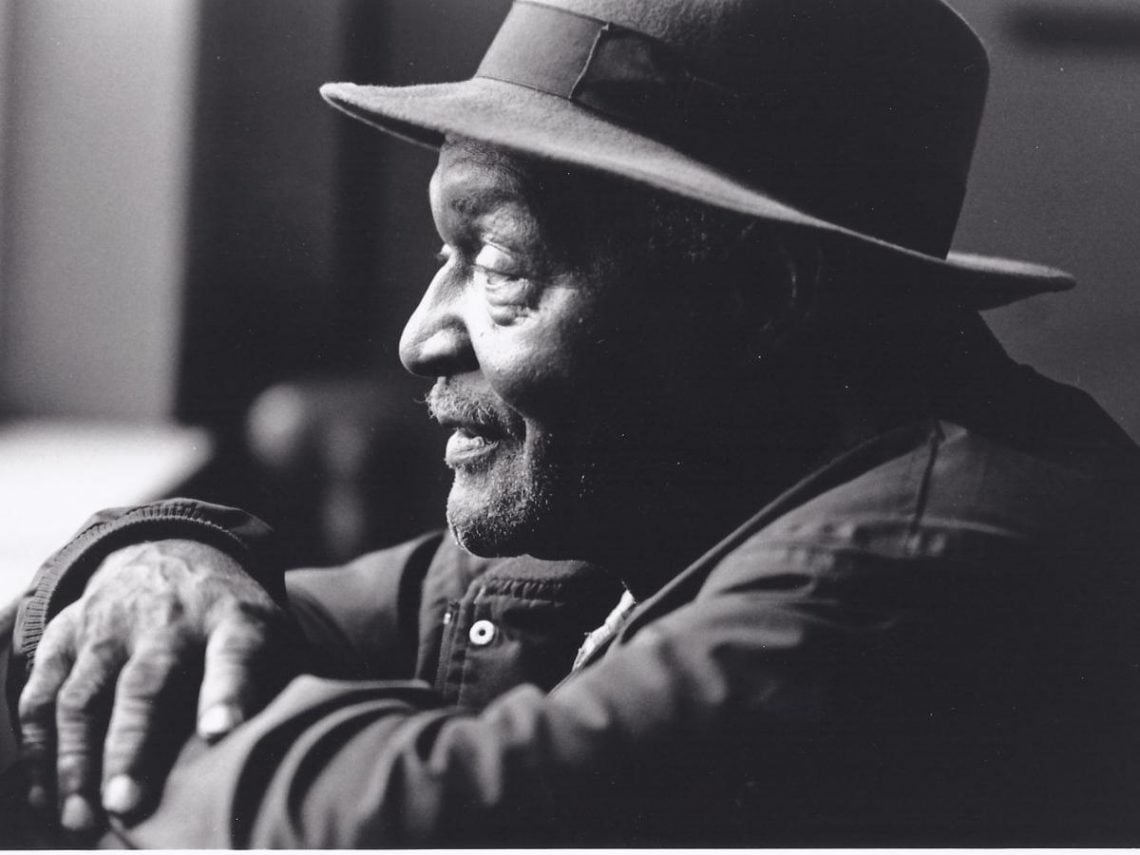
Memories of Uncle Jessie White

I have always lived in Windsor, Ontario, Canada. And being a fan of blues music, it was easy to take the bus which traverses underneath the Detroit River to the city of Detroit to see many of the iconic, even legendary, blues artists who played there. Many times they would take the same route to play in our own city. I am speaking of 30 or even 40 years ago. Still, I knew that an opportunity was being squandered. So many of these men were getting on in years, and I did not see that their stories were being recorded as they should.
I decided that I would interview as many as I could, and it is not false humility when I say that I knew then and maintain now that I am really bad at interviewing. I would ask where you were born? When did you start playing music?—that sort of on-the-surface stuff which never got into the real meat of a person’s mind and life. But I did what I could. It is with that skill set that I went to interview Uncle Jessie White at a bar where he played every weekend in Hamtramck, Michigan, just outside of Detroit. It was 30 years ago, in the fall of 1992. I published the results of that interview in the newsletter of the Detroit Blues Society and in issue number nine of Blues Review Quarterly (summer 1993). My skills at interviewing were equally matched by my skills at writing up these talks. I now realise that I omitted the very best moments and observations out of embarrassment or a needless fear of offending someone else. Here, then, are the leftovers, which are, in fact, the crème de la crème of those conversations.
An amusing and even startling moment occurred when I asked Uncle Jessie which musicians he had a chance to see when he was growing up in Mississippi in the 1930s and ’40s. He remembered seeing Muddy Waters and Howlin’ Wolf, he recollected two fellows known as the Patterson brothers, and he really likes a travelling musician named Tommy Johnson — he played a song called The Big Road Blues. I was pleased that Jessie had known Tommy Johnson. Jessie, for his part, was surprised that I had heard of Tommy Johnson. Sure, I said; he sang the Cool Drink of Water, Canned Heat, and Maggie Campbell.
Jessie gasped. “How do you know Tommy Johnson?”
“Well, from his recordings,” I replied.
“Tommy Johnson cut a record?” he replied.
Uncle Jessie had not bought a record or listened to blues programming on the radio since the 1940s. He was unaware that this musician he admired had been recorded 60 years earlier! This, however, meant that Jessie’s music was as unadulterated as it was possible to be for fans of early blues piano playing.
I now know that it is standard protocol for camera operators not to stop filming just because things may not be going according to script. I suppose this admonition could be applied to interviewers with tape recorders also. I was speaking to Jessie in an unoccupied back room of the bar where he played (The Attic) when a very drunk young man entered and saw that there was an interview going on. He began yelling: “Hey Jessie! Uncle Jessie! I got a question for you. You old, Man! Was you a slave? You old, Jessie. Was you a slave?” I reached over and shut off the tape recorder until we could get back to the real questions. But Jessie sat back and mused: “Was I a slave? Was I a slave? Now, let me see. I remember working can to can’t.* I picked cotton, ploughed mule, drove a tractor. I lived in the same shack that slaves used to live in. Never had any savings or anything to call my own. I really can’t say if I was a slave or not!” I later learned that the young man was Jessie’s son-in-law. I, as a young white man, could never be so bold as to ask similar questions of “old” Uncle Jessie, but these are precisely the moments which get to the true soul of the interviewee.
Uncle Jessie White remained unrecorded until Blues Factory records of Detroit issued a 12 song CD in 1991 under the title ‘Uncle Jessie White and the 29th Steet Band’. At that time, a popular Detroit DJ of a blues radio programme, who often played Jessie’s music, would only refer to him as “Mister” Jessie White. A few people asked me why that was, and perhaps, there are many today who would not understand. For a long period during slavery in the US and also after, the elderly workers who were moved to the white peoples’ houses to work as domestic servants were referred to as “Aunt” and “Uncle”. These white people may have had some pangs of conscience about the confinement and forced labour of their “help” and so eased their consciences with the fiction that “we are all like family.”
This historical precedent is the reason that the Uncle Ben and Aunt Jemima products have only recently changed their names. So, it made me wonder why Jessie White chose the moniker “Uncle”. I asked him one day how he got that title. He told me that in the 1960s, blues music was in steep decline in Detroit, what with Motown and soul on the upswing. With that, many of the musicians were out of work, and Jessie’s house became a gathering place every Sunday afternoon for any blues musician who wished to join in and play together. The only problem was that the house was full of Jessie’s nephews and nieces who needed regular attention. They would come running in: Uncle Jessie, I want this, Uncle Jessie, I need that. The other musicians would laugh and say: “Uncle Jessie, can you sit down for a minute? Uncle Jessie, can we play one now?” So the name stuck, and everyone called him Uncle Jessie for that time.
In the blues, we have many Sons and Sonnys, we have Mas and Mamas and Papas, we have Brothers and Sisters, and even one Cousin (Cousin Joe from New Orleans). Surely there remains room for one Uncle? Especially since the name applies so well to Uncle Jessie. He is a man who wanted to travel north but remained in Mississippi to care for his aged parents until they passed; he quit music for years when his children were young, and he had to work long hours and again to care for his dying wife. He was a man who always put family first in his life. So, who better to be called Uncle?
Uncle Jessie left this world in 2008, but his fantastic music remains. Those interested can hear some of his songs on YouTube and elsewhere on the internet. It was a pleasure to know him. May he rest in peace.
* A common expression among indentured servants in the Southern United States. It refers to working from the first light of day (when you can see) until dark (when you can’t).
