


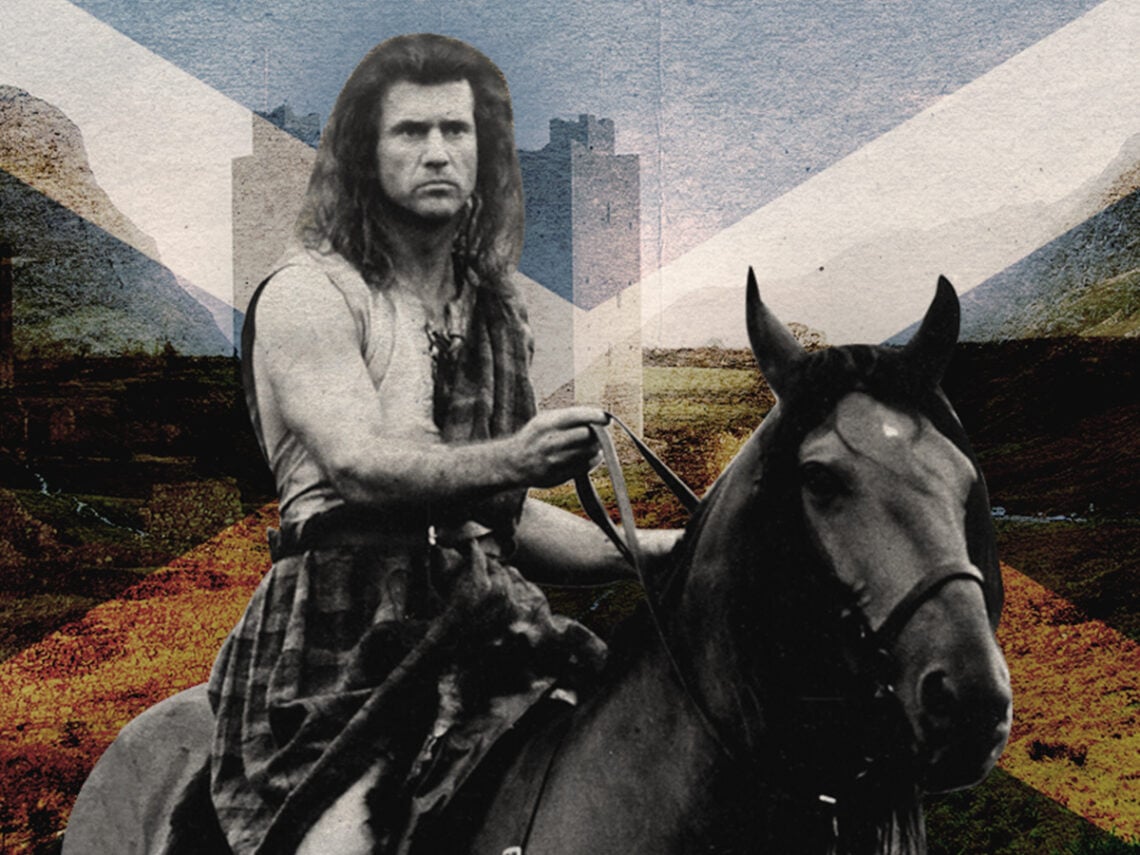
Mel Gibson – ‘Braveheart’

In 1995, Mel Gibson crowned his vendetta against the English – perhaps a by-product of his teenage years spent in Australia – with the epic historical action film Braveheart. The movie, which Gibson also directed and produced, sees the American actor portray Sir William Wallace, the legendary Scottish warrior who led Scotland in the First War of Independence against the English and King Edward I in the late 13th Century.
We begin with a young Wallace witnessing the execution of several Scottish nobles after King ‘Longshanks’ Edwards invades Scotland and Alexander III dies without an heir. Wallace’s father and brother die defending themselves, but Wallace is hurried away from the scene by his Uncle Argyle, who takes him on a European pilgrimage.
When Wallace returns to Scotland many years later, he’s about as ripped as humanly possible in the 13th Century – and as gorgeous too. He’s also well-educated and cunning, and it’s not long before he falls in love with his childhood sweetheart Murron who he weds in secret ‘neath the moon. However, Wallace gets even more fuel for revenge against the English – whose noblemen Longshanks has given land – when Murron is publicly executed after he saves her from being raped by their soldiers.
A rebellion begins with Wallace at its centre; he beats back the English garrison and sends them packing back to their king. Word of Wallace grows, and several clans from across Scotland join the fight back. Several violent and bloody battles ensue with persistent calls for “freedom!” from the Scottish and Wallace in particular, and the legendary freedom fighter cements his place in the annals of history.
There’s a reality about Braveheart that other historical epics sometimes lack. The Scots are dirty and downtrodden, Gibson’s hair a messy mullet, and there’s a general air of believability about the entire offering. So, too, are the battle scenes some of the greatest ever committed to film and perhaps some of the best since Akira Kurosawa’s Seven Samurai, only now with a generous Hollywood sheen added for good measure.
Simultaneously, however, there’s a touching air of myth, of fantasy, of magic about Gibson’s Scotland, whether it be the glittering moonlight cast down on Wallace and Murron – and later Isabella of France, initially sent to distract Wallace from his true plight – or the glorious Celtic soundtrack, rife with equal moments of fierce battle motifs or tender flute pieces.
In one light, though, there’s a slight sense that perhaps Braveheart is really just about Gibson, his muscular physique and his undoubted machoism. After all, this film has Gibson producing, directing and starring. Then again, every great movie needs its star, and in Gibson, Braveheart certainly has it. He can deliver a rousing speech as though he were performing in a Kenneth Branagh Shakespeare but can turn on that Hollywood romantic energy when necessary, all the while portraying Wallace as the Scottish cheeky, yet rebellious, chappy that he truly was.
Braveheart is a glorious film, and even though the audience may roll their eyes at the occasional over-gratuitous Hollywood nature of the scenes, there truly is an exploration of the things that humankind has treasured since the dawn of civilization: love, freedom, justice, vengeance, camaraderie, one’s country, one’s place. It would be foolish to say that Gibson has not delivered a feast for the eyes that rouses one’s inner anger at injustice – and, in a way, colonialism – and his Braveheart is undoubtedly one of the most significant historical epics ever made. In the world of film, Braveheart is just about as legendary as its rebellious protagonist.
