


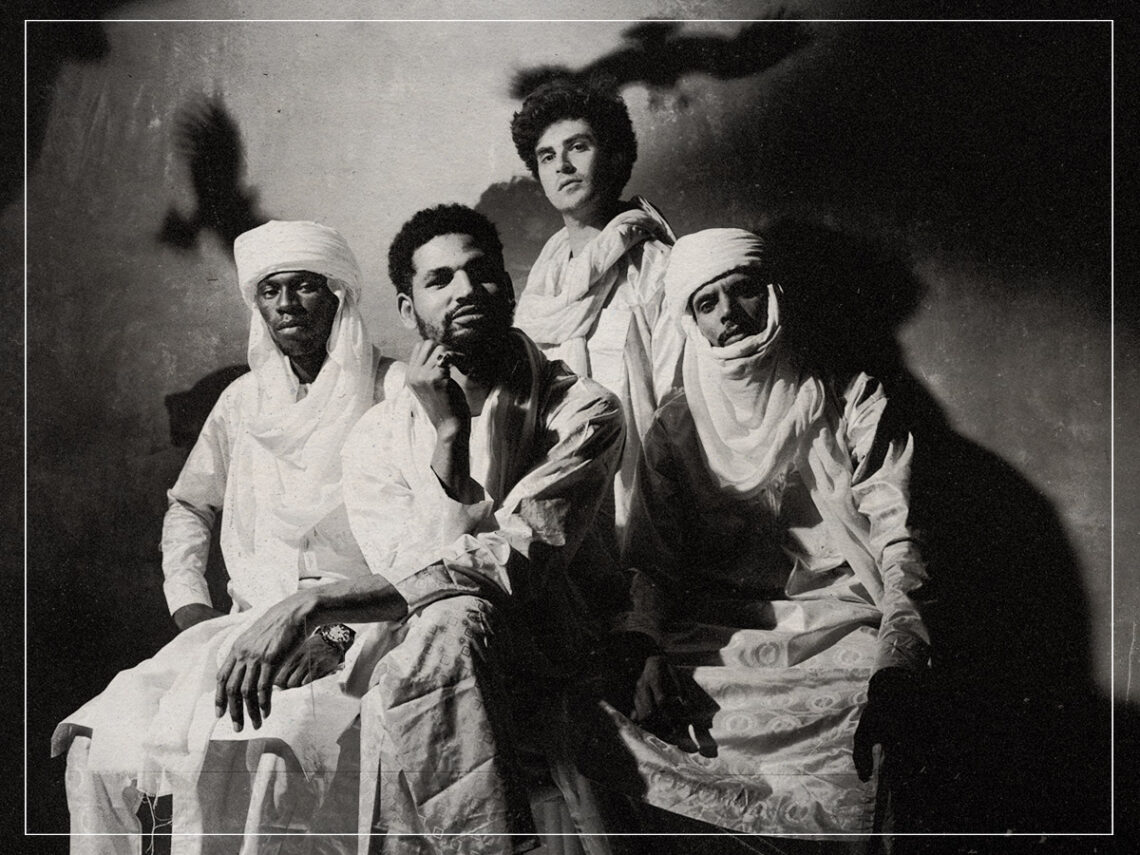
A collection of Mdou Moctar’s favourite records

Their sound comes weaving forth in a heady haze, like the mirage from the sands of their homelands. Mdou Moctar, hailing from Niger, are one of today’s finest bands. Searing guitars and a unique arpeggio approach to psychedelia typify their captivating sound. However, as their favourite records convey, their inspirations and influences are universal, capturing a culture in transition.
This beauty is born from a brutal truth. The EIP estimates that by 2050, 1.2 billion people will be displaced by climate change. The worst affected areas will be places already on the brink of climatic extremes, like Mdou Moctar‘s Saharan homelands. Resource scarcity and economic hardship in the area have already proliferated power grabs by Al Qaeda and ISIL, both of which have enforced Sharia law in seized regions of neighbouring Mali, making music for the purpose of entertainment a crime punishable by death.
This brutalism is at odds with the traditions of the Tuareg people, who once roamed there freely—their nomadic lifestyles were shaped by the harsh and unforgiving environment but existed in harmony with it. Mdou Moctar, who himself travelled from Abalak to Tchintabaraden and Arlit in his youth, embodies the inherent resilience of his culture through his music. It echoes the ancient rhythms and melodies of his Tamasheq-speaking ancestors while also serving as a form of defiant resistance against the insidious forces threatening his homeland.
This is blended with an array of modern influences from across the globe, showcasing how the music is now assimilating beyond its traditional borders without losing any of its individualism. There is as much punky jazz of Luke Stewart in their mix as there is Tinariwen. This makes for a potent blend that looks at the injustices of the world with shimmering desert blues solos and sweet indie structures.
As Mdou Moctar said of Amadjar, the Tinariwen album that helped to bring the genre to the world: “I find it very moving—the composition is very poetic and rich with meaning. The messages are very important; they’re quite revolutionary. I listen to it a lot. It makes me feel free and, when I am travelling, reminds me about who I am, that I come from the desert, and to be proud of that.”
But as for how that sound now embraces a wider assortment of sounds, he also heaped praise on Superwolf by Matt Sweeney and Bonnie ‘Prince’ Billy, telling Bandcamp: “I was incredibly touched when Matt Sweeney wrote to us to play on the new record. I learned a lot. I am not used to playing that way, but it was not as if we were recording; it was if we were having a jam with friends—dancing, not stressful. They were really supportive and very nice about the fact I had jet lag—as you Westerners say—and ended up sleeping all the time during my visit. They said, ‘It’s no problem,’ and encouraged me to rest.”
This life on the road has become a new, fitting extension of his culture. It is a nomadic way of keeping the Taureg ways alive in a different way. And it is a joy to behold. The record that helped to embody this for the guitar wizard was Anou Malane, who commented: “I listened to this a lot as a child. It mentions the deaths of many Tuareg people, courage, strength, freedom, surviving for months with little water. It’s about warriors who prefer to die in combat than give up on freedom. It moves me, makes me think about my brothers who died in rebellion, about my family and the hardships of life in the desert”.
Mdou Moctar and Mikey Coltun’s favourite albums:
- Jo Kanga Djiribi by Super Onze *(not on Spotify)
- Superwolf by Matt Sweeney and Bonnie ‘Prince’ Billy
- Amadjar by Tinariwen
- Anou Malane by Abdallah Ag Oumbadougou
- Exposure Quintet by Luke Stewart
- Room for the Moon by Kate NV
- Primrose Path by Curved Light
- Kubali by MC Yallah x Debmaster
