


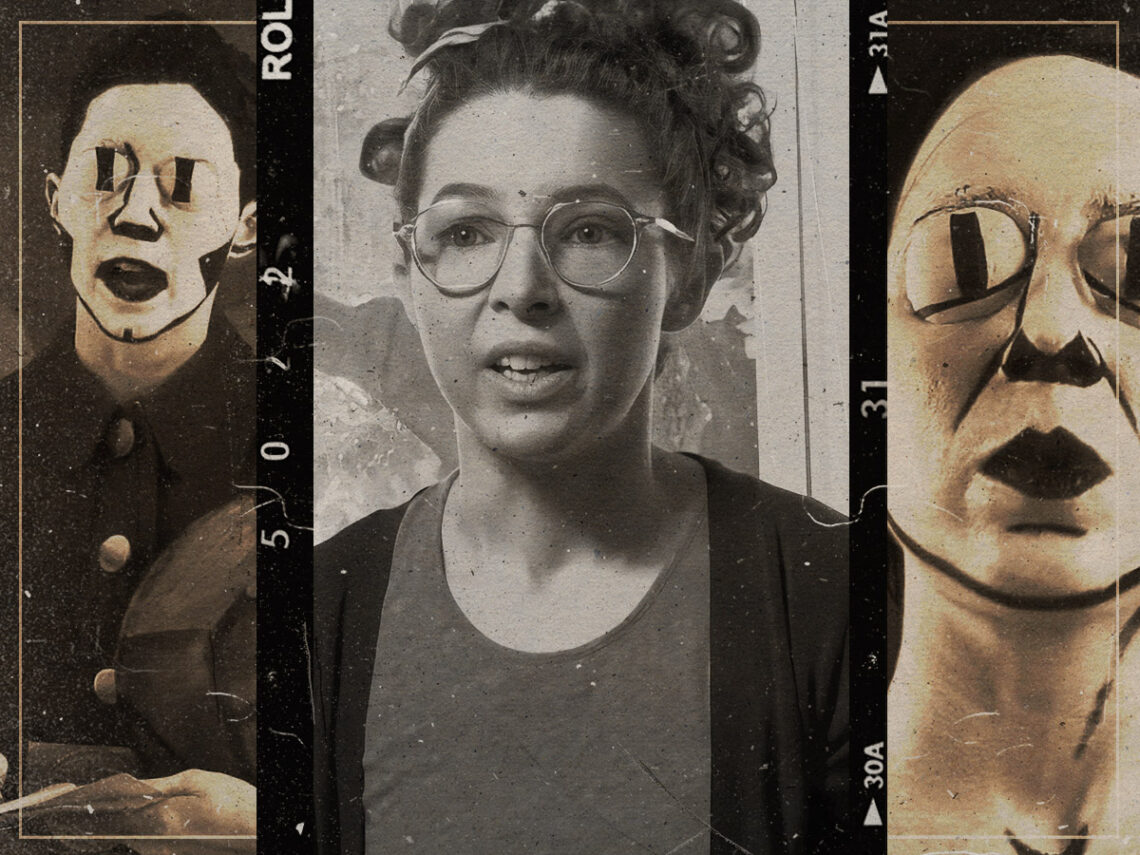
Mary Reid Kelley: Reanimating wartime history through visual art

When you leaf through history books about wartime, a lot of humanity is lost to cold facts. Real people’s stories – their heartbreaks and anxieties – get lost to statistics, and that intrigued American artist Mary Reid Kelley. When studying at Yale, she poured over the archives, looking at the material left behind by old students who had to leave during World War One. Kelley realised that even amidst the chaos of imminent war, these students valued art, poetry, and personal relationships.
But as a natural consequence of wartime coverage, Kelley found that the female experience was massively overlooked. While war poets like Wilfred Owen and Robert Graves were rightly revered for their work, scores of women who suffered through the same atrocities had their art forgotten. In a bid to rebalance the scales, Kelley’s first four films featured female protagonists, following wartime prostitutes, nurses, and factory workers, embellishing their lives with the same focus usually reserved for male figures.
Reflecting on her female focus, Kelley told ExtraExtra she had been learning more about the “cultural context” of war. She found herself increasingly preoccupied with the stories of First World War soldiers after doing text rubbings at Yale’s War Memorials. “I started really thinking about them a lot,” she said, “eventually I began writing these nonsense poems in the character of the soldiers and of the women they were involved with.”
While the female perspective is a constant, her style draws from a varied pool of influences: German Expressionism, surrealism, animation, and black-and-white cartoons. Her films are humorous but always created with the quite serious aim of elevating women’s voices. What often undercuts her scripts is a sharp satire, where Kelley will borrow from historical and literary references and then skewer them.
Take the Sopwith Camel as an example. It was a First World War-era biplane, a famous aircraft that flew into the Western Front in 1917. Kelley somehow took this idea of a fighter plane that downed 1,294 enemy planes and transformed it into a love interest for a soldier in one of her films. “That was the first video that we did,” she recalled. “It was called Camel Toe, which is a play of course, on the Sopwith Camel – a famous English plane from the First World War. ‘Camel Toe’ is supposedly the name of his girlfriend, who’s a ballerina.”
Kelley had the idea after reading about a pilot killed in 1918. She’d read a bundle of letters written between him and his sweetheart and then wrote a poem informed by his voice. “In the films,” she explains. “Language comes first chronologically – I know the voice of the character before I know what they look like.”
Kelley will take a few months of the scripts, and the visual world blossoms from them. “I have to think really long and hard about what the script is, but then the visual part just presents itself at the end.”
