


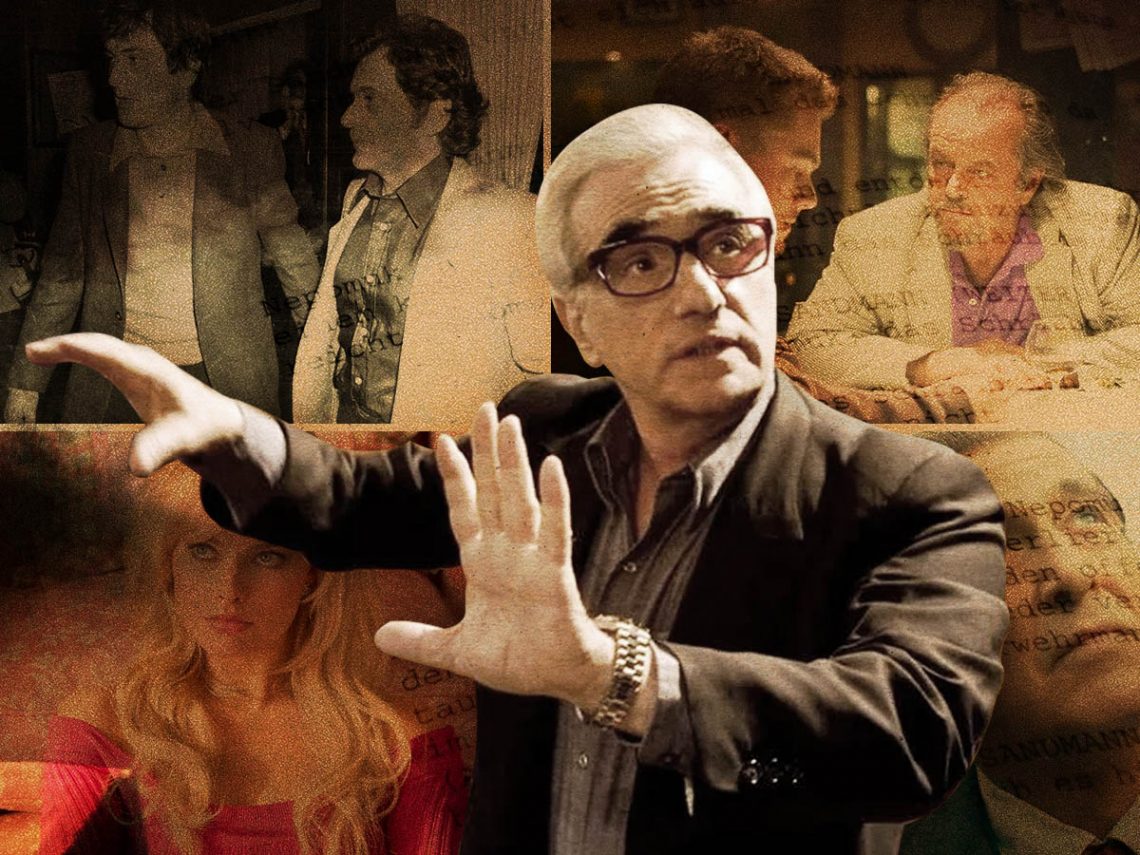
Martin Scorsese at 80: A Hollywood icon in the words of his admiring collaborators

This week, we celebrate the 80th birthday of one of Hollywood’s finest filmmakers since the dawn of the medium, Martin Scorsese. The New York-born filmmaker has sculpted a career like no other through his knack for depicting gritty, noir narratives, often centralised around the violent lives of machismo-leading men and their descent into a life of crime and nihilism amid burning tension. The perfect man for such roles has invariably been Robert De Niro, an actor who helped establish Scorsese’s aesthetic and salient ongoing career in a fruitful symbiosis. Beyond this associated style, however, Scorsese’s versatile talent has encountered very few bounds over the past 50 years.
Scorsese made his directional debut in 1967 with the Harvey Keitel-starring independent drama Who’s That Knocking at My Door at the age of 25, which earned him recognition at the Chicago Film Festival. He had sharpened his curiosity into something acutely applicable over the early 1960s as he studied for his filmmaking MA at New York University and made his presence known almost instantly.
A canopy climb through the late 1960s and early ’70s saw Scorsese return to the university to teach a class for undergraduate film students. His first major directional accomplishment came in 1973 in the form of Mean Streets, a feature which saw Keitel’s return, this time alongside De Niro. Mean Streets’ successful formula of perverse realism and an unfiltered reflection of inner-city life was brought to its climax in 1976 with the release of Scorsese’s magnum opus, Taxi Driver, starring De Niro and Keitel, this time with the former as the leading man.
Taxi Driver also marked the triumphant beginning of Jodie Foster’s career. At the time of filming, Foster was just 13 years old, and since her role was that of Iris, an outspoken child prostitute, Scorsese had to ensure a strong bond of trust with both her and her parents. In reflection, Foster has detailed how nurturing Scorsese and De Niro were, despite some bouts of giggling from the director.
“When we were shooting Taxi Driver, I think Marty was really uncomfortable with the fact that I was so young,” Foster remembered in a 2011 conversation with Harper’s Bazaar. “The memory I have is of him and Robert De Niro trying to tell me how to unzip [De Niro’s] pants. And Marty keeps bursting out laughing. He can’t get a word out, and he tries to act serious, you know? He keeps smoothing down his face on both sides, but he just keeps laughing. And then De Niro decides he’s going to take over because he can do it.”
“The Marty that you usually see on the set is a guy who’s talking a million miles an hour and giggling like Muttley, that cartoon dog,” she continued, revealing Scorsese’s playful sense of humour and professional drive. “He has all these references, and he’s continually tucking in his shirt. When we worked together, he had this crazy moustache too. But on that film, I also saw him as an actor—a different side of him. He was very frenetic and fast-talking, the way he is now, and just incredibly excited about life. He’s just adorable from the beginning to the end. And when I see him now, he’s adorable. Even though his black eyebrows are grey now and he wears a suit, he still is.”
Over the 1980s, De Niro and Scorsese formed a particularly tight bond, together furnishing a cosy corner in film history over the final two decades of the 20th century. New York, New York, Raging Bull, The King of Comedy, Goodfellas, and Casino followed Taxi Driver to seal an already timeless partnership in film. “I consider myself very lucky to have that long of a relationship with [Scorsese],” De Niro told People magazine in 2020. “I can’t imagine my life without it.”
“Marty is very sensitive about people and actors,” he added pensively. “He takes what actors give him and uses it. He is aware and well-informed about things and likes to read stuff. Directors have to be well-rounded in many facets of life. He’s really great.”

Italian-Americans like De Niro and Scorsese are well-known for their strong sense of family. Once bonds are made, they take a great deal of strain to sever. As a movie fanatic, there’s little so heart-warming to see than a working relationship that grows into a family of sorts over the years.
In the early 1990s, De Niro was hired to co-star in Michael Caton-Jones’ film-adaption of Tobias Wolff’s memoir This Boy’s Life. During this production, De Niro was introduced to the fine acting talents of a teenage Leonardo DiCaprio. Despite the pair’s violent on-screen father-son relationship, the pair established a bond of mutual appreciation off-screen.
As we all know, DiCaprio became Hollywood’s most promising pin-up over the 1990s after appearing in romantic dramas like Baz Luhrmann’s Romeo + Juliet and James Cameron’s groundbreaking Titanic. Moving into the new millennium, appreciative of his oeuvre as he was, DiCaprio was on the lookout for roles to shed him of his romantic hero image.
Fortunately, DiCaprio had De Niro as one of his mentors, who introduced him to Scorsese ahead of 2002’s Gangs of New York. “I got into this business because I worked with Robert De Niro, so I wanted to see everything he had ever done, and that led to this guy called Martin Scorsese that he had worked with a lot, and he is basically the greatest director around,” DiCaprio once told New York Foreign Press. “I became a huge fan of their movies, and ever since I was 16 years old, they have been my mentors, my icons and my heroes in the business.”
Following the success of Scorsese’s Gangs of New York, in which DiCaprio starred alongside Daniel Day-Lewis, the filmmaker took DiCaprio under his wing as he had done three decades prior with De Niro. This new partnership would boast a run of highly successful and thematically diverse films, namely The Aviator, The Departed, Shutter Island and The Wolf of Wall Street.
“From the type of movies he made, I was developing an idea of who he was, this really intense, maniacal, overbearing, moody, dark director, that would be really intimidating to meet,” DiCaprio told New York Foreign Press of his initial character assessment of the legendary filmmaker. “But when you finally meet the man, you realise that he is completely and utterly obsessed with cinema, and these are the type of people that make great works of art because they love the world of cinema so much that, when they finally get an opportunity to direct something, all that knowledge and all that passion, all those hours of seeing and studying films, show up on the screen”.
DiCaprio added: “And you see that he’s not trying to draw from hundreds of other directors, but he’s recreating cinema, and that’s what makes him a master. You have to be completely in love with what you do, to live and breathe your art form, and that’s what’s so inspiring about him.”
From hearing a handful of character assessments, one can comfortably derive that Scorsese is both intensely professional and headstrong but also eminently respectful and sensitive, with a side-order of good humour.
“You expect a matador, but you meet the poet who wrote about the bullfighter,” British actor Sir Ben Kingsley remembered in conversation with Harper’s Bazaar. “Marty cares deeply about fellow humans. If there’s a crisis in your life, he’ll talk in a responsible, compassionate way. He directs like a lover … a tough lover. A lover is supposed to know you, understand you, anticipate you, watch you closely. It’s like being held in a really taxing, demanding, but then loving embrace. I love to hear Marty’s laugh. Often on set, he’s in a black tent, he gives notes, and he goes back. To hear his laughter coming out of the black tent is something.”
On top of his well-balanced demeanour, Scorsese is a true workhorse and takes much pride in his attention to detail. “When we did Gangs of New York, he knew everything about that time in history: where did these people come from, why did they come here, who they are,” Cameron Diaz told Harper’s Bazaar.
This assiduous attention to the finer threads made Scorsese the only suitable candidate when Olivia Harrison, the wife of George Harrison, was considering filmmakers to document the former Beatle’s life. In 2011, Beatles fans were treated to Martin Scorsese’s George Harrison: Living in the Material World, a three-and-a-half-hour film consisting of exclusive interviews and archival footage that tells the story of the “Quiet” Beatle’s remarkable journey.
Olivia and Dhani Harrison warmed to Scorsese as they sought a director who could document his spiritual journey as well as his life as a rock ‘n’ roll icon. They wanted someone who would delve into the very heart of the man himself rather than displaying a half-baked reel of career highlights.
“George’s outer life was well known, and that would be an easy thing to do. You could put together that story, but the inner life was going to be impossible,” Olivia said in a statement at the time of the film’s release. “And I knew how deeply George felt about certain things in life and what he was trying to achieve, and that letter from a very early age was just a seed of what he was thinking”.
Adding: “That at the very pinnacle of the young, early career of The Beatles, there was something telling him that this was not going to fulfil him. I think I was hoping that that’s what would happen [with the film] and that’s what Marty tuned into.”
Impressed with Scorsese’s work on the 2005 Bob Dylan documentary, No Direction Home, Olivia ultimately chose the American filmmaker to tell George’s story. “Somehow, I ended up meeting Martin Scorsese, and he had a very definite idea about the story,” she remembered in conversation with Catherine Jones of the Liverpool Echo.
“Spending time with Olivia, interviewing so many of George’s closest friends, reviewing all that footage, some of it never seen before, and listening to all of that magnificent music – it was a joy, and an experience I’ll always treasure,” Scorsese added. “The closer I looked at his life and his career, the more I was drawn to him and to the way he coped with and learned from the peaks and the valleys. I think he eventually came to understand the ephemeral nature of both success and failure.”
In many ways, Scorsese is similar to George Harrison; both are remembered as highly intelligent, witty characters with a vision far beyond that which befalls the eye. Both put heart and soul into their art not merely as a means to an end but as a vital function of their earthly purpose. In spiritual terms, like Harrison, Scorsese never fails to see the value in blurring the line between professional and personal relationships. Because of this, Scorsese always gets the very best from his actors and film crew. Combine this with an insatiable thirst for creative exploration and scrupulous attention to detail, and you have yourself one of the finest filmmakers who ever lived.
