


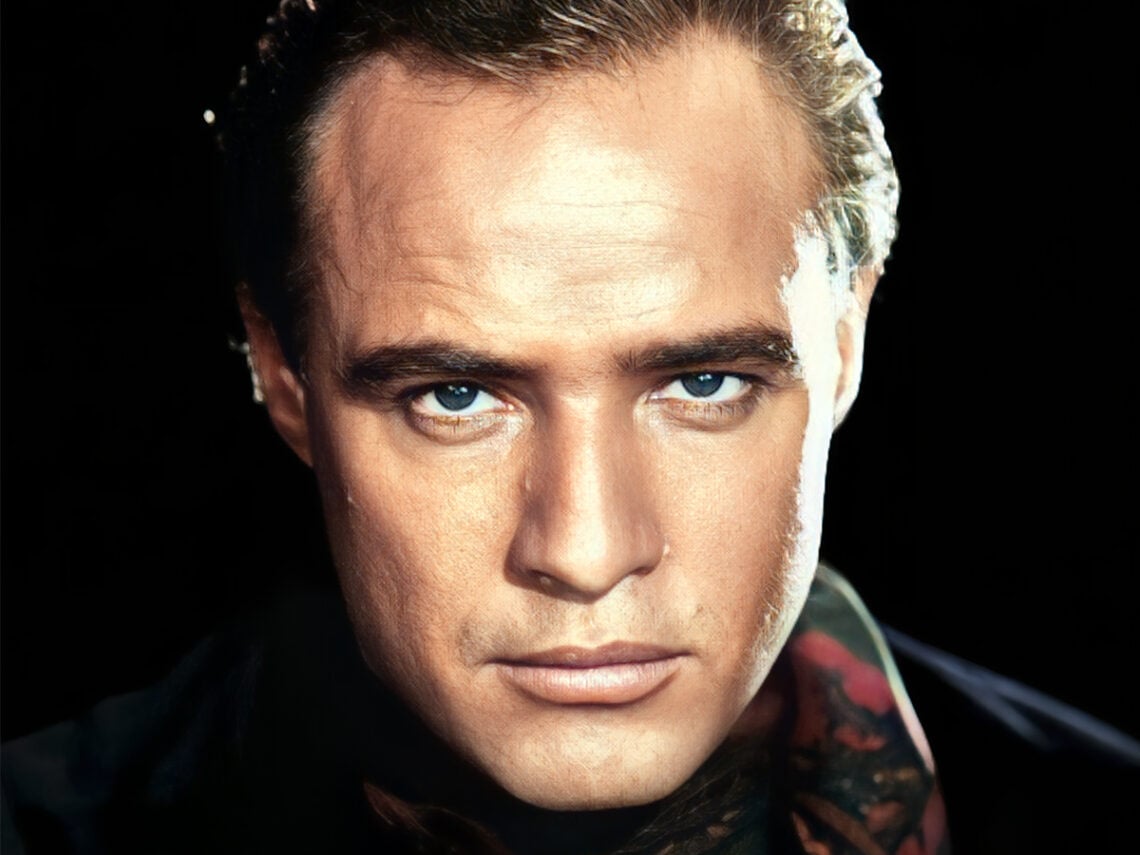
Marlon Brando’s 1990s mission to revolutionise conga drumming: “It’s a pretty far-out invention”

For all the many, many thousands of years that musical instruments have been around, there’s been one in particular that hasn’t really changed: the drum. It’s a skin stretched over a hollow cylinder, and that’s it; the design was perfected pretty much straight away, but that didn’t stop Marlon Brando believing he could improve on it.
The reason he thought that was not due to an artist’s ego spiralling rampantly out of control, although that could have had something to do with it, but more down to the fact that Brando, when he wasn’t busy being the best actor of all time, had two quite distinct interests: drumming and inventing stuff.
In the late 1990s, the latter of those interests led to Brando’s representatives reaching out to a man called Kevin Costanza, a Los Angeles-based lawyer who dealt with patents on inventions, because the great man had a few he wanted to run by him, one of which was a tuning mechanism for conga drums, in addition to a pair of shoes that would be worn in a swimming pool that would cause friction while walking to give a better workout.
An avid reader of Scientific American magazine, Brando was convinced that his conga invention was a goer and so spent five years working with Costanza to make it a reality, producing schematic drawings and getting prototypes custom-made, leading to his being awarded four patents for parts of the design, which replaced the usual bolts around the top of a conga drum with one interconnected tuning lever.
Brando also worked with an award-winning jazz percussionist called Pancho Sanchez to perfect the invention, and although they would go on to speak regularly on the phone, he initially struggled with interacting with someone of Brando’s fame and standing, telling NPR, “It was outrageous at first. I would be out on the road, and my wife would say, ‘Marlon Brando called you today'”.
Costanza, on the other hand, was warned by Brando’s people that he was not to try to get too cosy with the actor, revealing they told him at the start, “He doesn’t want to be called an actor, he doesn’t want to know he’s your favourite actor, he doesn’t want to know how much you loved his movies. He doesn’t want to talk about acting or Oscars or any of those kinds of things.”
Sadly, Brando, Sanchez and Costanza’s efforts came to nought. The actor died in 2004, and they were unable to get the mechanism manufactured due to it being prohibitively expensive (and not entirely needed).

Although the invention became a bit of an urban legend within the percussionist community in the US, only one or two survive in a lock-up, and as Sanchez said, “It’s a pretty far-out invention”.
Toward the end of his life, Brando had sadly become something of a recluse, putting on a considerable amount of weight and barely emerging from his home on the island of Tahiti. He made just one movie in this century, 2001’s The Score, alongside Robert De Niro and Edward Norton, a well-received and stylish heist thriller. He spent the last months of his life seldom interacting with anyone other than Michael Jackson, before dying of congestive heart failure at the age of 80.
