


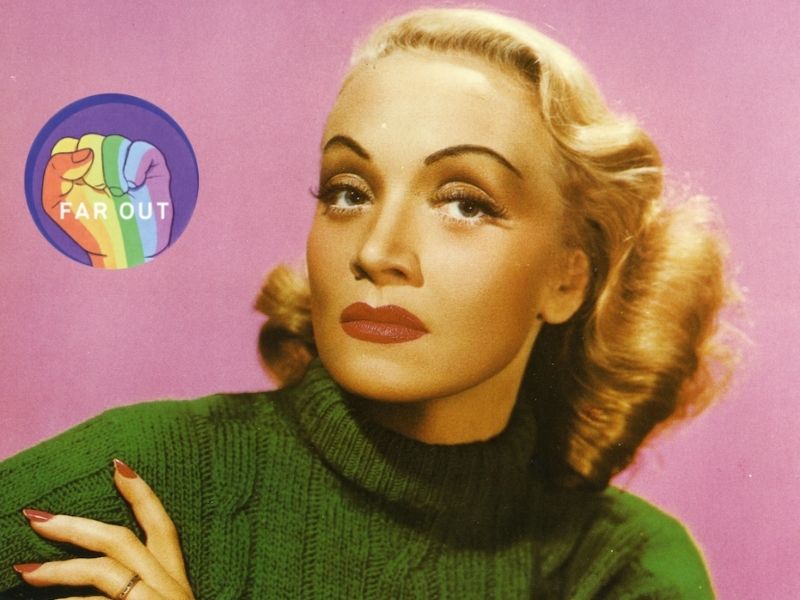
Marlene Dietrich: The iconic bisexual leader of the liberating Hollywood ‘Sewing Club’

The swinging sixties get a lot of credit as the age of liberation and progress, but in Europe, between the wars, a budding bohemian revolution was already underway to such a rabid extent that it often descended into decadent oblivion. Berlin in the mid-1920s was a cesspit of hedonism that would even make David Bowie at his rock ‘n’ roll pinnacle blush with prudence.
Bob Dylan may have sung “the times, they are a’changing” but Marlene Dietrich and the likes had already stubbed out the smouldering cares of the past under a sauntering heel, and she was lighting up the future with a phosphorescent flare of unapologetic bravura.
This heady scene of sexual liberation and skylarking heathenry blossomed in Berlin where Marlene Dietrich’s friend, Anita Berber was Queen. To give you a whiff of the zeitgeist, Berber was a lesbian cabaret star who was married to the sex scientist Magnus Hirschfeld. In the cabaret bars, she was known to mix an equal measure of chloroform, morphine and ether in a small rice bowl on the table. She would then remove a single white rose from her handbag and gracefully begin to stir the mind-bending concoction. Then, like some sort of demented gardener of all things Godless, she would eat the rose petals dipped in the ‘Class A’ potion and, presumably, the high kicks would soon cease thereafter.
In short, the streets were awash with artistry, an atmospheric air of sanguine spring following the dark winter of the war, and all those things that money can’t buy like poverty. Dietrich was the cerebral star of this scene who helped propagate the best of it throughout the world and condemned the worst.
She was born in 1901 in the same Schönenberg neighbourhood that Iggy Pop and David Bowie would later call home. Her dreams of becoming a concert violinist were curtailed at an early age owing to a wrist injury. Albeit she continued to pursue the profession and was eventually hired to play in a pit orchestra. She only lasted four weeks before being fired.

However, this short-lived period of scoring silent films fuelled a love for the entertainment industry from which her fate would flower. By 1923, she made her film debut with a small part in The Little Napoleon. Her name soon spread through the industry and in 1923 she met her husband, Rudolf Sieber, on the set of The Tragedy of Love. Despite a slew of affairs rumoured to be in the hundreds with both men and women from John F. Kennedy to Frank Sinatra, the pair remained married until Sieber passed away in 1976. They had one child, Maria Elisabeth Sieber, a year after meeting.
Following her initial breakthrough, Dietrich bestrode the blooming Berlin art scene in an almost literal sense. Her legs were a weapon amid the cabaret scene that she yielded to great effect, once remarking: “Darling, the legs aren’t so beautiful, I just know what to do with them.” Her ‘golden legs’ may have been a calling card, but it was her cerebral wit that figuratively kept them in shape and sported them gamely to the masses. Quotes such as, “Every man is more interested in a woman who is interested in him, than a woman who has beautiful legs,” were commonplace and made her a beguiling figure who defied any cutesy expectations that Hollywood would later attempt to foist upon her.
This silver-tongue and her continually eye-catching performances led to her becoming a cultural numen in Europe and shortly following her role in the 1930 Josef von Sternberg film The Blue Angel, she was Hollywood bound. Her image as a femme fatale was crystalised thereafter succeeding six consecutive films with von Sternberg. Her contribution to Hollywood and the surrounding society, however, was far more complex than that.
Marlene Dietrich was the lynchpin to an underground society that she called ‘The Sewing Circle’. This term described an underbelly of Hollywood comprising of closeted lesbian and bisexual film actresses reportedly including Greta Garbo, Ann Warner and a string of other big names from Hollywood’s Golden Age.
Within this liberated circle, Dietrich encouraged others not to conform to expectation and as such was a key figure in the sexual liberation movement. Her defiance was paramount in not only establishing the power of women within the industry but in promoting sexual equality. She even had the first lesbian kiss in Hollywood history back in the 1930 film Morocco. From the Berlin drag balls of the 1920s to defying gender conventions by joining prize-fighter Sabro Mahir’s boxing gym, she proudly lived life her own way with her head held high and helped others do the same.
She was even a trailblazer during the Second World War, filing for U.S. Citizenship and condemning the regime in her native Germany in several anti-Nazi broadcasts, and she housed German and French exiles throughout the war.
Liberation in all of its guises requires bravery and Marlene Dietrich gave meaning to the word. She was a true original trailblazer who not only changed attitudes through her daring individualism but also illuminated the profound necessity and meaning behind her progressive iconoclasm. Her acting and singing may have made her a star, but seemingly her intent was never to be anything other than herself.
