


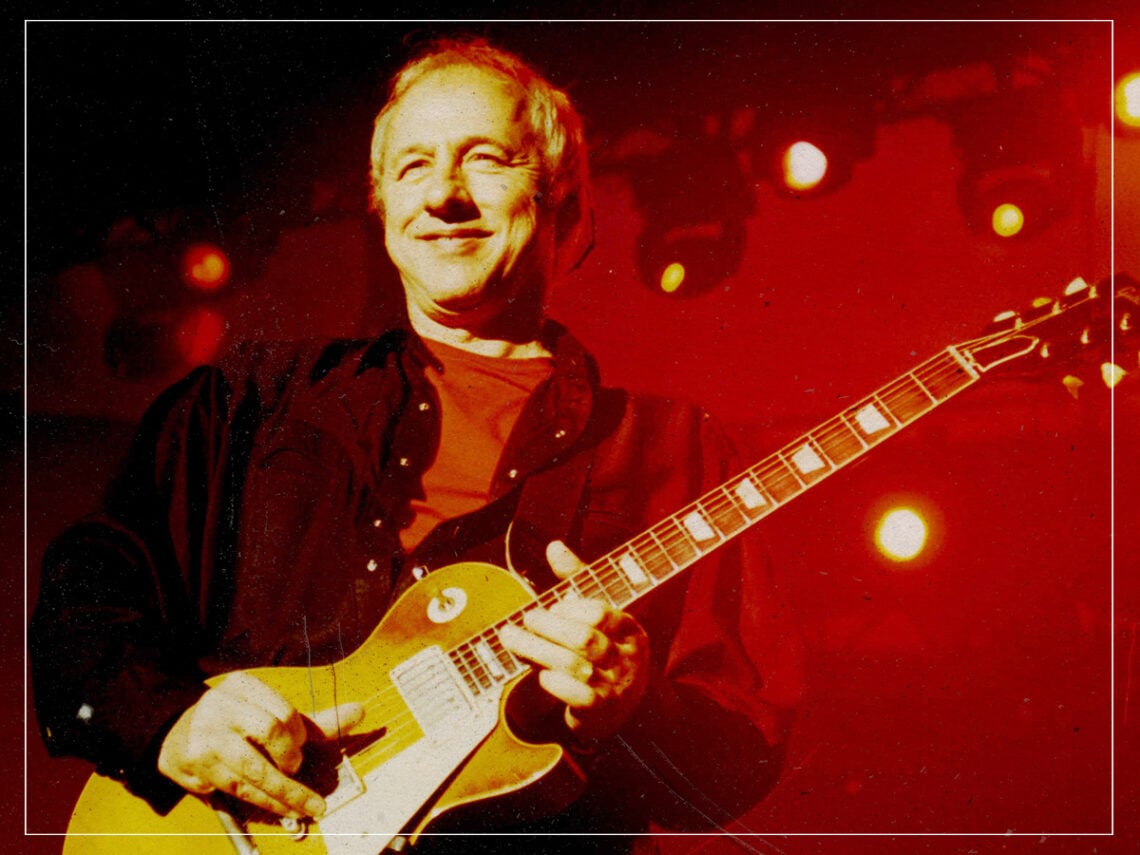
“He was really tremendous”: Mark Knopfler on the one guitarist who truly blew him away

Love or loathe his band, no one can doubt that Dire Straits leader Mark Knopfler is a masterful guitarist. He established a distinct blues-rock sound that blends Americana with the Celtic roots of Britain. From ‘Sultans of Swing’ to ‘Money for Nothing’, the Glaswegian has more than a few standout moments to his name.
Knopfler, a highly distinctive player, has often been asked how he formed his signature style. Typically modest, he told Music Radar in 2018: “People say, ‘How do you get that sound?’ Well, I plugged it in and then I started fiddling with the knobs until I got something that I quite liked [laughs]. That’s how I did it. But I can tell you some things that I do.”
He continued: “I’ve just found on my old Tone King amp, for instance, that I like the rhythm channel better than the lead channel for a lot of things that I do.”
It’s telling of the power of Knopfler’s playing that one of the greatest players of all time, Pink Floyd’s David Gilmour, has effused about it. “I was a blues fan, but I was an all-around music fan,” Gilmour said when speaking to Guitar Classics in 1985. “For me, it was Leadbelly through B.B. King and later Eric Clapton, Roy Buchanan, Jeff Beck, Eddie Van Halen and anyone you care to mention. Mark Knopfler has a lovely, refreshing guitar style. He brought back something that seemed to have gone astray in guitar playing.”
Mark Knopfler’s style and his tribute to Stevie Ray Vaughan
Knopfler is such a titan of the fretboard that he’s often been asked to name his favourite guitarists. His list of heroes is wide-ranging, including names like Chet Atkins and Hank Marvin. Still, one name stands out. According to the Dire Straits frontman, one of the best he’d “ever heard” was Stevie Ray Vaughan, the Texas blues rock icon who tragically died in a helicopter crash at just 35 in 1990.
During an interview for the TV documentary A Tribute to Stevie Ray Vaughan, Knopfler praised Vaughan and deemed him a successor to Jimi Hendrix and Buddy Guy. He said: “He was one of the best ever. You know, he was really, really tremendous, especially later on”.
Knopfler added: “You know, I thought that uhm… something was happening where the Hendrix and Buddy Guy influences were giving way to some real powerful stuff. He’s one of the best I’ve ever heard, no question.”
For Knopfler, tone isn’t something you chase with gear lists and plug-in presets; it’s something that lives in the fingertips. You can hear it in every slide and sting, each bend held a moment longer than expected. It’s why his playing stands out the way it does; not because it’s louder or faster, but because it feels lived-in. There’s an ease to it, like the music already existed and he’s just pointing it out to the rest of us.
What makes Knopfler’s praise of Stevie Ray Vaughan hit harder is how rarely he throws that kind of reverence around for a man who carved his own lane in rock, to tip his hat to Vaughan as “one of the best ever” is no small gesture. Vaughan, after all, wasn’t just replicating the greats, trying to follow in their footsteps. Where Hendrix lit the match, Vaughan kept the blaze going in his own unique way. And for Knopfler to spot that shift, that moment when influence morphs into something singular, is the kind of recognition only a fellow craftsman could offer.
