


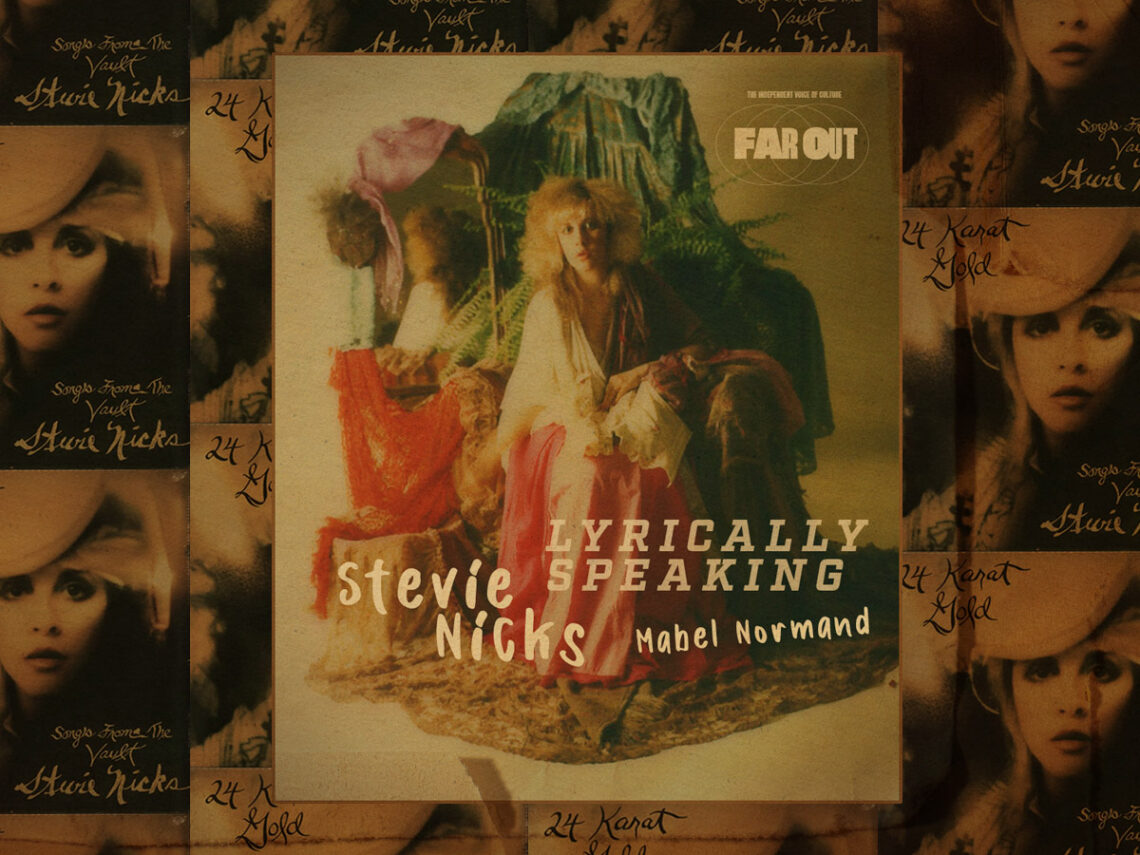
Lyrically Speaking: The tragic downfall of substance addiction in Stevie Nicks’ prophetic ‘Mabel Normand’

For Stevie Nicks, gaining perspective on her own substance abuse first fell into place when she came across Mabel Normand. Braiding the lines of her life with hers after watching a documentary one night in 1985, Nicks gained clarity for the first time and felt inspired to write a song about her experiences “at my lowest point”. Less than a year later, she entered rehab.
If crossing paths with Normand’s story was the first stepping stone to Nicks getting help, the second was the song itself, ‘Mabel Normand’. Like Nicks, Normand was a famous figure with an intense battle with cocaine addiction, and although she died of tuberculosis, the damage from her addiction contributed significantly to her physical and mental downfall.
And, also like many in the spotlight, Nicks had also encountered her share of challenges that made coping difficult. Starting as a seemingly natural part of life in the business, substances soon appeared as the only meaningful constant; something that made sense that she turned to at every corner, until one day she received a much-needed wake-up call.
Around the same time she discovered Normand’s story, the doctor had told her that she had given herself a hole in her nose from her excessive drug use. Realising how things could “go downhill fast”, she was also told she would likely suffer from a brain haemorrhage if she continued taking the substance. “I was a happy person back then,” she later reflected to Billboard. “I just got addicted to coke, and that was a very bad drug for me. It was obviously a very bad drug for Mabel too.”
This intense escalation is poetically reflected in the song lyrics. Although inspired by Normand with direct references to her in the song, the story is also Nicks’, with markings of her own self-destructive tendencies coming through in the various symbolism, like being an “unapproachable comedienne” whose heart was “quietly crying” and who grew to feel “guilty about even dying”.
There are also several shifts throughout the story, which sometimes make it unclear whether Nicks is narrating from one perspective or two distinctive ones. Either way, there’s an underlying tragedy as she crafts the fragile central character—whether herself or Normand or both—and how these choices impact those around her, usually in the scramble to keep connected to home and what it means to have a clear focus on what truly matters.
“Why does someone always have to win?” she asks, before tapping into the perils of addiction and how it can destroy romance and meaningful relationships: “Strange things do follow when you love someone,” she sings. “So you put that someone in exile. How about I call you Beloved Exile?” This is where the haze of addiction becomes clear, and the delicate lines between dedication and disengagement become blurred, leading to a disconnection that paves the way for loss and pain.
Even through the next verse, in which the second figure urges the addict to not “give up”, they seemingly have no clue about what they’re referring to, before they’re let in on all the ways the world keeps turning, people keep moving, and life fills itself with different memories and experiences, and yet, in the crux of addiction, nothing changes: “You’ve been gone, Rome burned down / And still it’s all the same”.
Still, there is no happy ending to this story, as Nicks makes clear with her variations of losing control and meaning (“I pray every day for the answers in a still and almost silent night” and, later, “she fought a losing battle, one day at a time”), navigating the pillars of addiction and how it can cause others to lose themselves in the complex network of everything losing gravity.
This becomes even more poignant at the end as Nicks brings the story back to its unsuspecting subject, Normand, reflecting on her as the blueprint for struggle and of talent that diminishes in the spotlight, under the cruel gaze of cocaine. “Sad girl / So beautiful,” she repeats, and amid the suffering, it becomes harder to ignore how much these words feel less prophetic to Nicks’ story and more like a warning to recognise the darkness before it devours her, too.
