


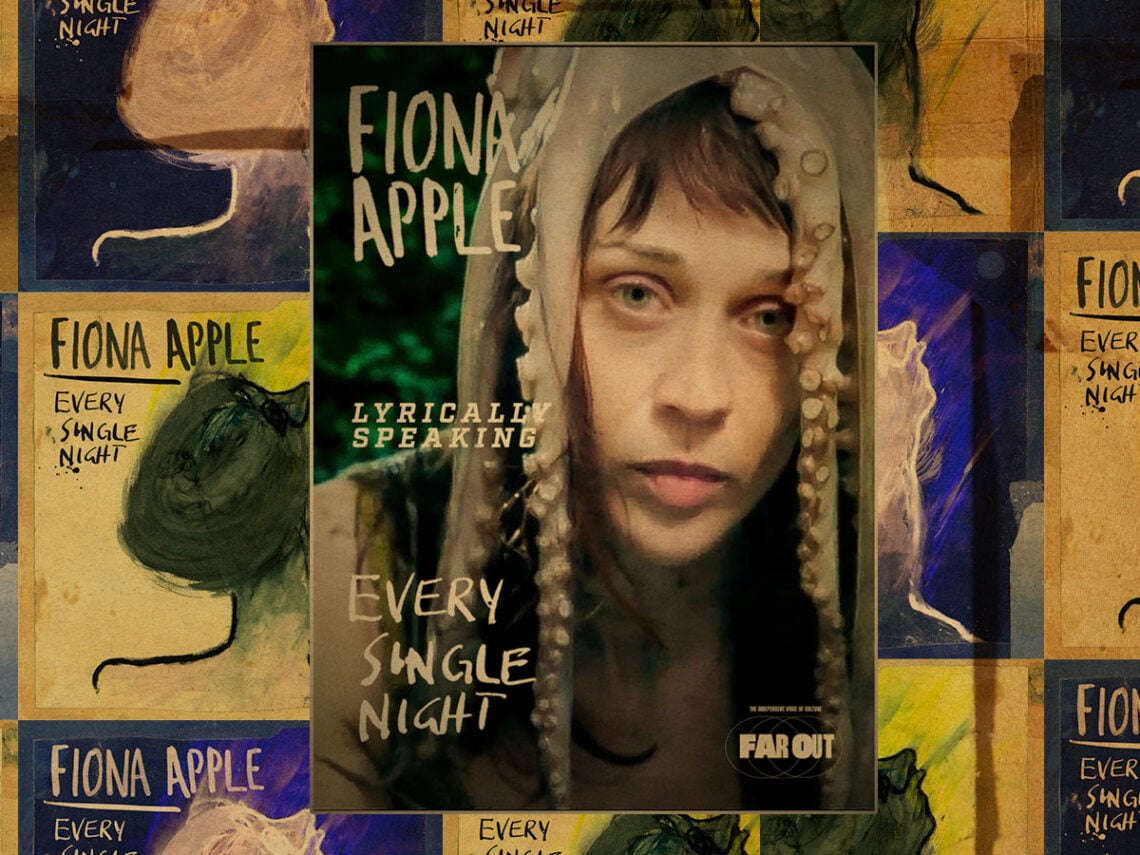
Lyrically Speaking: The haunting fragility of ‘Every Single Night’ by Fiona Apple

When used in the right way, the voice can be one of the most colourful artistic devices, capable of evoking the kind of emotional nuance that everyday vernacular rarely touches. While many exercise this to varying degrees of success, few come close to the vocal depth achieved by Fiona Apple, who lives and breathes every word as if it were a world built on pure rawness.
The first single from The Idler Wheel…, ‘Every Single Night’ sparked an unexpected sort of reaction when it was first released. While some struggled to understand the meaning behind the sudden psychological complexity, others labelled it her best work yet, hitting the target with analyses about how the song beckons invitations into her deeply fractured and far-from-perfect world.
And that’s precisely the desaturated sense of unease that emanates from the track immediately, with melodic chimes that set the scene for something unruly yet charming in its flaws. When Apple arrives with words narrating the patchwork nature of her mind, and how, every single night, she endures “little wings of white-flamed” of “butterflies in my brain”, it feels less like an outburst and more like an intimate glimpse into her reality, delivered with an almost trepidation.
However, the further into this story we venture, the more Apple oscillates her voice between confident and timid, crescendoing unexpectedly with various lines, like, “That’s where the pain comes in / Like a second skeleton / Trying to fit beneath the skin”, before simmering once again, poised for the more explosive chorus, “Every single night’s alight with my brain”.
These meticulous dynamics—between softer crooning and more purposeful belows—accentuate the poignancy of Apple’s poeticism with remarkable precision, reflecting the nuances of her mental prison in a way that evokes an inexplicable physicality, the kind burdened by humanity’s incessant desire to apply a cognitive label to absolutely everything it feels or experiences. As Apple puts it, “My heart’s made of parts of all that surrounds me.”
These observations are compounded by Apple’s unreliable understanding of her own existence and how she’s defined not only by her thoughts—the ones that plague her every single night—but by the actions and choices that follow (“What I am is what I am cause I does what I does”). That said, these disturbances are less a means of shying away from pain and suffering but more a way of wallowing, even when it refuses to offer respite. As she repeats in the song, “I just want to feel everything”.
Perhaps the moments that feel more effortlessly intimate stem from the fact that Apple was fairly reclusive while writing the song, completing it in secret like a precious gem she didn’t know would eventually shine into a full composition. Or, maybe it’s her innate ability to use her voice as the main instrument, allowing the words to feel more like delicately placed textures in a way that still feels broad.
Either way, the vulnerability becomes enhanced by Apple’s organised chaos, charged with a fervour that isn’t always sure of itself, but more beautiful in its uncertainty. From start to finish, she coasts the edge, savouring the bliss of fragility and knowing that, as long as the darkness persists, that’s how she knows she’s alive. “Every single night’s alright, every single night’s a fight,” she sings, “And every single fight’s alright with my brain.”
