


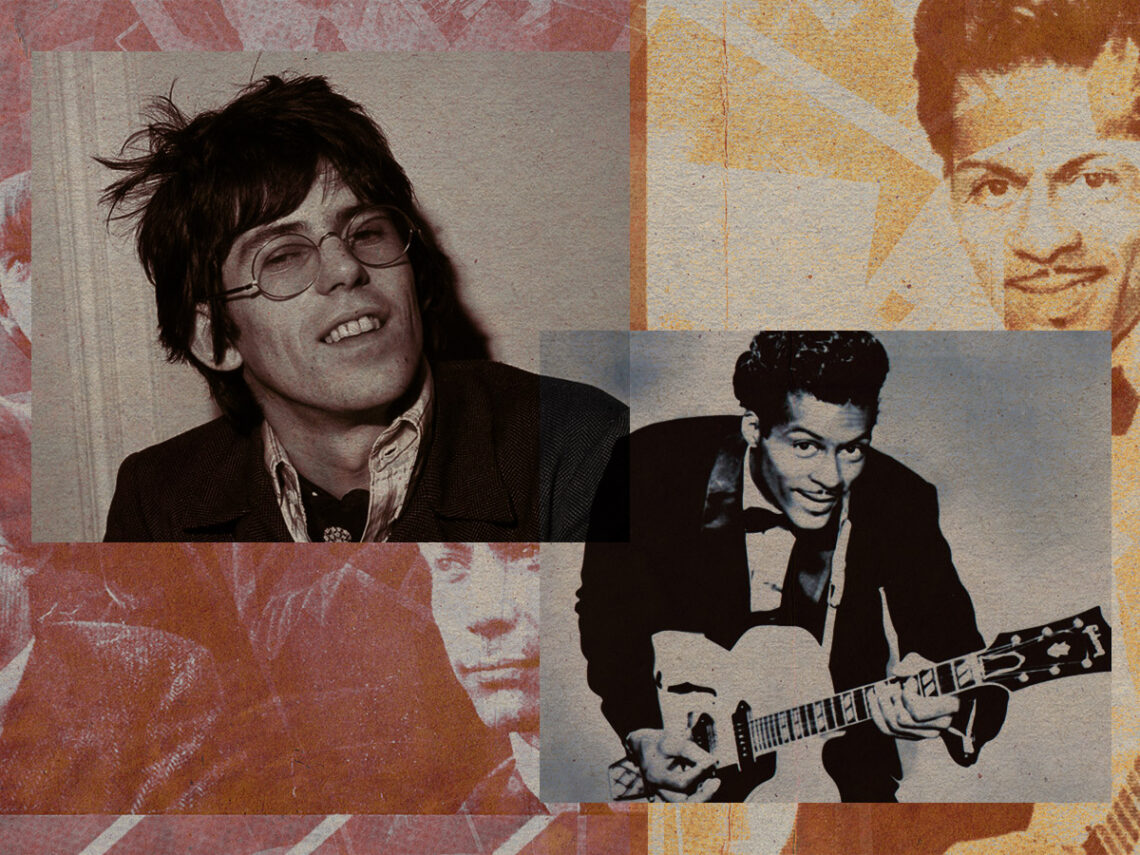
The love/hate relationship of Keith Richards and Chuck Berry

For The Rolling Stones’ Keith Richards, the late Chuck Berry was the man he always wanted to emulate. Berry was crucial in switching Richards onto the blues and opening up his horizons. Years later, he’d begin a friendship with his idol, but it was far from ordinary, and their relationship was often tempestuous despite their mutual respect.
Berry was a gateway drug for Richards, and his tones immediately enchanted his own creative sensibilities. The English guitarist once said: “When I started, all I wanted to do was play like Chuck [Berry]. I thought if I could do that, I’d be the happiest man in the world”. While they had their personal differences, Richards’ appreciation for Berry as a guitarist never diminished, and he successfully separated the man from the music.
“When I saw Chuck in Jazz on a Summer’s Day as a teenager, what struck me was how he was playing against the grain with a bunch of jazz guys,” Richards told Rolling Stone about Berry’s performance at Newport Jazz Festival in 1958. “They were brilliant — guys like Jo Jones on drums and Jack Teagarden on trombone — but they had that jazz attitude cats put on sometimes: ‘Ooh… this rock and roll’.”
Richards continued: “With ‘Sweet Little Sixteen,’ Chuck took them all by storm and played against their animosity. To me, that’s blues. That’s the attitude and the guts it takes. That’s what I wanted to be, except I was white … I listened to every lick he played and picked it up. Chuck got it from T-Bone Walker, and I got it from Chuck, Muddy Waters, Elmore James and B.B. King. We’re all part of this family that goes back thousands of years. Really, we’re all passing it on.”
In Richards’ mind, he is merely a custodian of the blues, a role that is required to hand the baton on to others while keeping the music alive. For him, they are all members of the same club, and while his background in leafy Surrey to Berry’s early life in St. Louis, their shared love of the blues aligned these two disparate worlds.
At times, Richards found it difficult to disguise the enthusiastic fan within himself when he was in the company of Berry, and on one infamous occasion, the pair came to blows. However, rather than get angry about his hero attacking him, the Rolling Stone took it on the chin and accepted it was an adequate punishment for his behaviour. “Chuck Berry once gave me a black eye, which I later called his greatest hit,” Richards wrote after Berry’s death in 2017. “We saw him play in New York somewhere, and afterwards, I was backstage in his dressing room, where his guitar was lying in its case. I wanted to look, out of professional interest, and as I’m just plucking the strings, Chuck walked in and gave me this wallop to the frickin’ left eye. But I realised I was in the wrong. If I walked into my dressing room and saw somebody fiddling with my axe, it would be perfectly all right to sock ’em, you know? I just got caught.”
Richards added: “He would do things like throw me offstage, too. I always took that as a reverse compliment, sort of as a sign of respect – because otherwise, he wouldn’t bother with me. He was a little prickly, but at the same time, there was a very warm guy underneath that he wasn’t that willing to display. There were other times between us when we’re sitting around and rehearsing, and going, ‘Man, you know, between us we got that shit down” – and there would be a beautiful, different feeling.”
The story behind their performance of ‘Maybelline’ at Berry’s 60th birthday celebrations at the Fox Theatre in St. Louis epitomises their strange relationship. In rehearsals ahead of the concert, tension came to the fore between the acts as they fought over who would contribute lead guitars to the song, with Berry reportedly snapping at Richards, who backed down, and allowed the birthday boy have his moment in the sun. After all, the evening was a commemoration of the ‘Father of Rock and Roll’, and he was who the crowd were eager to see.
This instance boils their relationship down to its core and explains the hierarchy between the two musicians. At that moment in time, Richards had been a star for two decades with The Rolling Stones and conquered everything in music, but compared to Berry, he still viewed himself as an inconsequential figure.
