


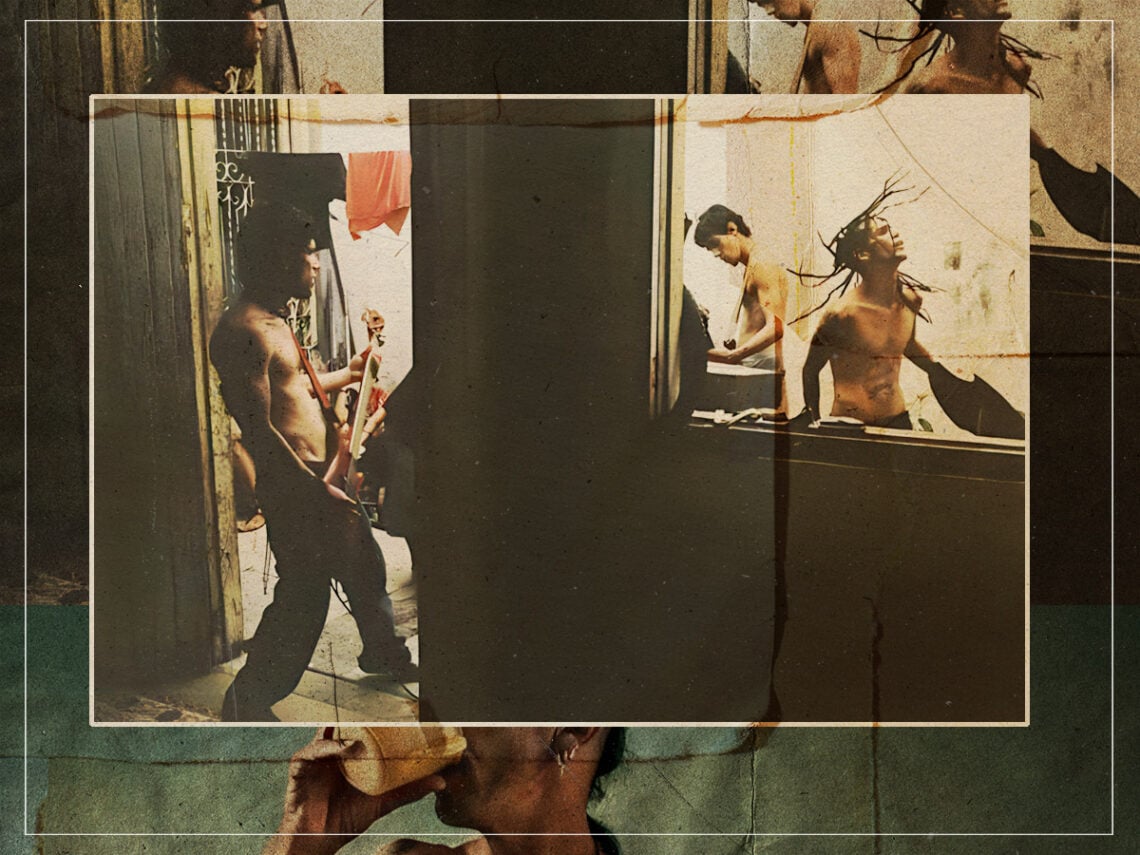
Los Frikis: the Cuban punks who injected themselves with HIV

Punk music and subculture have always stood defiant in the face of authority. What first began in the sweaty clubs of New York and London soon captured the attention of a global rock audience yearning for something a little more revolutionary. As such, it makes sense that punk found a particularly dedicated audience in communities living under totalitarian rule in places like East Germany, the USSR, and even Cuba. The most hardcore of these Cuban punks were known as Los Frikis.
Roughly translating in English to ‘The Freaks’, Los Frikis originated in Cuba during the 1980s. At the time, the nation was experiencing a particularly tumultuous political landscape, moving ever closer to the all-encompassing austerity which engulfed Cuba during the early 1990s as a result of the dissolution of the USSR. On top of that, Cuba was involved in various conflicts across the globe, which led many young people back home to feel ostracised from their country and angry at the regime they were living under.
It is worth remembering that the youth of Cuba during the 1980s lived their entire lives under the rule of Fidel Castro, so they could not compare the state of the nation to the period before the revolution in 1959. As a result, many young people began to turn to the revolutionary rock and roll sounds that had taken the Western world by storm. In contrast to their American counterparts, however, Los Frikis placed a much larger emphasis on the lifestyle and attitudes of punk rather than the music itself.
The rock scene in Cuba was certainly a minority, with Castro denouncing the style as “the music of the enemy”. Unsurprisingly, the idea of subcultures and politically charged music was seen as threatening by the government of Cuba, who viewed Los Frikis as a challenge to the collectivism and inherent ethos of Cuban society at the time. Hence, those who chose to dedicate themselves to this brave subculture were often outcasted from society, shunned by their families, and regularly found themselves victims of police brutality and governmental discrimination.
Visually, Los Frikis tended to look a little more egregious than prevalent punk scenes in neighbouring nations. Body modifications, piercings, mohawks, and ripped clothing were staples of the subculture, and the music was largely dominated by hardcore and anarcho-punk. The rise in popularity of the scene, coupled with the fact that its members were increasingly ostracised from mainstream society in Cuba, meant many Los Frikis were forced further and further into the subculture, unable to find work or any kind of support from their government.
Eventually, something had to give. However, Los Frikis took rebellion to entirely new heights. During the 1980s, the AIDS virus ravaged a vast portion of the globe, and islands in the Caribbean were particularly affected. Today, Cuba has one of the lowest levels of HIV and AIDS in the surrounding area, but the same could certainly not be said during the 1980s. Finding themselves outcasted from society and receiving no form of support from their families or state, many Los Frikis made the decision to deliberately inject themselves with the HIV virus.
Of course, this was not a decision to be taken lightly. However, deliberately contracting HIV was a profound act of rebellion against a society which had shunned Los Frikis, and it also meant that the government was forced to administer aid to these defiant punks as a means of preventing the further spread of HIV and AIDS on the island.
As a result of this unparalleled act of rebellion, countless Los Frikis died after contracting HIV. Although the scene remained prevalent in Cuba throughout the 1980s and 1990s, it has been in steady decline since the turn of the millennium. The reasons for this are myriad, ranging from a change in musical tastes to the simple fact that there aren’t many of the original Los Frikis left, four decades on from their heyday. Nevertheless, Los Frikis remains one of the most defiant and revolutionary punk scenes in the history of the genre.

Never Miss A Beat
The Far Out Punk Newsletter
All the latest Punk content from the independent voice of culture.
Straight to your inbox.