


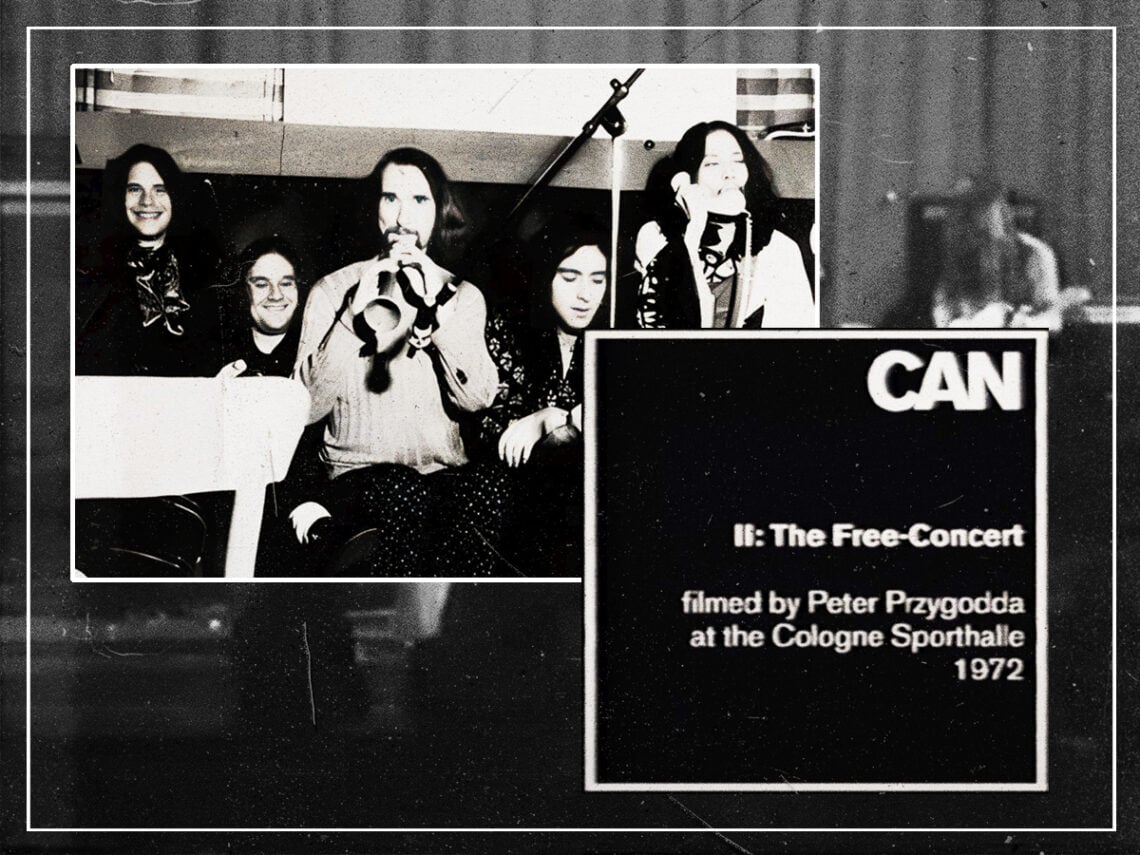
Look back at Can’s insane free concert from 1972

In the late 1960s, various musicians across Germany began experimenting with new sounds, rebelling against the dominance of American popular music. These bands often played extended jam sessions where songs were cyclical and textured, disregarding the conventions of traditional song structure. The music that emerged from this period became known as krautrock, with groups such as Can, Neu! and Faust earning the most recognition.
Krautrock songs were never going to be international radio smash hits, but the sheer innovation possessed by these artists made the subgenre a quintessential influence over the development of alternative rock. According to Faust’s Jean-Hervé Peron, speaking during an interview with The Wire, “We were trying to put aside everything we had heard in rock ‘n’ roll, the three-chord pattern, the lyrics. We had the urge of saying something completely different.”
However, if one band did receive glimpses of commercial success, it was Can. The experimental band was formed in 1968 by Holger Czukay, Irmin Schmidt, Michael Karoli, and Jaki Liebezeit, who possessed backgrounds in avant-garde classical music. Inspired by the likes of experimental alternative rockers The Velvet Underground and jazz and early electronic artists, Can began making music that flitted between lengthy jams and shorter, more accessible cuts, like ‘Vitamin C’.
The band found unexpected success with ‘Spoon’ in Germany, which appeared on 1972’s Ege Bamyasi a year after its release as a single. Subsequently, Can decided to host a free gig for their fans, which over 10,000 people attended. The performance was filmed by Robby Müller, the frequent cinematographer of Wim Wender, Egon Mann and Martin Schäfer, with direction from Peter Przygodda, who often edited Wender’s movies.
Within the concert film, the band play a six-song setlist, although most of the tracks are extended into long jams. For example, kicking off with ‘Spoon’, Can transform the song into an 18-minute epic instead of its usual three-and-a-half minute runtime. At one point, Paul Joho plays the saw while an acrobatic troupe named Oberforstbach perform alongside the band, and elsewhere, a juggler called Fred Ray joins the stage.
The performance, which took place at Cologne’s Sporthalle on February 3rd, 1972, is sandwiched between behind-the-scenes clips of the band, including soundcheck and the recording of Tago Mago. Alongside ‘Spoon’, Can also played ‘Shikaku Maru Ten’, ‘Hallelujah 1’, ‘Bring Me Coffee or Tea’, ‘Hallelujah 2’ and ‘Full Moon on the Highway’.
The show was bizarre, but that was the nature of Can. Never ones to slip into the comfort of traditionalism, the band were constantly experimenting, especially in a live setting.
Watch the performance below.
