


Live review: Sahra Halgan brings the enchanting music of Somaliland to Leeds

Bank holidays always bring with them a certain air of excitement and revelry, particularly in a place as joyous and community-focused as Brudenell Social Club in Leeds. On this particular night, ahead of the Good Friday bank holiday, the venue had particular reason for excitement, as the vocalist and performer Sahra Halgan was set to take to the Community Room to deliver a rapturous set of garage rock-infused protest anthems and traditional compositions from Somaliland.
Halgan, born Sahra Ahmed Mohamoud, has been recording and releasing music for a number of years now, but her story stretches back decades further. Growing up in Somaliland during a particularly turbulent political period, plagued by coups, bloodshed and, eventually, civil war, the vocalist initially worked as a nurse during the conflict. However, she soon turned to music as a means of defiance and solidarity with her homeland. “At the front, I was finally free. The soldiers had other things to do than forbid me to sing,” she later shared.
It was the storming 2024 record Hiddo Dhawr that first placed Halgan on my musical radar. The album was high up in my list of top releases from last year, and the record is still rarely off my turntable. A few months after the release, I went along to The Crescent in York to witness her awe-inspiring tones in person, but the train timetable dictated that I was to miss the last few songs of the set – yet another reason to resent Northern Rail. Luckily, this bank holiday provided me with a chance to rectify this injustice, with Halgan performing a stone’s throw from my digs, at Brudenell Social Club.
Upon walking to the venue, I was greeted by the sight of Sahra Halgan – this magnificent performer who has soundtracked the historic struggle of people in Somaliland – backing a van towards the stage doors. It struck me that this is not a sight you would expect to see at most concerts, where there is usually a disparity in status and stature between the audience and performer. That seemingly inconsequential event set the tone for the rest of the evening; there was no divide between the stage and audience, everybody was together as one, united by this incredible music.
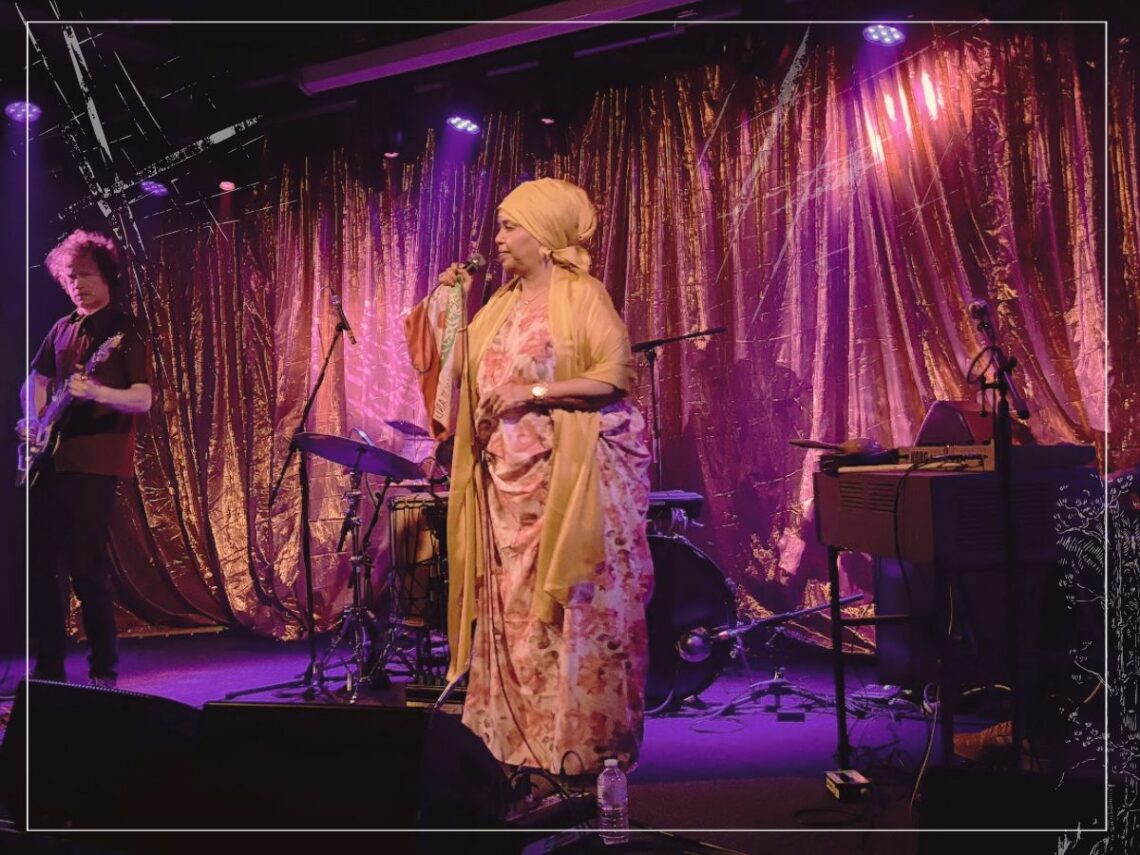
In defiance of logic and reason, the crowd at the Community Room was not colossal. There were around 30 people in the room when Halgan emerged onto stage, bedecked in a golden hijab and clutching the flag of Somaliland. Her band had already erupted into their infectious blend of psychedelic surf-rock and traditional East African rhythms, but it was Halgan’s awe-inspiring voice that formed the final piece of the puzzle.
The singer took the audience on a journey through her music and activism, stopping only occasionally to notion to the significance of certain tracks, and how they relate to the continued struggle of her people in Somaliland. I have been to countless gigs over the years, encountering every kind of vocalist under the sun, but I can truthfully say that I have never heard a vocalist like Sahra Halgan before.
Particularly during the early part of the set, Halgan’s performance was so mesmerising that you almost forgot your surroundings. It was as though the singer had cast a trance over the audience, which only seemed to grow in number with every subsequent song. The spiritual quality of her performance was likely bolstered by the stripped-back nature of her backing band.
Due to scheduling conflicts, drummer Aymeric Krol told me after the show that the band used for this tour differed from the musicians featured on Hiddo Dhawr. Although the stand-in performers were unquestionable in their performances, this change in personnel did give the music a different atmosphere; it certainly felt much more intimate in sound than what I had witnessed in York last year, or indeed what featured on the studio recordings.
This intimate, trance-like performance was only disrupted around halfway through when a man, presumably deep into his celebration of the bank holiday, slowly moved back and forth in front of the stage dancing in a style that can only be described as a standing frontstroke, in the style of a double-Pete Townshend windmill. Whether the man was captured by the innate beauty of the band’s music or whether this dance was a standard part of all of his nights out was not clear, but as it went on over multiple songs, the band members struggled to contain their giggles.
In fairness to that strange dancing man, who mysteriously disappeared into the night after a few songs, he did at least break the ice for the rest of the audience to set themselves free. By the time Halgan came to perform ‘Sharaf’ – a clear highlight within the set, thanks to its driving rhythm and compelling guitar riff – there was scarcely a body in the room which was not moving in time with the beat.
Following ‘Sharaf’, the band played a few more tracks before sending the sparse audience back into the revelry of a bank holiday social club. Such is the awe-inspiring power of Halgan’s work, however, that I, like the rest of the audience, left not only with tired feet from dancing, but also with an inspiring sense of resistance and solidarity. Halgan is adept at blending these attitudes of political activism and defiance with infectious and groovy rock and roll music, and it seems as though a live performance is the ideal setting in which to receive her sermon.
