


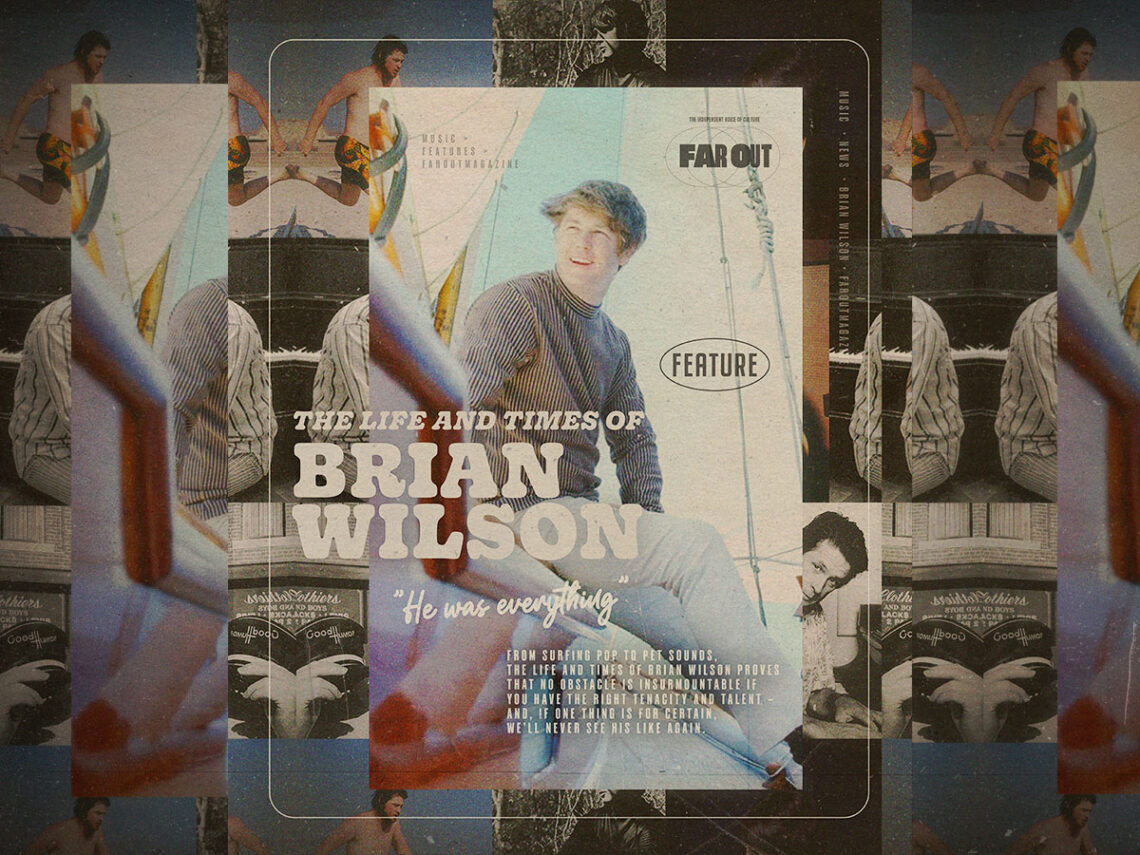
“He’s everything”: The life and times of Brian Wilson

It’s easy to view the life of Brian Wilson in snapshots – the nascent formation of The Beach Boys, the critical acclaim that came with Pet Sounds, and his triumphant return to the stage decades down the line. But this perception, although not wholly inaccurate, would do a huge disservice to the story of a man who, while being hailed as a musical genius, overcame mountains of struggles and strife to secure his visionary status. The journey was certainly not always a smooth surf.
Looking back over the scores of his life after he passed away on June 11th, at the age of 82, it’s natural that artists the world over lauded him as a pioneering muse, from a sonic perspective. While music ebbed from every moment, pulse, and beat of Wilson’s life, he was just as equally a son, brother, husband, and father who knew more about facing up to the world in one’s darkest times than most.
Wilson was born on June 20th, 1942, in Inglewood, California, as the first child to Audree and Murry Wilson – his brothers and future bandmates, Dennis and Carl, would arrive in 1944 and 1946, respectively. He experienced a peppered childhood; one with a strong family bond, certainly, but occasionally marred by violence and abuse by his erratic father. What became Wilson’s solace and eventual saviour, however, was his parents’ insistence that he learned music.
This was an area in which the eldest child surprisingly excelled, in the sense of his instant prodigal aptitude for picking up instruments, despite being deaf in one ear. Becoming adept at the accordion, piano, and being deemed as having perfect pitch by his church choir director while not even out of his boyhood, Wilson’s sights on musical greatness were, in many ways, always written in the stars.
But the conception of The Beach Boys wouldn’t come until much later, after Wilson had put himself through high school, going through all the pretences of sporting all-star and academic protégé before he could return to his one true love – the music. By 1961, roping in his two brothers as well as cousin Mike Love and friend Al Jardine, The Beach Boys were given their first rodeo with the help of $250 left by Wilson’s parents, meant for food while they were on holiday. But opting to buy musical equipment with the cash instead, the group of teenage boys struck gold—without ever knowing it at the time.

First recording the song ‘Surfin’, written by Wilson and Love, the band garnered a modest hit in their native California and thus set out on a family venture, namely by Murry Wilson becoming their manager. The following year, they were snapped up and signed by Capitol Records, promptly recording their debut and sophomore albums one after the other, Surfin’ Safari and Surfin’ USA. Almost at the flick of a switch, The Beach Boys were the pinnacle of Stateside pop, and Wilson was leading the pack.
The frontman’s ingenuity was a trait that quickly turned heads in the business, as in addition to writing songs for his own band’s ensuing discography, he also penned no less than 42 hits for other musicians during this early ‘60s period. It seemed like the best of times on the surface, but underneath, there was a brewing storm. All in the space of 1964, Wilson had fired his father as his manager, written three albums, and then the British invasion took over America to really get his back up. He confessed two years later that, “The Beatles invasion shook me up a lot. […] So we stepped on the gas a little bit,” but this transpired only to be the making of his problems.
It was no help that, despite four other bandmates in tow, Wilson was seen as the sole integral piece of The Beach Boys, a notion snarkily solidified by his brother Dennis, who claimed: “Brian Wilson is the Beach Boys. He is the band. We’re his fucking messengers. He is all of it. Period. We’re nothing. He’s everything.” This moniker continued to pile on the stress, to the point where, at the age of just 22, Wilson had a series of breakdowns, resulting in his decision to step away from the Beach Boys brand.
Making the choice to no longer tour with the group was one thing, but what Wilson really needed to reinvigorate his spirits was to facilitate an evolution away from the shiny surfing sonics on which he had made his name. Indeed, the very source of his stress – The Beatles – and their 1965 album Rubber Soul was what gave him the push to venture into new sonic lands, and thus enter the crux of his most prolific period.
The iconic ensuing record, Pet Sounds, was released in 1966 to instant universal and critical acclaim. The sheer mastery of songs like ‘God Only Knows’ and ‘Wouldn’t It Be Nice’ placed Wilson on a precarious pedestal which he had previously feared the heights of. But nevertheless, the power of one single album definitively changed the world, with artist after artist simply left gawping in its wake.
Lauding Pet Sounds was all well and good, but the unspoken undercurrent of the album was that it largely hinged on Wilson’s drug use, which, following his series of mental breakdowns, had been exponentially increasing. As well as the pressures of fame, this was attributed to the breakdown of his marriage to Marilyn Rovell, with whom he’d had two daughters, Carnie and Wendy. The result was cataclysmic – as with his other records, a follow-up to Pet Sounds was quickly expected, but instead it took 37 years.
The subsequent three decades not only marked a downturn in Wilson’s critical success but also undoubtedly the darkest period in his life, plagued by drug addiction and reclusiveness. The plug had been pulled on his magnum opus record Smile, and despite various other ventures – including opening his own health food store in the Hollywood Hills – nothing could propel Wilson out of his slump.
This was not helped by the intrusion of his feud with Love entering into the fray, who, allegedly abhorred by Wilson’s heightened experimental efforts in the recording realm, as well as his addiction issues, began a legal battle that would last decades, and in the end never be fully reconciled.
As the years wore on, his brothers eventually decided enough was enough and enlisted the help of psychologist Eugene Landy to stage an intervention. In short, this relationship helped the songster get back on track for sporadic periods, allowing him to re-engage with music in some forms throughout the 1970s and ‘80s before once again relapsing. It wasn’t until the 1990s that his partnership with Landy was definitively ended, after it was deemed that the psychologist had breached boundaries by becoming involved in Wilson’s business assets and enacting a conservatorship over him.
By all accounts, the chips were well and truly down for Wilson, and for any other artist, the mountain of climbing back to glory would be an impossible task. Yet by some miracle, this was exactly what he managed in the early ‘90s with a series of re-recordings of Beach Boys classics, this time in his own right as a solo artist. Then, having overcome the first obstacle, it was time to revisit the biggest challenge of all.

Having made a triumphant return to the stage for the first time since his early 20s, Wilson was, somewhat uncharacteristically but gladly, on top of the world. Performing granted him a new lease of life, and subsequently spurred him on to return to the entity that had niggled at him all those years: Smile. Premiering his reimagined version, Brian Wilson Presents Smile, at the Royal Festival Hall in London in 2004, it was the definitive closing of a chapter on what had long been an unspoken blight on his career. The follow-up to Pet Sounds had finally arrived, albeit half a century later, but still in all its technicolour, expansive brilliance.
The latter two decades of Wilson’s life were thankfully marked by a return to form. He produced various albums, reunited with The Beach Boys in 2012, was the subject of the biopic Love and Mercy in 2014, and was largely just generally lauded as the genius he had always been. It was the chance to collaborate with artists old and new, as well as make up for lost time with the proclamation in 2016 that he had no plans to retire.
Naturally, however, as he aged into his late 70s and early 80s with the dawn of the 2020s, a somewhat slower pace of life beckoned. Eventually giving up life on the road in 2022, tragedy struck two years later when Wilson’s second wife, Melinda Ledbetter, died in January 2024. Merely a month later, it was announced that Wilson was suffering with dementia, and was placed under another conservatorship, this time by his family, to look after his affairs.
But there are still questions within this. Wilson had been working on a new album, Cows in the Pasture, which was based on an unfinished work from 1970. In the wake of his passing, it is not known whether this now potential posthumous record will ever see the light of day, or if the world will be left to revel in Wilson’s sonic spirits with all that came before.
With the outpouring of grief and tributes paid in Wilson’s honour as a result of his death, it is impossible to overstate how seismically this man changed the course of music. Most of all, perhaps what inspired people was not just Wilson’s sonic genius, but that his path to achieving this was never plain sailing, and indeed, at times, a hard-fought battle. From surfing pop to Pet Sounds, the life and times of Brian Wilson proves that no obstacle is insurmountable if you have the right tenacity and talent – and, if one thing is for certain, we’ll never see his like again.
