


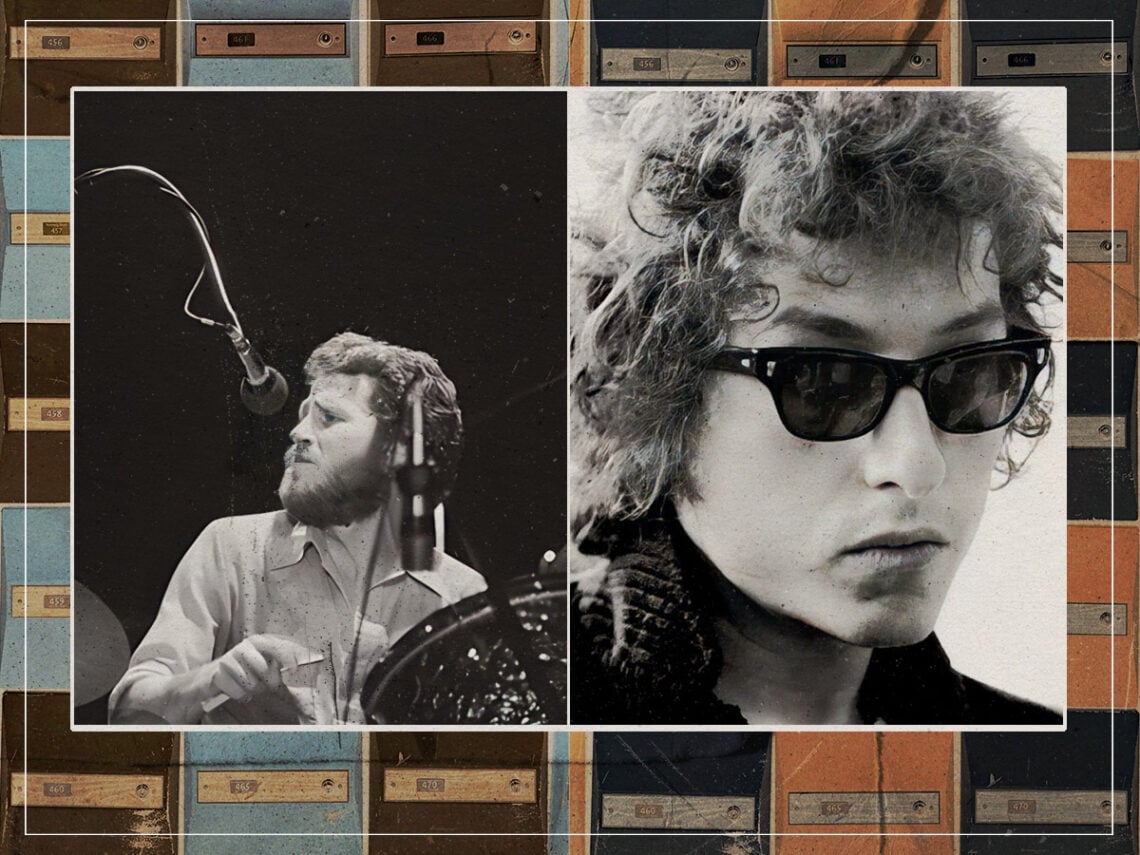
A question of taste: why Levon Helm hated playing with Bob Dylan

It became evident to Levon Helm early on that he wasn’t destined for an ordinary life. More drawn to music and girls than academia, by the age of 17, fellow Arkansan rocker Ronnie Hawkins had recruited him as his drummer. Alongside his fellow members of Hawkins’ backing band, The Hawks, Helm played a pivotal role in shaping the Toronto sound, eventually supporting Bob Dylan’s transition to electric music.
The days from 1958 to 1963 when Helm and the rest of The Hawks backed Ronnie Hawkins are the stuff of rock ‘n’ roll lore, filled with ample sex and partying. However, their musical innovations are the most important from this era. They established a specific rockabilly character by focusing on the Delta sound of storied Black pioneers and fusing it with new rock ‘n’ roll. While each member was vital to this, Helm’s drumming stood out as their bedrock as he blended rock and jazz influences into unique grooves. Their music was so impactful that older statesmen such as BB King and Muddy Waters became fans.
Things would eventually sour between Hawkins and his band, with him paying each member $75 per show and taking the rest of the $1,000 cheques for himself. After The Hawks were free of their old master, they looked to their future. Suitably, another innovator soon came calling in folk hero Bob Dylan. He offered them more money than they’d ever received for their previous efforts to help bring his new electric sound to the masses.
After releasing his controversial but now widely influential album Bringing It All Back Home in March 1965, Bob Dylan hired The Hawks for a US run, and the ensuing world tour the following year. The 1966 stint is highly significant as it was his first with a band.
Famously, these shows with The Hawks polarised fans, some of whom saw the new move as musical blasphemy, with others championing his fresh sound. This divisive nature was not helped by the first half of the shows being played solely by Dylan on acoustic guitar and harmonica and the second half being rock music backed by The Hawks. It was a confusing medley for those who didn’t know the gravity of what they were witnessing.
The hatred was so intense from some people that one fan even attempted to stab Dylan. This hostility would also affect Helm so much that he would leave the run after just over a month and sit out the rest of the shows, including the world tour of 1966. Needing a break, he went to work on an oil rig in the Gulf of Mexico.
After the 1966 run, the remaining Hawks moved to Saugerties, New York, where they made a series of recordings that would become Dylan’s 1975 effort, The Basement Tapes. The sessions with the Duluth musician ended in October 1967, and by this time, Helm had rejoined the fold, with the group starting to write original songs at their house, Big Pink. This period would provide the basis for The Hawks to become The Band during those 12 months and a musical act in their own image, kicking things off with 1968’s Music from Big Pink. In total, they released ten studio albums across two stints and collaborated with Dylan occasionally.
Despite Dylan playing such a key role in their metamorphosis, Helm openly said he hated playing with him, as revealed in Sandra Tooze’s book, Levon: From Down in the Delta to the Birth of The Band and Beyond. He said that playing with the ‘Gates of Eden’ songwriter “cut him all the way to bone” due to their antithetical musical tastes, with Helm’s R&B and blues supposedly opposed to that of Dylan’s folk.
The drummer would even describe performing with Dylan as “another shitty day in paradise” and that he simply “couldn’t take it”. This might also account for his departure, in light of him explicitly saying he would poke fun at the jeering audience calling for Ringo Starr by flipping them off, making it seem that he wasn’t so bothered by the hate. Bolstering this, he’s quoted as saying the group were also perplexed by Dylan’s sonic experiments, saying: “We’d get confused and didn’t know if we were playing great music or total bullshit”.
Despite Dylan being a pain to work with, Helm maintained that he ignited The Band’s “creative spark”, inspiring them all to take it up a gear and start writing originals again. As we all know, Music from Big Pink is a masterpiece, featuring era-defining cuts such as ‘The Weight’, which would capture the heady essence of hippiedom in its final days.

Never Miss A Tale
The Far Out Bob Dylan Newsletter
All the latest stories about Bob Dylan from the independent voice of culture.
Straight to your inbox.