


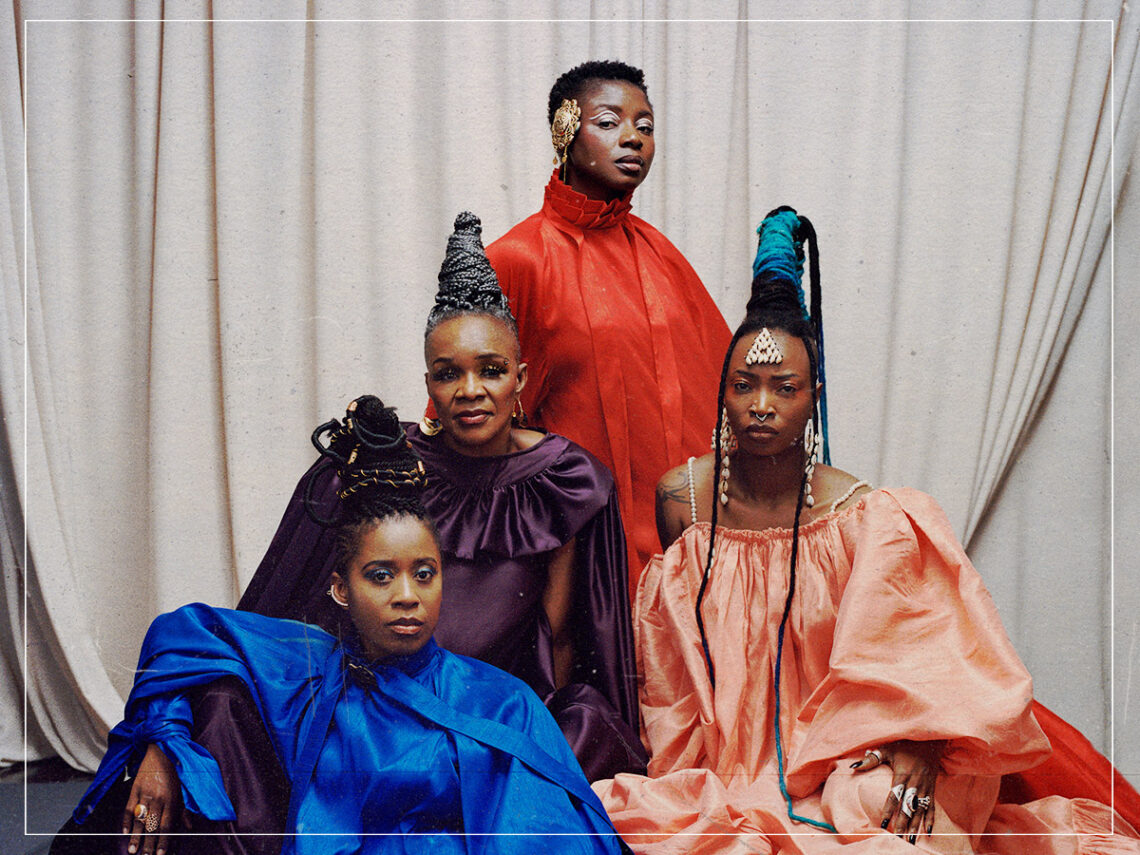
Les Amazones d’Afrique – ‘Musow Danse’ album review: a bombardment of joy

THE SKINNY: Is it possible to have too much of a good thing? For every hungover soul nodding their head in agreement, there’s a poor fellow counting change and saying no. This is the quarrel that rattles around the listener’s mind throughout the new Les Amazones d’Afrique album Musow Danse. So, is it too manic, or is it an exuberant bombardment of joy?
In the end, it feels like both. The explosion of sound on every single track is a force to behold, and it is strangely one that both supports the empowered message of the album while simultaneously crowding it out of clear focus. It’s a glowing exhibition of skill and a thrilling wall of innovative pan-African sounds, but it can also bewilder you to the point where you beg for a bit of pause and refinement.
The album’s title translates to Women’s Dance, and its tagline could easily be: righteous anger rendered danceable. That’s a bold and inspiring concept that thrills on paper alone. When you throw in Jacknife Lee’s famed high-power production and the supergroup at their most unabating in their ten-year span to date, it reaches a soaring height. But it also soars a little close to the sun in some moments, throwing just a few too many flavours into the pot and masking its own complexity as a result.
However, the operative phrase there is ‘in some moments’ because, for the most part, the excited energy is both delightfully fresh and justified given the themes of emancipation that run throughout. The group that formed in Mali wholeheartedly decided to be whatever they wanted to be, which is usually upbeat and belting by tone, but everything from dub to Afrobeat and traditional chanted folk – sometimes at the same time – in musicology.
All in all, Musow Danse is a record that can’t be ignored. Nor should it. It is an important album, but it doesn’t let that get in the way of having a good time—and it does that to an extreme degree, only briefly pausing for more solemn, soulful sections. As a result, like attending a wild wedding party in your 40s, your heart is warmed, and you’re invigorated, but by the end, you’re also utterly worn out.
For Fans Of: Attempting to clean an entire house in one mad hour splurge on a Saturday morning and crashing and burning shortly thereafter, leaving the day’s plans cancelled.
A concluding comment from Tom’s mother: “An album that feels not unlike going to the gym in every way. A triumph if you’re in the mood for it, almost untenable if not”.
Musow Danse track by track:
Release Date: February 16th | Producer: Jacknife Lee | Label: Real World Records
‘Musow Danse (Women’s Dance)’: The record begins with a garbled polyphonic melody that sounds not unlike a broken children’s toy before exploding into a dub bass. This kicks things off like going to a theme park and heading straight from the car park to the biggest ride. It’s fun, but it’s a lot. [3.5/5]
‘Mother Murakoza’: A synthesised club phaser wails away as brooding vocals belt over the top. The song continues on this high-energy oscillation throughout. The end result is something with a lot of atmosphere, so much, in fact, that you wish it move on somewhat because you’re growing woozy, breathing the same air for too long. [2/5]
‘Flaws’: A groovy disco bass provides ample wiggle room for a sexy chanted topline to twist and turn. The vocal harmony put down is sublime. The truly singular mix of textures and sounds is stunning. The empowerment is unabating. Sleek transitions put the cherry on top. [4.5/5]
‘Kiss Me’: Opening with the album’s first moment of calm, this slow-building traditional chant is captivating throughout. The song steadily layers itself into a choppy house mix—but it’s a mix that could be smoothed out with a little more consideration. [3/5]
‘Kuma Fo (What They Say)’ – The attitude on ‘Kuma Fo’ is profound, with the track borrowing musical contours and cadences from hip hop. However, the way it marches to the beat of its own drum throughout is a symbol of the album’s triumphant originality and the idiosyncratic exuberance of the performances. [3.5/5]
‘Espérance’: Suddenly, things get solemn, and the twinkling ambience is mellow. If the album is a wedding party, then this is the exchanging of vows. It is in this moment where the true vulnerability of the emancipation they sing of is displayed, and the record’s importance dawns. [4/5]
‘To Be Loved’: A rather more retro cut sees a sparser production approach arise. The song is largely driven by a drum beat, a background choral chant, and a superb topline performance by featured artist Kandy Guira. It’s a track primed for the build-up to a pivotal scene in a movie. [4/5]
‘Queen Kuruma’: A song that you might describe as lovely if you just slowed its tempo a fraction. Instead, it seems to race ahead of itself somewhat, forcing the vocals to be a little breathless. This unrelenting pace also hammers home the repetition that can become a little grating. [3/5]
‘Bobo Me (Interlude)’: While the initial beat feels a little bit pre-set, the song soon develops into an embalming mix of modern pop decorated with traditional flourishes. Suddenly, the familiar has a mystical feel, akin to an Afrobeat remix of Billie Eilish. [3.5/5]
‘Amahoro (Don’t Get Angry)’: Sadly, the album’s daring sonic adventure heads toward a cluster of cliched commercial sounds with this outing. While the performances are still vibrant and as singular as ever, that high-pitched, cheap synth stab just makes the whole thing feel far cornier than it is. [2/5]
‘My Place’: The stagnated cuts at this point in an already manic album create an unnecessary dose of annoyance, but steadily, the strange, pulsing energy of the mystic song enraptures you in a manner akin to watching the seamlessly aimless flight of a bird on a day with few plans to test your patience. [3.5/5]
‘Bobo Me’: The track revisits the interlude we heard only two songs ago. It is a welcome return to a curious piece of highly original music, but it also makes you question whether the interlude should have been 92 seconds the first time around because the grand finale ultimately feels a bit like listening to a song you’ve already just heard, so what would be a fascinating, enigmatic piece of music is actually somewhat stilted. [3.5/5]

Never Miss A Beat
The Far Out New Music Newsletter
All the latest New Music from the independent voice of culture.
Straight to your inbox.