


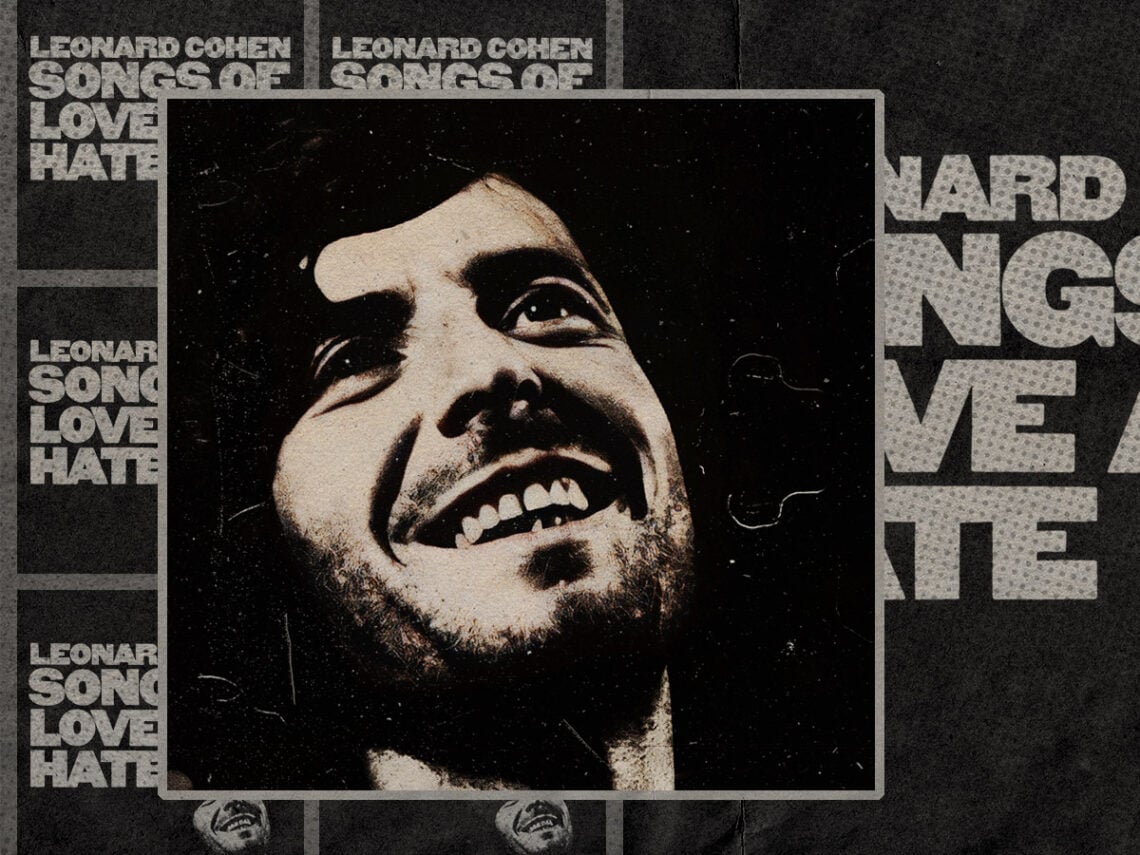
Leonard Cohen – ‘Songs of Love and Hate’

Few artists have expressed the breadths of human emotion with as much poetic potency and deep understanding of love and loss as Leonard Cohen. After beginning his career as a poet and novelist, he began performing his words as musical compositions in the late 1960s with the release of his debut album, Songs of Leonard Cohen.
The musician was a master of exploring human concerns, from politics to sex to religion, the latter infiltrating almost every aspect of his work. Songs of Love and Hate is no exception. Released in 1971, Cohen once explained that during the period in which he wrote and recorded the record, “absolutely everything was beginning to fall apart around me: my spirit, my intentions, my will. So I went into a deep and long depression.”
Subsequently, the album reveals fears of uncertainty regarding religion and death, heartbreak, and self-doubt. Cohen imbues every track with a complete offering of his soul, revealing the depths of his emotional plight as he muses on love and hate, themes that intertwine with each other. The songs cannot be divided into one category or the other. Instead, Cohen allows himself to feel both emotions at once. Often, his hate is spurred by love or vice versa.
Songs of Love and Hate begins with ‘Avalanche’, a haunting composition that received a punk-inspired reimagining in 1984 by Nick Cave and the Bad Seeds. Although Cave offers an interesting interpretation of the song, Cohen’s original composition is incomparable, opening with acoustic guitars that unravel with intense picking as brooding strings enter to create a dark and foreboding atmosphere. His use of metaphor, such as an avalanche that “covered up my soul”, conveys the depths of his pain with sheer beauty, creating a dichotomy that reflects a divide within us, forcing us to acknowledge our paradoxes and complexities.
On ‘Last Year’s Man’, Cohen continues to employ religious imagery, much more explicitly this time. He sings such breathtaking lines as, “Some women wait for Jesus, and some women wait for Cain/ So I hang upon my altar/ And I hoist my axe again,” further establishing themes of division and contrast, reflecting the album’s overarching idea of opposites merging themselves as one. In these lines, Cohen compares himself to both religious figures before acknowledging that he is, in fact, neither.
‘Dress Rehearsal Rag’ takes the album to one of its darkest peaks, albeit with plenty of black humour. Cohen contemplates suicide after describing his bleak living conditions, singing: “That’s right, it’s come to this/ Yes it’s come to this”. Due to the intimate nature of the topic, Cohen never sang the track live, stating: “I haven’t been able to release that song from its private area.” It remains one of the record’s most painful tracks, although Cohen reminds us of the absurdity of life by incorporating lines such as “Cover up your face with soap, there/ Now you’re Santa Claus.”
Cohen moulds his voice into something more fierce on ‘Diamonds in the Mine’, which ups the pace as the musician channels fury and raw sexuality, not without many biblical allusions, as he sings: “He was eating up a lady where the lions and Christians fight”. Cohen brings back the fast-paced plucking of ‘Avalanche’ for ‘Love Calls You By Your Name’, which the Canadian introduced at a concert as “about that place between the beginning and the end of things, in which you summon yourself.”
However, one of the finest songs the singer ever penned appears next, in the shape of ‘Famous Blue Raincoat’. From Cohen’s gentle chords and the lilt of his voice to the tender female backing vocals and subtle violins, the song is practically perfect. The piece addresses the new man of Cohen’s previous lover, describing him as “my brother/my killer”. This is a further biblical allusion to Cain’s murder of his brother, Abel, which is considered the first act of murder in the history of humanity, thus reflecting Cohen’s deep despair. The track is utterly heartwrenching, as evidenced in the lines, “Yes, and thanks for the trouble/ You took from her eyes/ I thought it was there for good/ So I never tried.”
Cohen calls back to the previous two tracks at the beginning of the upbeat ‘Sing Another Song, Boys’, giving listeners a break from the heartbreak previously delivered. Although the song is not entirely hopeful (“But let’s leave these lovers wondering/ Why they cannot have each other”), Cohen doesn’t lament melancholically. Rather, he embraces the situation of temporary sexual unfulfillment as a natural part of the human experience, rejoicing in “La la la la’s”.
Songs of Love and Hate ends with ‘Joan of Arc’, which Cohen described in an interview with Kathleen Kendal as “about total gift, of total giving and total consummation of a spirit in that kind of experience. It takes in the whole shot to me: man and woman”. Cohen delivers his thoughts on destiny and desire from the perspective of the fire that engulfed Joan of Arc, singing simple yet powerful lines such as, “And then she clearly understood/ If he was fire, oh then she must be wood”.
Cohen’s third album demonstrates his incredible talent for writing poetical narratives, leaving an indelible mark on the listener. As Nick Cave once wrote: “Leonard Cohen will sing, and the boy will suddenly breathe as if for the first time, and fall inside the laughing man’s voice and hide”. This sentiment encapsulates Songs of Love and Hate, which remains one of the artist’s most breathtaking outputs.
