


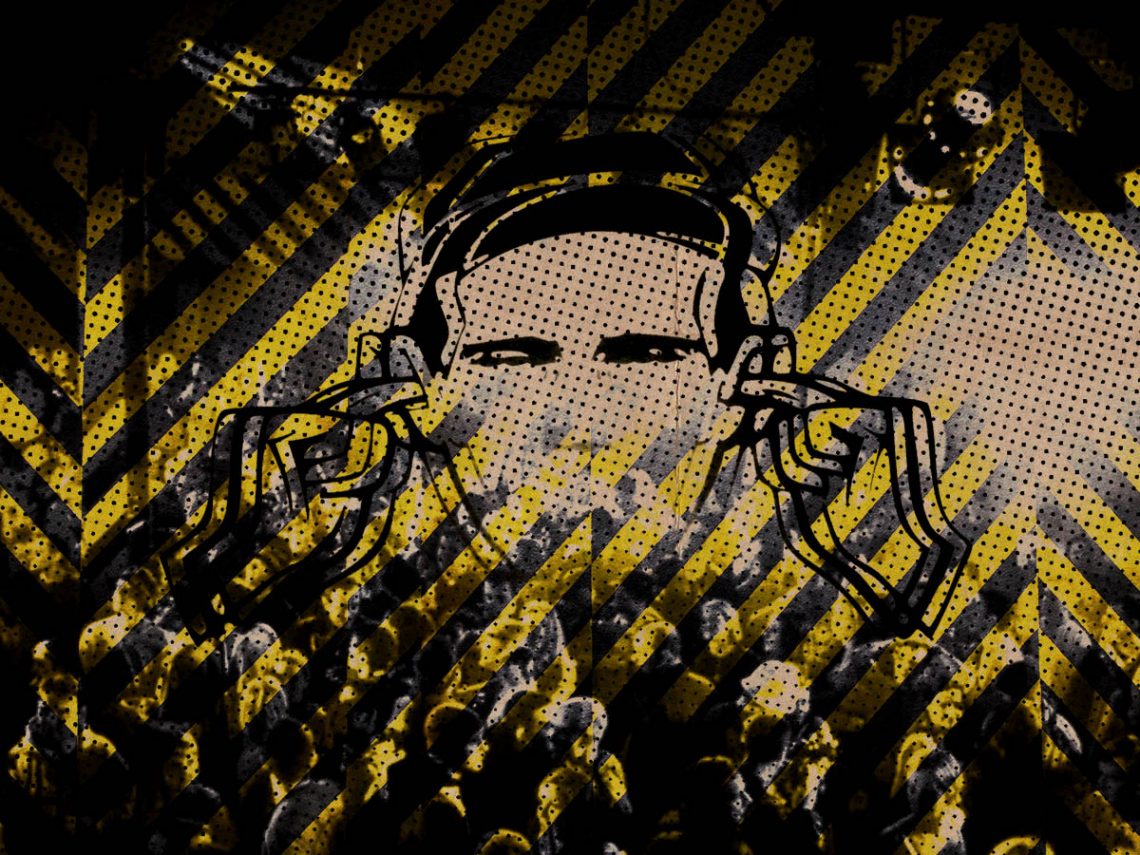
The Hacienda Must Be Built: the legacy of Britain’s greatest nightclub 40 years on

Today, only the memory of the Hacienda remains. In its heyday, the Manchester nightclub represented the very pinnacle of British youth culture. It was the centre of the acid house revolution, gave birth to a new breed of groups like The Happy Mondays, and transformed a neglected post-industrial city into the epicentre of a music revolution.
And then, just like that, it was all over. Though it’s been 40 years since the Hacienda first opened its doors, the story of this incredibly influential space remains more important than ever. As well as providing valuable insight into how cultural movements are born, it reminds us of the central importance of venues and shared spaces. This is an oral history of the Hacienda: the nightclub that changed Britain.
Before the Hacienda
The Hacienda was never conceived as a nightclub. It wasn’t conceived as a music venue either. Factory Records founder Tony Wilson wanted to create a “cathedral” for the people of Manchester, a space where creativity and cultural innovation could bloom. He’d just been to America with New Order and A Certain Ratio, where he’d visited New York discotheques like Danceteria and Hurrah’s – venues with multiple floors and huge sound systems.
There was nothing remotely similar in Britain at the time, let alone Manchester. The city was, by all accounts, an unflinchingly grim place to live at that time, least of all because, by 1978, almost all the venues had been shut down by the authorities, the anarchy of youth swept away by law and order. “At that time, Manchester was in decline,” Joy Division and New Order bassist Peter Hook tells me over a shaky telephone line. “This was the era of the three-day week, of blackouts and all that. A lot of people were unemployed; the economy was shot; the miners were on strike – it was a very turbulent time. There was also nowhere you could go in Manchester dressed how we were dressed. So we were excluded by being punks, by being post-punk and by being new-romantic. If you wanted to go out, you had to dress a certain way and listen to a certain kind of music, which was very much commercial pop.”
Acting as a sort of punk ambassador, Tony Wilson decided to fill the void with The Russell Club, which hosted bands like Joy Division and eventually led to Factory Records. When Ian Curtis died, the label recieved a huge influx of money, which Wilson decided to give back to Manchester in the form of The Hacienda. “I always thought in some ways it was Factory paying royalties to the city,” the label boss told Jon Savage in 1992, “Great pop comes out of cultures, there’s always culture behind it. Part of the genius of Joy Division was the culture of Manchester, and we were repaying some of those royalties building it for the city. It’s been there, feeding all the time.” But before any cultural innovation could occur, the Hacienda needed to be built.

Building the Hacienda
Musical movements are reactions to and reflections of the spaces in which they are born. I was interested in uncovering to what extent the layout of the Hacienda contributed to it becoming the birthplace of acid house, so I spoke to the man who designed it, Ben Kelly. When he was first shown the building, which had sat empty for some considerable time, it was “a dirty, filthy, empty, and slightly ragged-around-the-edges former yacht showroom.” Wilson and Gretton had originally intended Factory’s in-house album artist Peter Savile to design the interior. On seeing the space, Savile turned down the job, suggesting that they get in touch with his friend, Ben, instead. “I got the train up from Manchester and was taken to the building and given the whole tour,” Kelly recalls. “When we came back to the entrance, they looked at me and said, Do you want the job? And I said, “of course, I want the fucking job.”
Kelly quickly set about forming plans for the space. “Knowing that bands were going to play in this place, the first debate was where exactly the stage should go. I strongly believed that it should not go, as had been suggested, at the far end of the building because that would imply that the space was a venue and the idea was it was going to be a club. I felt strongly that it should be at one side, and that led me logically to assume that the bar should be at the far end so that when people came into the space, they would make a journey to the first place they really wanted to go – the bar. The idea was that people would encounter various things along the way. And because the space was so huge and cavernous and cathedral-like, it sets up the idea of there being a kind of landscape within the space. The journey to that landscape was an important thing.”
“There were actually already a couple of people on the team when I arrived, one of whom was a lighting designer who put forward a proposal for a lighting scheme, which was a kind of computer-driven extravaganza that I just thought that’s going to kill the whole project – this stupid bloody computer, which will go through a number of permutations and then go back and do them all over again. I felt really strongly that that was wrong, it would be turning into what I then called a discotheque because that was the vibe you got from that kind of lighting. And I believe that the lighting should be more like theatre lighting and that it should be able to cope with the whole space.” Without knowing, Kelly was implementing design features that would make The Hacienda the perfect place for acid house. “We needed to look at longevity,” Kelly recalls, “knowing that personnel changes, band changes and fashion changes would be inevitable. We thought the club should be able to handle all that stuff so that it had a future and wasn’t locked in one time period.”

Living the Hacienda
Sadly, Kelly’s designs were a little too forward-thinking for some. When the Hacienda first opened, it completely baffled the young people of Manchester. Here was a venue that looked like a warehouse, operated like a pub and behaved like an avant-garde theatre. Nobody knew what to make of it, so it remained pretty much empty save for a few goths and shoegazers sipping ale and looking moody. At one point, Wilson and Gretton even experimented with putting on a stripper to attract mid-week punters.
Suffice it to say it didn’t work. Initially, dancing just didn’t seem to fit with the overall vibe of The Hacienda, as Madonna discovered when she performed an early set to a crowd of fringes doing their best to look surly and unenthused. “The club seem to be too big and too cold,” says Peter Hook, whose band New Order was often on the bill in the early days. “You were always fighting the architecture. People would come in and look at the club and go, ‘Oh my God, it’s beautiful, It’s wonderful – It’s like an art gallery.’ But they didn’t want to go dancing or get laid. You don’t get laid in an art gallery, do you? You get laid in a club with low ceilings, where it’s dark and steamy and there’s a load of corners and shit like that.”
This is the Hacienda’s forgotten era – the years before acid house took off when it looked like it might bankrupt New Order (who were bankrolling the whole project) and Factory Records in one fell swoop. That’s not to say there weren’t moments worthy of remembrance. “I made a journey from London, where I lived, to Manchester to see William Burroughs perform live readings onstage at the Hacienda,” Kelly tells me, recalling his favourite memory of the venue. “And that, to me, was absolutely mind-blowing. For some reason, the club was full that night, and it’d been half empty before. It was all because of the intrigue and interest generated by Burroughs’ being there.”
Things really started cooking around 1986. By this point, electro and rap had started moving in. But according to Peter, Rob Gretton and Mike Pickering had been championing Detroit house from as early as 1983. “I’ve got flyers downstairs showing the same lineup we put on the bloody Hacienda nights now. So they really were ahead of their time. Hewan, the first DJ [at the Hacienda], he actually DJ’d on Radio Merseyside and was playing a lot of reggae and a lot of funk and a lot of what you’d consider Black music. So the grounding, if you like, of the DJing at the Hacienda was funk, soul, disco. That had an effect on Rob and Mike and let them to Detroit house.”
The Hacienda’s clientele was changing, as were their musical tastes and attitude towards Black music. “Suddenly, so many more people were interested in house music, and they all crowded into the Hacienda,” Peter explains. “And all of a sudden, it was steamy. And it was dark. And everyone was off their nut – it was the perfect place for acid house. It really was the uniqueness of the design and the grandeur of the ‘cathedral-like’ spaces, as Tony always used to say. It really lent itself to the music and really came into its moment with the hordes, if you like, that wanted to celebrate house music at that time.”
By the end of 1988, the Hacienda was the beating heart of the acid house revolution. This bought almost as many problems as it did benefits. The popularity of ecstasy amongst the clientele meant that everyone stopped buying beer, one of the venue’s few reliable sources of revenue. Then again, money had never been on the top of Wilson or Gretton’s list of priorities. They’d remained adamant that nobody should pay to get in and eventually started giving away beer for nothing. In The Hacienda, countless young people found a place where they could be free. “That’s what the Hacienda was all about: It wasn’t exclusive, it was inclusive,” Hook says. “It seemed to say, ‘whoever you are, whatever you wear, wherever you’re from – you’re welcome here.’ That was what Tony and Rob had envisaged, and that’s how they ran it as much as they could.”

Remembering the Hacienda
Tony Wilson once called nostalgia “a disease”. Peter Hook isn’t so phased. “I like it,” he says, dismissing the way Wilson used to accuse him of being regressive. “‘Ooh, you’re so melancholy,’ he used to say – as if it was bad. The whole point of the Hacienda Classical [set to take place on July 8th, 2023] is to celebrate the music. And we’ve been selling out every year for seven years. 8000 people for the Hacienda night.”
Hook would be the first to admit that The Hacienda was a badly run club. It continually lost more money than it gained until drug-related deaths, organised crime, and gun violence finally forced it to close its doors. And yet, people still worship its memory. Why? Perhaps because it represents the importance of risk, the value of putting joy above profit, and reminds us that there was a time when music had real cultural clout. “Rob and Tony took a chance every night,” Hook says. “If you look at something like Flesh, the LGBTQ+ night: that became a celebration of a wonderful aspect of our culture. People were free in the Hacienda to do whatever they wanted. So you’ve got to respect them. But they were terrible businessmen,” he concedes. “Absolutely awful businessmen. Peter Stringfellows, they weren’t.”
The Hacienda was undoubtedly a product of its time. Countless people would love to see something like that happen again, but it’s possible we’re too spoilt for choice. “The thing is, clubs have got a lot of competition now,” Peter says. “Most wine bars and pubs can stay open till two or three, and they can get a late license till four. In the Hacienda’s day, it was only clubs that could stay open till two, so it had no competition. Nowadays, with the amount of entertainment on offer on television, you’re able to entertain yourself so much that the clubs, especially from a cost point of view and with how difficult they are to run and all the red tape etc., they’re really on the back foot. Now, through Covid, the industry has greatly declined and really hasn’t had much help.”
If the story of the Hacienda teaches us anything, it’s that cultural innovation requires public space. The club was a gift for the people of Manchester, and the people of Manchester treated it as such, embracing an explosion of new trends, new ideas and new music. The Hacienda represents a patchwork of shared experiences, a collective memory of collective joy. With Saturday marking its 40th anniversary, now is the time to rekindle that joy and check out some of the upcoming events taking place to celebrate the occasion.
If you want to learn more about the Hacienda’s history and legacy, check out BBC Two’s new one-off documentary, The Hacienda: The Club That Shook Britain, which features interviews with some of the club’s key players and aired on BBC Two on Saturday, November 5th.
