


Hear Me Out: Labelling Ghost as ‘metal’ is too reductive

Ever since Ghost first commanded the spotlight back in 2010, the band has been shoehorned into predominantly ‘metal’ spaces. This has angered die-hard metal fans, who – somewhat problematically – call their music too ‘camp’ to be real metal. Whatever ‘real metal’ is these days.
Of course, they also pull out many other reasons why Ghost is not welcome in their elite facets, like not being metal enough or not being the ‘right kind’ of metal. The worst critique is that the band are simply ‘too theatrical’ to ever be taken seriously. Now, most of these critical points come from fans of nu-metal, namely Megadeth, Korn, Pantera, Deftones, and so on. None of the aforementioned groups are bad, it’s important to say, but it’s equally vital to acknowledge that if you’re reducing metal to a subset of restricted characteristics, Ghost most certainly won’t deliver to your expectations. Neither will many other bands, for that matter.
In reality, the cornerstone of Ghost’s music is a tasteful blend of various musical conventions. The early sensibilities of heavy bands like Metallica, Iron Maiden, Black Sabbath, and Slayer have been forged with the alternative dynamics of Depeche Mode, Eurythmics, and Genesis, along with the artistic pop grooves of ABBA, Tina Turner, and Kim Wilde. The result? Music that is incredibly addictive, intensely enjoyable, and beyond most major rock players of today’s landscape.
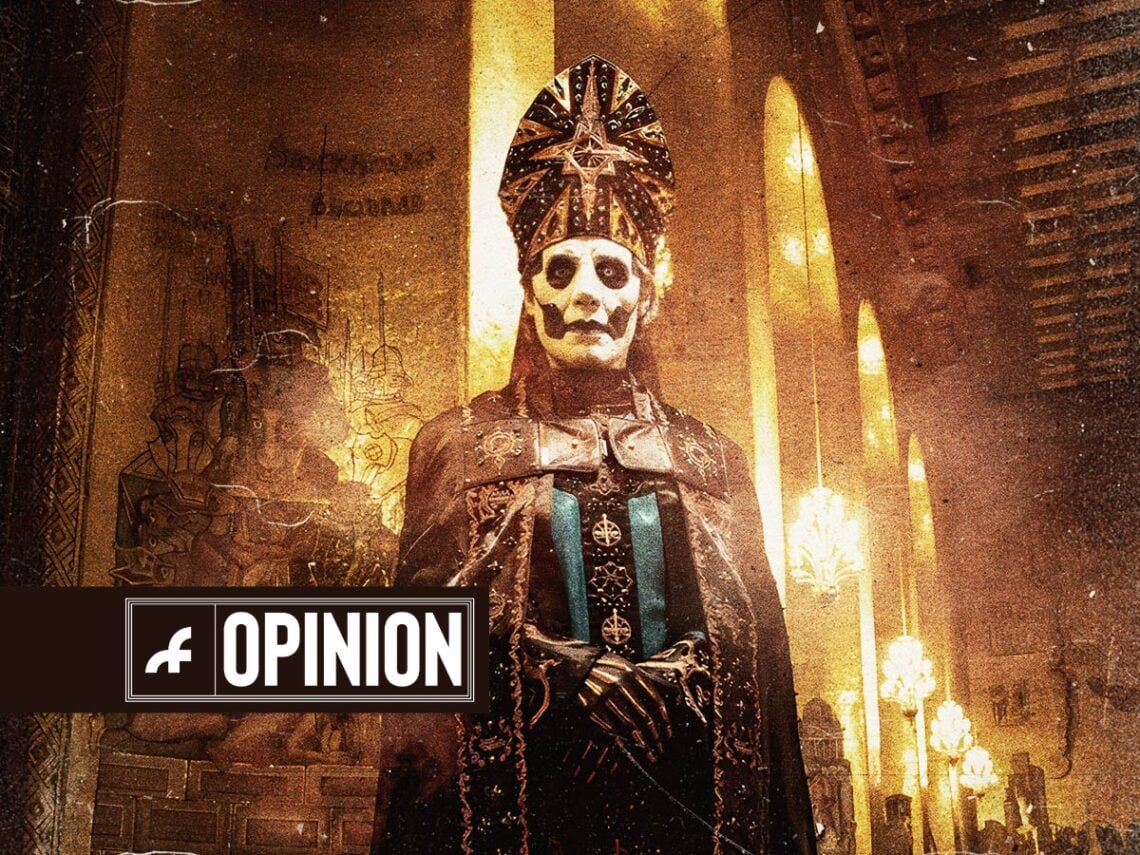
And that’s just their sound. Their image is another beast entirely – explaining Ghost to anyone that’s unfamiliar is an interesting challenge. In essence, with each album, the band forgoes a new era, along with a new frontman – but the frontman is also a fictional character, played by the band’s singer and principal songwriter Tobias Forge, who wears an extensively-built mask to convey this new persona. He’s also accompanied by his band members, aptly called ‘The Nameless Ghouls’.
The band’s on-stage theatricals and pyrotechnics have been long-criticised by metal fans who deem them too childish or animated for their beloved circles. However, considering the way Ghost transcends all genres and fuses their lore with deeply engaging narratives, with characters who are rich in humour and musical satire, they are beyond a label as reductive as simply just metal. Make no mistake, the band borrows a lot from metal, but calling them an entirely metal band doesn’t feel all that fitting anymore.
Ghost is the brainchild of frontman Forge, who comes from an almost exclusively metal background. His previous bands were all within the death metal spaces, with the exception of Subvision, which was considerably lighter, but when he moved on to Ghost, he created something even richer than anyone could’ve imagined. The most important thing is that they’re accessible to all; they incorporate that familiar rawness of early metal contributions, coupled with layered lyricism and catchy, pop-like melodies.
Forge himself is a music lover, and Ghost was a project intended to feel like a band from the past coming back to haunt you – in the best way possible. At the same time, Forge finds amusement in receiving ‘hate’ for such shallow reasons because it reminds him that his music isn’t for snobs or, worse, bigots.
