


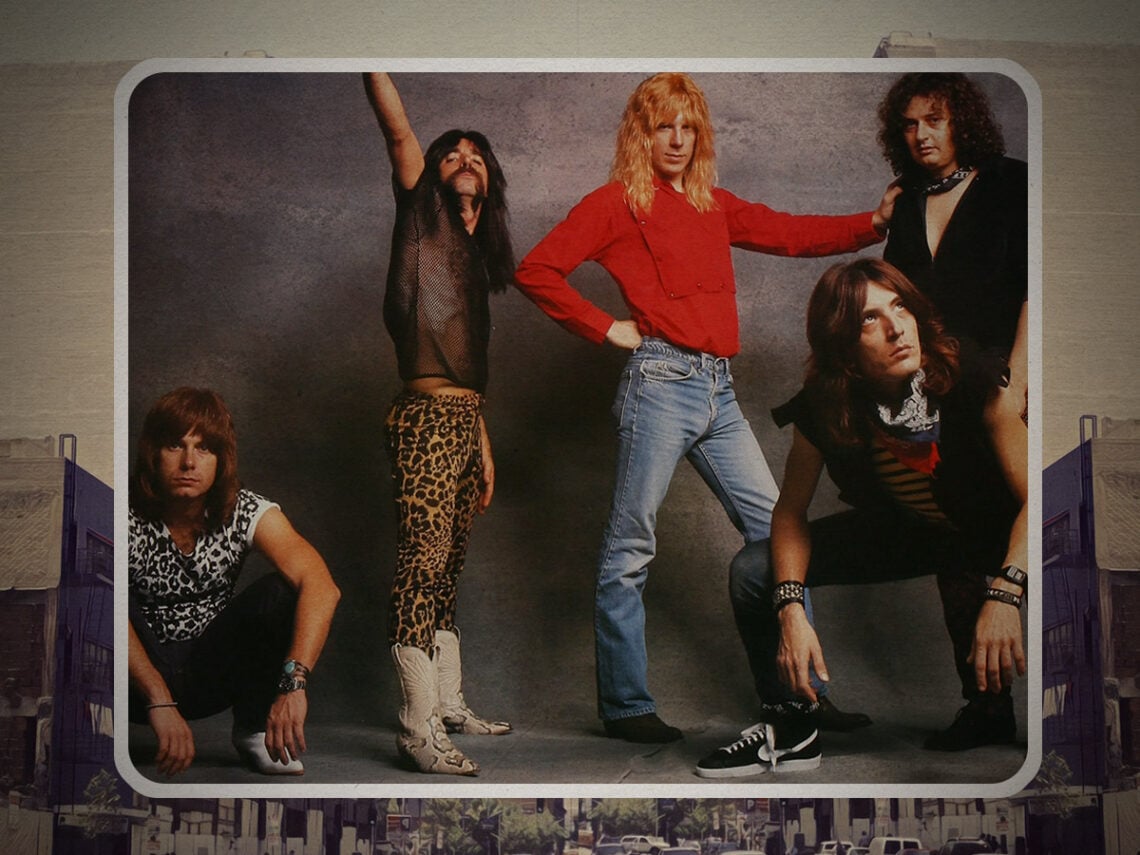
The LA hotel that accidentally formed the UK’s greatest fictional band: “Where’s your bass?”

The United Kingdom has been responsible for some of the greatest and most iconic bands in music history, but the nation’s most iconic fictional group originated in the lobby of an LA hotel.
Whether it’s The Beatles, the Rolling Stones, Queen, Pink Floyd, Led Zeppelin, Black Sabbath, The Who, or anyone else, the 1960s and 1970s were awash with British acts who became global superstars, touring the world to packed houses and changing the landscape of the industry forever.
Naturally, then, the country’s most famous band, which technically wasn’t a real band until it kind of was, had barely any connections to the UK at all. While their founder and creator, if you can even call them that, had an English-born father, the rest of the band were American, and they made their debut in a movie that was directed by an American, which isn’t very British at all.
And yet, are there any fictional bands that can hold a candle to Spinal Tap in terms of impact or legacy? After all, they served as the basis for the movie that ushered in the age of the modern mockumentary, and Rob Reiner’s feature-length debut is still regarded by many as the benchmark for the entire genre.
Christopher Guest, Harry Shearer, and Michael McKean have toured and played live shows as Nigel Tufnel, Derek Smalls, and David St Hubbins, recorded and released four studio albums, and despite existing solely for the purposes of making audiences laugh, some of their songs are actually pretty damned good.
As per their fictional history, Spinal Tap began life as beat musicians, The Thamesmen, in 1964. They evolved into a psychedelic pop group under their current moniker two years later, before adopting their signature heavy metal sound in the ’70s, all while several of their drummers died under mysterious circumstances.
While Spinal Tap’s first appearance was in a 1979 skit that aired on TV, the seed was planted long before then. “In the ’70s, I was in LA, in the lobby, waiting for a friend at a hotel,” Guest recalled. “And a British band came in, and the manager went up to the desk, and he was checking in. And he turned, and one of the musicians was standing there, and he said, ‘Where’s your bass, where’d you put your bass?'”
Naturally, the bassist had no idea, and Guest watched them bicker back and forth about it for 20 minutes. Every time the manager asked a question about its whereabouts, the answer was some variation of, “I don’t know, do I?” In his head, “this lodged into some kind of bizarre one-act play,” and he couldn’t seem to forget about it.
Several years later, and with Guest and McKean already having written and performed songs together, and with the former having also played guitar under the Nigel Tufnel pseudonym on David Lander’s album, Lenny and the Squiqtones, everything coalesced together by the end of the decade, Spinal Tap was born, and history was ready to be made.
