


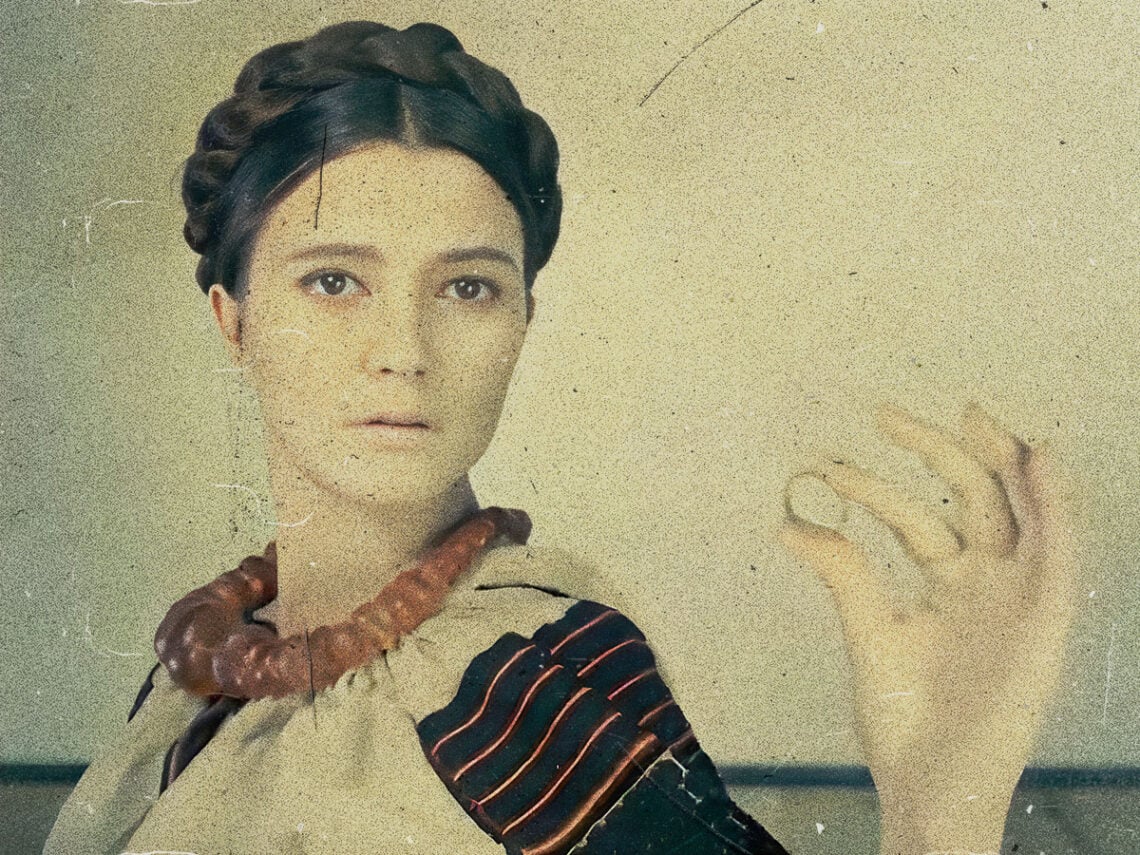
‘Kyiv Frescoes’: glimpses of a lost Sergei Parajanov masterpiece

Throughout the history of cinema, several great artists have contributed to its evolution by working on innumerable innovations and developments. However, very few have approached the medium with an artistic vision so original that their styles became simultaneously influential yet practically inimitable. Armenian auteur Sergei Parajanov belongs to that formidable latter category, having made some of the most distinctive cinematic projects of all time.
Inspired by pioneers like Andrei Tarkovsky and Pier Paolo Pasolini, Parajanov transcended the limitations of contemporary social realism by formulating a new visual language that was infinitely more symbolic and profound. While modern audiences primarily know him due to the seminal impact of his magnum opus, The Colour of Pomegranates, Parajanov’s fascinating aesthetic frameworks paved the way for a form of artistic expression that seemed so unfamiliar but personal.
During an interview with Ron Holloway, Parajanov claimed that he primarily saw himself as a graphic artist working with film. He explained: “I’m a graphic artist and a director who seeks to shape images. [Igor] Savchenko, our mentor, encouraged us to sketch our thoughts — and give them plastic form. We all had to draw our thoughts at the film school. For the entrance examination, we were brought to a room and told: ‘Draw whatever you like…'”
Although The Colour of Pomegranates proved to be the ultimate manifestation of Parajanov’s unparalleled style, it actually originated in a lost masterpiece called Kyiv Frescoes. Censored by the Soviet authorities, who were afraid of Parajanov’s uncompromising originality and his revolutionary language, the production was stopped. The filmmaker was also ordered to destroy the negatives, robbing the world of what could have been a fundamental artistic thesis.
“I worked and suffered, under three despots,” Parajanov reflected in the same interview. “The despots were in the Kremlin. And today, perestroika is seeking to become the cardiogram of the times. Perhaps, one day, a book will appear dealing with all those years, something like a cardiogram. As Stalin was on his way up, he lowered the price of socks. And people were content; socks were two kopeks cheaper. Every six months, he would drop the price of socks and undershirts. But the price of bread didn’t change. A cardiogram… The Soviet films of that era – and not just mine – are like a cardiogram of terror. They are cardiograms of fear. The fear of losing your film, the fear of starving. You feared for your work.”
It’s easy to watch the surviving 15 minutes of Kyiv Frescoes and fantasise about the potential of the project, but even in its current form, it’s a work of sublime beauty. Due to the fragmentation of the narrative, it almost seems like the individual vignettes anticipate the absurdity of some of Roy Andersson’s ideas. However, it’s the infinitely nuanced symbolic interface of the visual layer that marks a critical turning point for Soviet cinema. It’s obvious that Kyiv Frescoes could have been a remarkable work like The Colour of Pomegranates, but just this compilation is enough to demonstrate Parajanov’s genius.
Watch the film below.
