


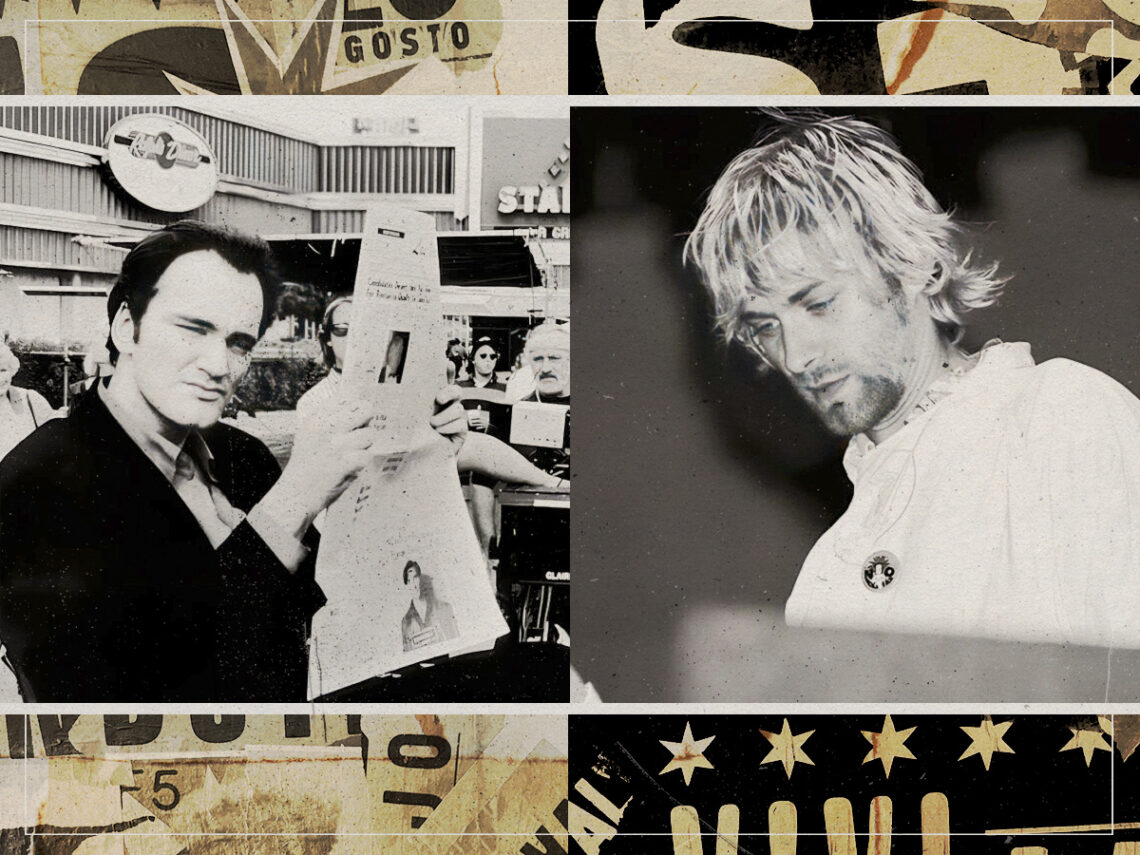
“On parallel tracks”: Why did Kurt Cobain thank Quentin Tarantino on ‘In Utero’?

The 1990s have become increasingly mythologised in recent years.
From the resurgence of the decade’s most questionable hairstyles to the nihilistic attitude shaped by the looming sense of apocalypse that defined its youth, the ‘90s are undeniably back in fashion. Yet, beneath the nostalgia lies a decade that truly had its bright spots—an exhilarating time for artistic creation. It was a cultural moment when the underdogs seemed to rise up and topple the monoliths that had long dominated music, film, and media. With a simultaneous changing of the guard in both industries, opportunities to thrive outside the mainstream grew. Nirvana, with their raw, unpolished sound, and Quentin Tarantino, with his fearless storytelling, became the torchbearers of this new era, helping to shape Gen X in their bold, unfiltered image.
Nirvana’s frontman Kurt Cobain was even hotly tipped to appear in Tarantino’s 1994 film Pulp Fiction, which sadly never came to fruition. According to Courtney Love, Cobain was set to be cast in the movie as Lance, Vincent Vega’s heroin dealer, though the acclaimed director has always quashed this theory.
However, that’s not where the links between the two behemoths of cinema and music end. There is perhaps no more significant 1990s pop culture crossover than this one. Cobain was rightly christened as his generation’s voracious voice. Meanwhile, Tarantino was breaking all the rules and similarly reimagining the film industry.
The 1990s emerged as a visceral reaction against the mass consumerism that defined the previous decade. The Reagan-era ’80s had transformed society into a ruthless capitalist venture, driven by brutal competition that left the “little guy” battered and bleeding on the floor. The insatiable hunger for more—fuelled by hyper-commercialisation—was in overdrive throughout the ’80s. By the time the ’90s rolled around, people craved something money couldn’t buy. The revival of DIY ethics became a powerful antidote to the excess, reintroducing heart, authenticity, and a sense of grassroots community into the cultural zeitgeist.
Cobain was ready to step up and bring some authenticity to the alt-rock genre. Meanwhile, over in Indiewood, a young Quentin Tarantino was doing the same—creating visually stunning and narratively captivating films for a new generation. The Nirvana frontman was taken back by Tarantino’s greatness to such a degree that he even thanked him on 1993’s In Utero, even though the two men never met.
Tarantino later spoke in detail about how the two pop-culture phenomenons aligned. He told Australian radio station Double J: “There was an aspect of American independent cinema in general, and my movie, Reservoir Dogs, in particular, coincided with the alternative music grunge scene. We were kind of on parallel tracks. We were doing a new type of way to do a movie.”
It was a notion that appealed to a whole host of people. It didn’t just pull in audiences from across the globe but also connected deeply with other artists: “People had got sick of the corporatised Hollywood movies of the ’80s and the same with the corporatised music of the ’80s for music,” Tarantino explains. “One thing that’s interesting from Reservoir Dogs, part of the ironicness of it, is that we are playing these innocuous ’70s pop songs with this violent crime story,” reflected the director, drawing out one of the film’s genuine plot points.
“One of the things that was really interesting without me trying to do this at all, the Seattle grunge bands of the day loved Reservoir Dogs,” recalled Tarantino, with a smile across his face. “Basically, I think it was a good tour bus movie, you could put the video up, and you could play it all the time, and everyone knew the dialogue.”
Tarantino then revealed, “Pearl Jam loved the film, Nirvana loved the film, and Kurt Cobain loved the movie so much he thanked me on his second [sic] album. On In Utero, I’m in the thank you’s, and I never met him. He just loved Reservoir Dogs so much that he thanked me in the thank you’s.”
While Tarantino’s adoration for Nirvana seemingly wasn’t reciprocal to Cobain’s love of his work, as he mistakenly labelled In Utero as the Seattle band’s second album. Despite the rookie error, it’s clear that there’s deep respect held for what Cobain managed to do in the music industry and how he forcefully changed society’s aesthetics, just like Reservoir Dogs did.

Never Miss A Take
The Far Out Quentin Tarantino Newsletter
All the latest Quentin Tarantino content from the independent voice of culture.
Straight to your inbox.