


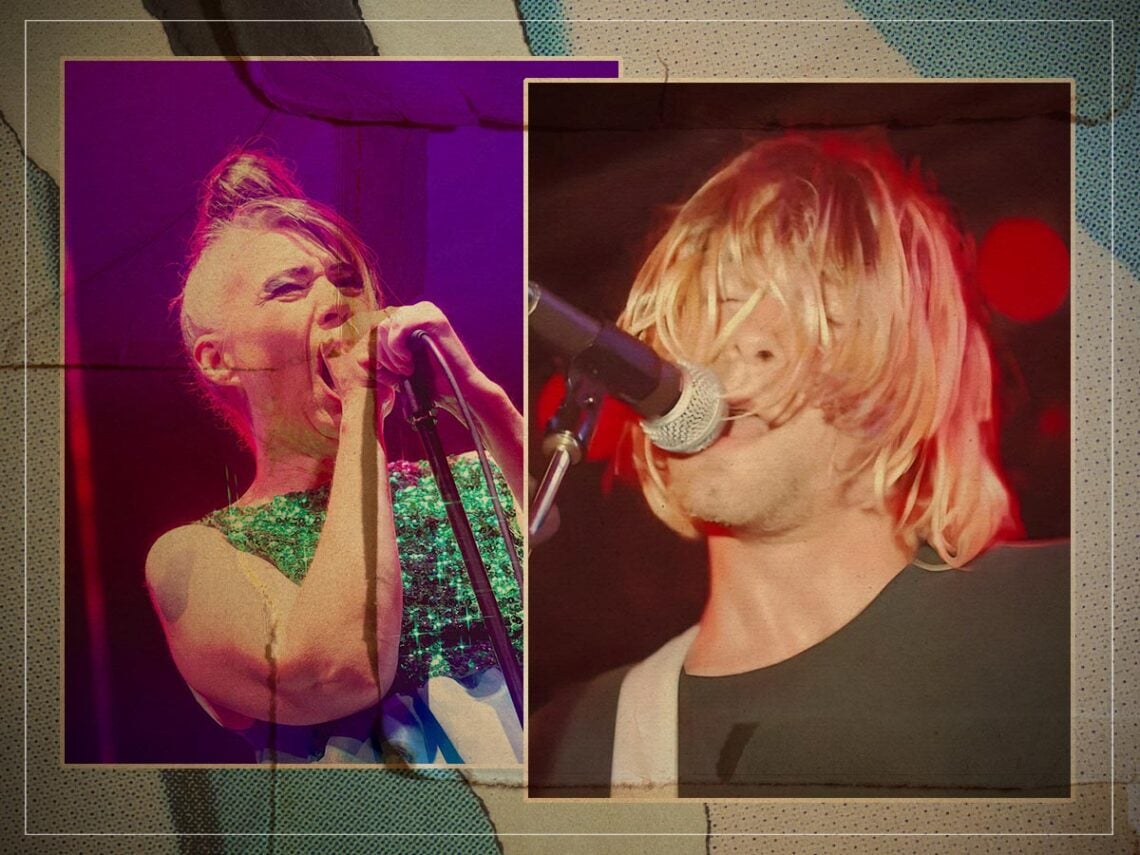
“I wish he would’ve seen us”: the fated friendship between Kurt Cobain and Kathleen Hanna

When Kurt Cobain was at school, he struggled to make friends. Unlike some, whose struggles usually centre around coming out of their shell, Cobain knew he was different the moment he detected the problem with playground vernacular. “Women are just totally oppressed,” he once said, “I mean the words ‘bitch’ and ‘cunt’ were totally common.”
Like Cobain, Kathleen Hanna’s reckoning with real-world injustice happened early. At age nine, she learned the power of fabled feminist thought leader Gloria Steinem after her mother took her to an event where she was billed. “It was the first time I had ever been in a big crowd of women yelling, and it really made me want to do it forever,” she later recalled.
Hanna and Cobain didn’t know each other then, but their minds already worked in similar ways. While the future Nirvana frontman could never truly understand Hanna’s personal struggles as a woman navigating a male-dominated society, he grasped the concept of oppression earlier than most. He felt ostracised, burdened by the realisation that he seemed to be one of the few who recognised such societal shortcomings.
Hanna carried this weight into her spoken-word poetry, calling out such unrelenting ugliness as Steinem had. The path would never be easy, but it felt only natural, like a fire inside that never stopped burning, only exhumed by people who thought, saw, and spoke about the world in ways that were far different from anything she had ever deemed reality.
In school, Cobain didn’t just struggle to make friends because he seemed different. He struggled because he felt there was an innate issue with how people presented themselves. While these were just children, it set a precedent for how they would enter society, which made him feel even more lonely without any real conduit for expressing such disillusionment.

Thankfully, Cobain eventually channelled his values into his music, as did Hanna when she pivoted her craft from spoken word to something more unifying. Such figures don’t come into the mainstream very often, if at all, but the pair’s forthcoming camaraderie was even less likely, which led to them going out drinking together in August 1990. That night saw them painting the world with hopeful prophecies in more ways than one.
Already aligned, the graffiti they left in their wake signalled their desire to change the world for the better—Hanna spray-painted the words ‘fake abortion clinic’ on the side of a pregnancy centre in Washington, while Cobain left his equally provocative message, ‘God is Gay’. Afterwards, they went to a few more bars before Cobain’s apartment called them back to continue the rebellion.
The following day, Hanna knew she had become lost the night before as the haze of a politically intoxicated mind took over, and all she became was a more uninhibited version of herself side-by-side with her like-minded partner in crime. The streets of Washington weren’t privy to such unadulterated controversy, at least not from two influential figures, and while the pair truly held such beliefs, the hangover that followed felt almost as heady as trying to save the world from itself.
According to Hanna, it was “one of those hangovers where you think that if you walked in the next room, there could be a dead body in there.” Although they could have done something far worse than litter their unpopular opinions around the city of Olympia, what followed was something far more important: inspiration for one of the most iconic songs of youth in history. Upon realising she had “smashed up a bunch of shit” the night before, like the true anarchist that lurked within, she had also written the message ‘Kurt smells like Teen Spirit’ on his bedroom wall in reference to a deodorant brand his girlfriend had been wearing at the time.
Here are where the discrepancies in their personalities make themselves clear. While Hanna had desired to make some subtly offensive quip, Cobain found the wording quite profound, almost like it captured the essence of youthful rebellion in just five words. And it did. Much like most of Nirvana’s music, the song tapped into the angst of a generation who had become filled with despair, like a cataclysmic channelling of everything Cobain had felt plagued by growing up.
Even now, Hanna knows their flames would have ignited with the same fervour, much like that one fated night in Washington. Reflecting on her friendship with Cobain and the legacy of Nirvana in her recent book Rebel Girl, her only wish was that he had lived long enough to witness what became of his work. “I just really wish that Kurt could have enjoyed it,” she said. “And that’s the hard part, just being like, ‘Wow, I wish that he would’ve seen us live past the stupid Nineties, you’re-a-sellout thing.’ I was very much a part of that and feel horrible.”
