


Director Kevin Lewis discusses ‘Pig Hill’: “I think good horror is good drama”

What happens when you combine real American folklore with a literary adaptation, and then bring it to the screen as a genre-hopping blend of psychological horror, old-school exploitation, and family drama, all laced with timely and relevant themes? You get Kevin Lewis’ Pig Hill.
Based on Nancy Williams’ Pig: A Supernatural Thriller, and inspired by the myths and legends surrounding the cannibalistic people who inhabit the dark and dingy corners of Meadville, Pennsylvania, the director who pitted a silent Nicolas Cage against animatronic animals inhabited by the spirits of a satanic cult in Willy’s Wonderland is back with his latest foray into horror.
In Pig Hill, Rainey Qualley’s Carrie has long been fascinated by the tales of the pig people, especially when a tenth young woman goes missing in the local area. Digging deeper in an attempt to separate fact from fiction, she encounters Shane West’s Andy, who’s returned to his hometown after spending years in New York City, and they discover that the story has much more than meets the eye.
Carrie also needs to reckon with the trauma of her failing marriage, Shiloh Fernandez’s overprotective older brother, Chris, and anyone who doesn’t want her getting too close to the truth. That’s barely even scratching the surface of what goes down, and for want of a better phrase, Pig Hill is a fucked-up movie.
“That’s cool,” Lewis grinned. “I’ll take it. I’ll take the compliment.”
The filmmaker’s latest feature premiered at FrightFest in August 2025, and to illustrate how gnarly it gets, the distribution rights were picked up by Cineverse, the outfit that backed Damien Leone’s Terrifier trilogy and Macon Blair’s Toxic Avenger reboot.
That should offer some indication of where Pig Hill may or may not be heading, and Lewis knows it’ll split opinion down the middle. “The movie is very polarising,” he admitted. “A lot of people like it, love it, a lot of people are like, ‘Oh my god, I wasn’t expecting that’, in a good way. A lot of people were like, ‘I wasn’t expecting that’, in a bad way.'”
“I knew what we were getting into when I was making the film, and I knew that they’re going to be people that really dig this kind of movie, and there’s going to be people that really turn off,” he explained. “But in a way, if you get turned off by it, that says something, right? Because we’re talking about some pretty serious issues. Anytime you’re doing that, it’s a dance, and I try to be respectful.”
“It is a movie at the end of the day, too,” he added. “But there’s a lot of stuff, with the gaslighting culture that we’re going through and stuff like that. There’s a lot that’s relevant, but I’m excited for it to come out and for people to see it.” The aforementioned Willy’s Wonderland was Lewis’ first film in almost a decade and a half, but with Pig Hill marking his fourth in four years, his creative juices have been re-energised, and a life-threatening battle with Covid was the impetus.
“Taking a break off, and then went and did Willy’s, and then the whole thing with my Covid, and I just was like, ‘Let’s seize the day’. I’m really about a body of work,” he said. “Robert Rodriguez actually talked about that, and I thought it was really fascinating. He was like, ‘Commit to a body of work’. I’m not about one singular movie. Those days, to me, are passed. Now, I’m just about working.”
By working, he means “working with good people, being creative, doing the best I can in the circumstances, on the indie budgets or time, and just having a good time and trying to make some cool stuff that people will enjoy that will last.” For Lewis, his filmography is his legacy, and that’s what keeps driving him forward.
Pig Hill is also his fourth horror movie in a row, but there was no trepidation on his part about returning to the genre yet again. It’s one of cinema’s most malleable mediums, and because there are an innumerable number of offshoots, it ensures that even if he makes a hundred of them, he’ll never make the same film twice.
“Horror is such a great genre because you could do psychological horror, body horror, sci-fi horror. It’s malleable. That’s a great word for it,” he agreed. “I actually thought this was more of a drama with what’s going on with the characters. That’s what I really liked about it. That third act, when I read the script, I was like, ‘Wow, that’s something that I really want to sink my teeth into’. So that’s what really got the creative juices flowing on that.”
The opening scene will feel familiar to horror fans, with a guy and a girl parked up somewhere they shouldn’t be, where one of them almost instantly meets a grisly demise. It was all by design, though, with Lewis hoping to lull the audience into a false sense of security before the story begins twisting and turning.
“The whole thing was, I want to make it like a drive-in opening, like a drive-in grindhouse vibe,” he acknowledged. “So you’re like, ‘OK, we saw Willy’s. This is OK. This is kind of where we’re going’. And then it’s kind of a MacGuffin. Things kind of turn on their head. That was the plan, and I’m pretty excited how that turned out.”
About those twists and turns, as Rainey journeys deeper into the pig people rumours and her own psyche to confront her past, present, and future traumas, Pig Hill flits between a slasher flick, 1970s-style exploitation, grindhouse, a family drama, a police procedural, a supernatural fantasy, and a serial killer thriller, which is enough to give anyone tonal whiplash, especially the guy who made it.
“It’s always about the characters,” Lewis articulated of finding the right balance. “It’s Carrie’s movie, so it’s her POV and what she sees in her world. I was always trying to stick to that and really trying to be true to the characters and the story. The book that Nancy Williams wrote was great, and we took some creative liberties on some things. The ending of the book is actually more intense than what we have in the movie. There’s no way you could do that ending in the book, but that lit the way of like, ‘OK, this is how we’re going to try to work it out.'”
A film steeped in urban legends about pig people with a taste for murder and human flesh doesn’t sound like it would present many opportunities for shining a light on topical subject matter, but through Qualley’s protagonist, Lewis’ latest deals with residual trauma, shattered relationships, psychological abuse, and gaslighting, and he had no interest in horror for horror’s sake.
“That’s what I was interested in,” he agreed. “The characters and the journey they go through. Then I was like, ‘OK, if we could bring that grindhouse or slasher thing to it, but then turn it on its head”.
“I always love when you take a genre and flip it and do something subversive, do something interesting, and try to do something unique.”
Kevin Lewis
Once the stage had been set, the most exciting thing for the filmmaker was that once the premise had been established, the narrative would begin to “slowly turn on its head, change the game, and change the rules a little bit.” In Pig Hill, there are some pretty big and wild swings taken, especially in the third act, which was another reason why Lewis was so drawn to the material.
“Movie-making is so difficult, so why not try something fun and different, especially when you’re doing indie-level?” he rhetorically asked. “If you were working with a studio or something, you might be reined in on some things. But this was an independent film, and I had creative control, so this is what I wanted to do.”
Again, the concept may not come across as one that immediately lends itself to the utmost realism and authenticity, what with the pig people and all, but the movie was shot on location in Meadville. You might think that some of the locals wouldn’t be too keen on a film crew turning up on their doorstep to shoot a horror flick about one of the area’s most notorious myths, but the opposite was true.
“Shooting there was fantastic, because we had all of the local townspeople. They wanted to be in the film,” Lewis revealed. “They were extras. They were supportive. All the businesses around there, very supportive. We got to shoot at real locations. The folklore has been around for decades, and people all had different opinions on it. It was just cool. They were very supportive. It was great.”
One of the biggest scourges in modern horror is an over-reliance on exposition to relay information to the audience. Pig Hill involves a lot of world-building, and there’s plenty of mythology to be explained, but as it turns out, the filmmaker has no issues with having his characters deliver speeches to get the point across. That said, there was the unavoidable shadow of economics to deal with.
“It’s interesting, because I’m a sucker for a good monologue, and I love storytelling when characters tell stories,” Lewis admitted. “But I also know that it’s show, not tell; we’re making a movie. I try to show you as much as I can, but in terms of budget and schedule and time, sometimes, I can’t, so then I have to do it in dialogue, but I try to build the world as much as I can.”
From the first minute to the last, Pig Hill weaves between fact, fiction, and folklore, whether that’s through the characters, the set pieces, or the backdrops. It was a balancing act for the director to find the right tone, but it was a challenge he was eager to embrace once the picture entered post-production.
Lewis was cognisant that he was “doing this kind of genre, but then we’re slowly flipping to this.” To avoid the risk of ensuring the tone didn’t end up all over the place, he had a simple mantra: “At the end of the day, it was always about Carrie and her POV, and what she’s going through. If I stuck to that, I knew I would be OK.”
On the other hand, there’s a third-act twist that completely upends everything that came before. We’ll dance around spoilers, but the filmmaker designed the rug-pulling reveal not only with rewatch value in mind, but as a way to reiterate that nothing is ever as it seems in Pig Hill, which extends to the characters, their motivations, the mystery of the pig people themselves, and even Carrie’s entire worldview.
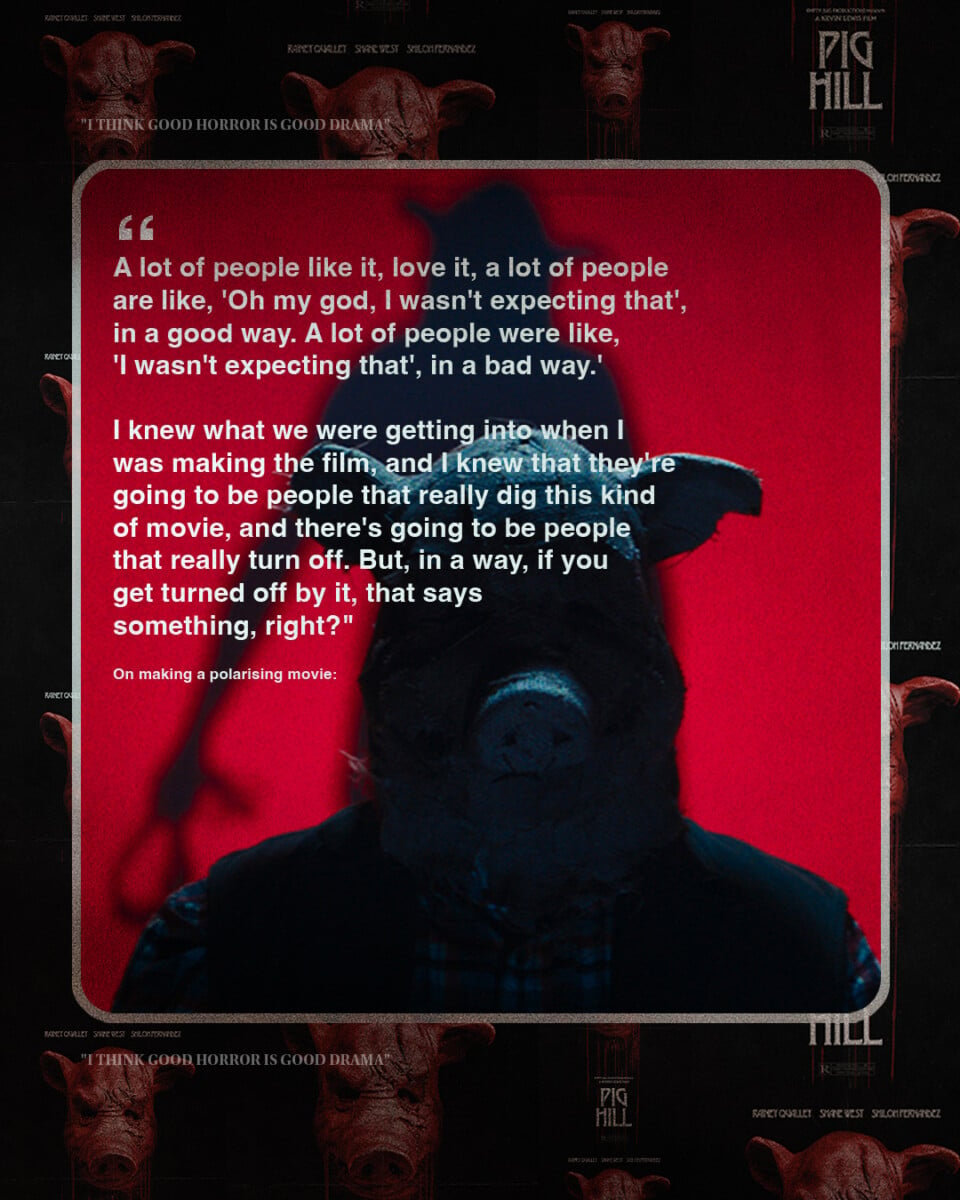
“What’s really cool about the movie is when you watch it for the first time, and you know everything, then you can go watch it again, and I did little Easter Egg hints so that you could pick up on things, but I think they’re subtle enough that you don’t get it on the first one,” he teased.
“Because it opens up like a drive-in grindhouse movie, and then it turns into a procedural, and it keeps dancing around these different genres. The third act was what I really loved about the story, and why I wanted to do it. I just thought it was really timely, and it was saying something”.
“This is a monster movie, but it’s more about the monster within, in a way, which I really enjoyed.”
Kevin Lewis
Lewis asked his line producer, who introduced him to the project in the first place, what she thought of the script. When he found out the ending “kind of threw her,” his mind was made up. “I was like, OK, well, now I’m interested in checking this out,” he recalled. “I was like, ‘OK, I really want to do this, and I think I know how to get a handle on this.”
Pig Hill continues the director’s prolific recent trajectory, and he shows no signs of slowing down. If anything, he wants to maintain his current pace, explaining that there are several new productions in the pipeline, which will also keep him tethered to horror for the foreseeable future.
“I’m working on a movie in post called Driver. It’s really cool. It takes place in the ’90s,” he hinted, which has Jeremy Piven, Colleen Camp, and Kaitlyn Kemp starring. “A bunch of kids are going to prom with a limo driver, and let’s just say he doesn’t take them to prom. That’s fun, and that’s got more of a Willy’s vibe. It’s horror, but it’s got comedy in it.”
He’s also wrapped Misdirection, a home invasion thriller with Olga Kurylenko and Frank Grillo, and another horror flick, Oak. “That’s kind of a Nightmare on Elm Street vibe,” he said of the latter. “A teen, more Stranger Things feel to it. I’ve got some good ones coming out.”
When this writer last spoke to Lewis, for his 2022 effort, The Accursed, he confessed that he’d always dreamed of helming an Evil Dead movie. Since then, Lee Cronin’s Evil Dead Rise became a huge hit, and Sébastien Vaniček’s Evil Dead Burn is set for release in June 2026, and it still remains the ultimate goal.
“I’ll always say an Evil Dead movie, because that’s the movie that I really got to see how you could be creative with the camera, and make a very visceral movie. So that’s always in my DNA,” he said. “But, I love science fiction. It’d be great to do a science fiction movie. I love drama, and that’s the thing about horror; I think good horror is good drama. It’s an aesthetic. You can build a world and be creative with the aesthetic around it, that’s what I really like about horror.”
Having directed four films in four years with another two in the can and plenty more to come, it doesn’t matter to Lewis if he gets the chance to realise his dream of making an Evil Dead movie; he’s in it for the love of directing, and he’s determined to maintain his current pace for as long as possible.
