


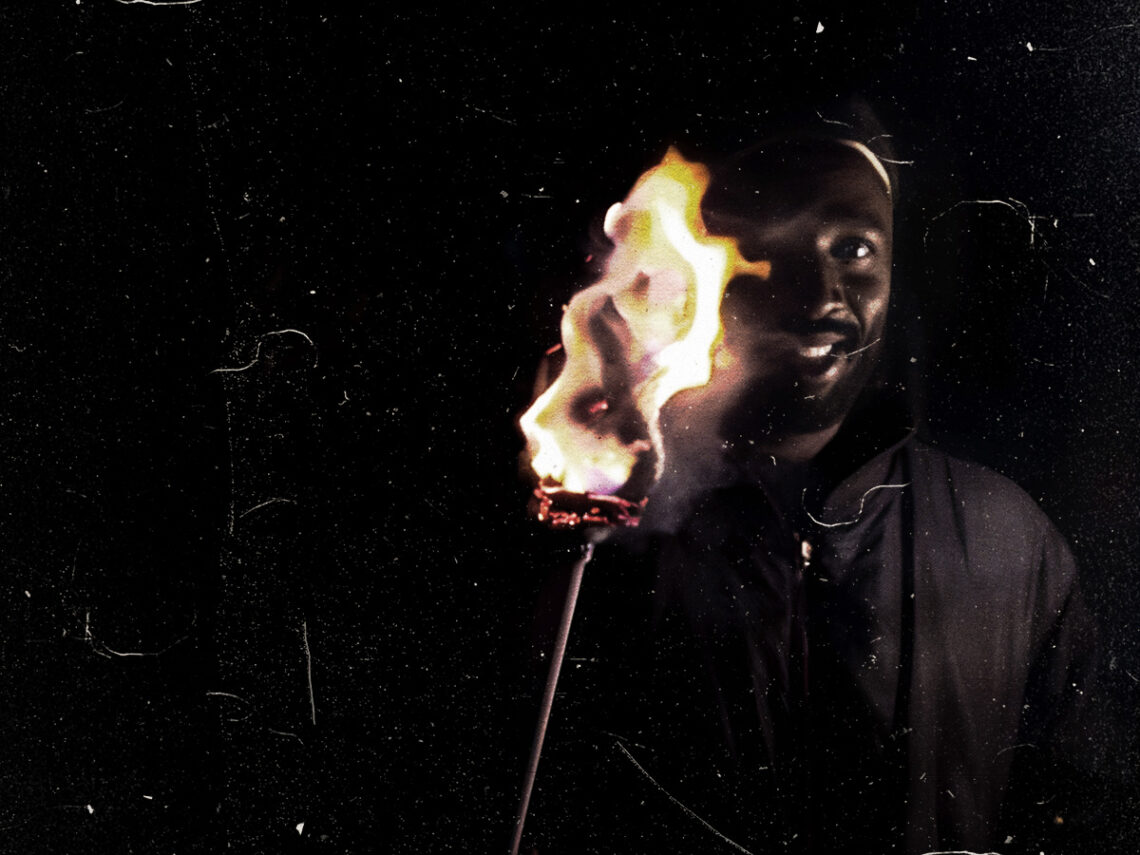
Kele – ‘The Flames, Part 2’

Of all the early-2000s indie rock survivors, Bloc Party frontman Kele Okereke has certainly had one of the most fascinating journeys. Coming to prominence just as the first wave of garage rock revival crashed and burned in the UK, Bloc Party has since been on a two-decade search for its own identity that has incorporated dance music, electronica, and synth-pop. Strangely enough, Okereke hasn’t had that much trouble finding his solo voice.
Okereke, going under the mononym Kele, has five solo studio albums that are way more experimental, fun, challenging, and personal than any Bloc Party albums of the last ten years. During the height of the Covid-19 pandemic, Kele released The Waves, Part 1, an intimate look at isolation and lost purpose that was stripped-down and lovely. Now, Kele is completing the cycle with The Flames, Part 2.
“Fire is powerful, it is both creation and destruction and I wanted that tension to somehow be reflected in the music,” Kele explains. “The sound of being consumed by our desires, of feelings burning so intensely that they literally burn out. Like The Waves it was important that all the sounds of the record were made by my electric guitar. Writing and recording a record within these parameters has forced me to become more creative as a musician, from the looped ambient textures to the brittle drum machine rhythms. It’s all made by my guitar and my loop pedals, and that’s how it will be performed.”
Launching with the electro-pop ‘Never Have I Ever’ establishes a tone that’s a lot lighter and less weighty than The Waves. A boilerplate song about club love, ‘Never Have I Ever’ is the complete flip side of what Kele was going through in isolation. Here, he’s extroverted, glib, and searching for something more fleeting and less foundational than peace of mind. It’s a head-spinning turn, especially if you were expecting a sound like The Waves.
That’s actually the best part of The Flames: it’s complimentary to The Waves while covering completely different ground. Like a piece of a puzzle, everything about Part 2 of this journey comes as a counter to Part 1. ‘Reckless’ tries to bring spontaneity and excitement back to the forefront after Kele expressly searched for the opposite on songs like ‘Smalltown Boy’.
You have to admire him for trying something different. Had Part 2 been another collection of ambient get-down ballads like Part 1, it wouldn’t have made for much of a listening experience. Kele is equally stripped down here – it’s just him and a drum machine throughout the songs, conjuring up sounds from pedals, effects, computer manipulation, and anything else that could add a different sonic signature to the tracks.
The funky and slinky ‘He Was Never The Same’ feels like a slow burn that’s building to something, at least until Kele decides to opt out without resolving the building tension. The same goes for ‘True Love Knows No Death’, which finds Kele trapped in a skittering beat that doesn’t go anywhere but continues to loop around the arrangement. But even if you’re not sold on the sound of the song, the defiant embrace of love in the face of pushback (and bigotry) is hard not to cheer on.
Songs like ‘Her Darkest Hour’ and ‘I’m In Love With An Outline’ definitely boost the album’s homemade feel, for better or worse. Put it this way: if you want your Kele experience unfiltered and unedited, then The Flames will be a tremendous insight into his artistic voice. A song like ‘No Risk No Reward’ and ‘Acting on a Hunch’ would have no place in the maximalist world of Bloc Party, but the space given to them on The Flames lets Okereke let it all hang out.
It’s only at the end of the record that Kele makes a motion back to The Waves. ‘The Colour of a Dying Flame’ is filled with the same intricately layered guitar lines that filtered all throughout Kele’s previous album, and the artist’s defiant decision to end such a frantically-paced album on a contemplative instrumental shows that there’s plenty of depth still at the heart of everything Okereke does.
The Flames, Part 2 is ultimately a record that is split in its identity. As a companion piece to The Waves, Part 1, it’s a satisfying conclusion that bridges the two records in complementary ways. As its own release, The Flames can feel maddingly slight. Still, it’s not like going back and listening to the engrossing sounds of The Waves is a homework assignment. Listen to these albums back-to-back to get the real beauty out of both. Without that context, The Flames doesn’t quite fly as high.

Never Miss A Beat
The Far Out New Music Newsletter
All the latest New Music from the independent voice of culture.
Straight to your inbox.